Yue Zhang , Jian Cao , Huan Liu , Cheng Wang , Chenglin Chu , Feng Xue , Regine Willumeit-Römer , Norbert Hort , Yuanding Huang , Jing Bai
{"title":"Exploring the degradation behavior of biodegradable metals (Mg, Zn, and Fe) in human duodenal fluid","authors":"Yue Zhang , Jian Cao , Huan Liu , Cheng Wang , Chenglin Chu , Feng Xue , Regine Willumeit-Römer , Norbert Hort , Yuanding Huang , Jing Bai","doi":"10.1016/j.jma.2025.02.034","DOIUrl":null,"url":null,"abstract":"<div><div>Biodegradable metals have been of great interest in making gastrointestinal implants these years. The most researched biodegradable metal is magnesium (Mg), followed by zinc (Zn) and iron (Fe). However, due to the limitations of in vivo experiments and the complex component of the gastrointestinal fluid, their degradation mechanisms in such an environment are still ambiguous. In this work, the human duodenal fluid (HDF) was used to investigate their in vitro degradation behaviors, with a simulated duodenal fluid (SDF) prepared for the control group based on the HDF ionic composition. After immersion of these metals for 7 days, it is found that HDF shows a stronger pH buffering effect than SDF due to the presence of organics. These organics can also hinder the degradation of metals by affecting their product formation in different ways. On the one hand, the adsorption of organics and their effects on the fluid dominate their degradation inhibition effect on Mg and Zn in HDF. On the other hand, they can hinder the further oxidation of the degradation products of Fe, which is the main mechanism resulting in a lower degradation rate of Fe in HDF rather than in SDF. Among the three metals, Mg unsurprisingly shows the highest degradation rate in both fluids. Interestingly, Zn is nearly immune to degradation in HDF, while it presents typical pitting corrosion in SDF. Compared to their degradation rates in popular pseudo-humoral media (e. g. Hanks’ Balanced Salt Solutions, Dulbecco's modified Eagle's medium) reported previously, Mg degrades faster, and Zn and Fe more slowly in HDF. The higher <em>in vitro</em> degradation rate of Fe than that of Zn is influenced by oxygen and ions in the degradation environment.</div></div>","PeriodicalId":16214,"journal":{"name":"Journal of Magnesium and Alloys","volume":"13 5","pages":"Pages 2103-2119"},"PeriodicalIF":13.8000,"publicationDate":"2025-05-01","publicationTypes":"Journal Article","fieldsOfStudy":null,"isOpenAccess":false,"openAccessPdf":"","citationCount":"0","resultStr":null,"platform":"Semanticscholar","paperid":null,"PeriodicalName":"Journal of Magnesium and Alloys","FirstCategoryId":"88","ListUrlMain":"https://www.sciencedirect.com/science/article/pii/S2213956725001008","RegionNum":1,"RegionCategory":"材料科学","ArticlePicture":[],"TitleCN":null,"AbstractTextCN":null,"PMCID":null,"EPubDate":"2025/4/2 0:00:00","PubModel":"Epub","JCR":"Q1","JCRName":"METALLURGY & METALLURGICAL ENGINEERING","Score":null,"Total":0}
引用次数: 0
Abstract
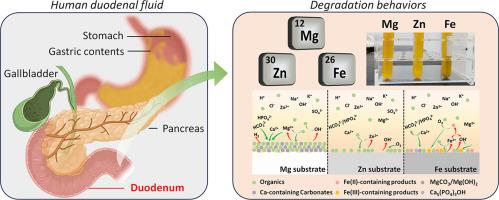
Biodegradable metals have been of great interest in making gastrointestinal implants these years. The most researched biodegradable metal is magnesium (Mg), followed by zinc (Zn) and iron (Fe). However, due to the limitations of in vivo experiments and the complex component of the gastrointestinal fluid, their degradation mechanisms in such an environment are still ambiguous. In this work, the human duodenal fluid (HDF) was used to investigate their in vitro degradation behaviors, with a simulated duodenal fluid (SDF) prepared for the control group based on the HDF ionic composition. After immersion of these metals for 7 days, it is found that HDF shows a stronger pH buffering effect than SDF due to the presence of organics. These organics can also hinder the degradation of metals by affecting their product formation in different ways. On the one hand, the adsorption of organics and their effects on the fluid dominate their degradation inhibition effect on Mg and Zn in HDF. On the other hand, they can hinder the further oxidation of the degradation products of Fe, which is the main mechanism resulting in a lower degradation rate of Fe in HDF rather than in SDF. Among the three metals, Mg unsurprisingly shows the highest degradation rate in both fluids. Interestingly, Zn is nearly immune to degradation in HDF, while it presents typical pitting corrosion in SDF. Compared to their degradation rates in popular pseudo-humoral media (e. g. Hanks’ Balanced Salt Solutions, Dulbecco's modified Eagle's medium) reported previously, Mg degrades faster, and Zn and Fe more slowly in HDF. The higher in vitro degradation rate of Fe than that of Zn is influenced by oxygen and ions in the degradation environment.
期刊介绍:
The Journal of Magnesium and Alloys serves as a global platform for both theoretical and experimental studies in magnesium science and engineering. It welcomes submissions investigating various scientific and engineering factors impacting the metallurgy, processing, microstructure, properties, and applications of magnesium and alloys. The journal covers all aspects of magnesium and alloy research, including raw materials, alloy casting, extrusion and deformation, corrosion and surface treatment, joining and machining, simulation and modeling, microstructure evolution and mechanical properties, new alloy development, magnesium-based composites, bio-materials and energy materials, applications, and recycling.




 京公网安备 11010802042870号
京ICP备2023020795号-1
京公网安备 11010802042870号
京ICP备2023020795号-1

 分享
分享
 求助内容:
求助内容: 应助结果提醒方式:
 扫码关注我们
