{"title":"Development of a dynamic predictive model for quality changes in strawberries under fluctuating temperatures","authors":"Wenming Xing, Lu Liu, Shaohua Xing, Hansheng Gong","doi":"10.1111/1750-3841.70149","DOIUrl":null,"url":null,"abstract":"<p>The purpose of this study was to establish a dynamic predictive model for quality change to ensure the safety of strawberries in the supply chain. Strawberries were stored at different constant temperatures of 4, 10, 20, and 30°C, and then weight loss, firmness, total soluble solids (TSS), titratable acidity (TA), and vitamin C (Vc) content were analyzed. The results showed that weight loss increased gradually, while the firmness, TSS and Vc content decreased during storage. Changes in firmness and Vc were fitted well by the zero-order reaction kinetics model. The reaction rate <i>k</i> could be well evaluated by the Arrhenius equation (all <i>R</i><sup>2</sup> > 0.900). Dynamic predictive models combined with the reaction kinetics model and the Arrhenius equation were established. Verification indicated that these models could be used to predict quality changes in strawberries during actual logistics (4–30°C). This study will offer an important reference for determining the shelf life of strawberries in the actual supply chain.</p>","PeriodicalId":193,"journal":{"name":"Journal of Food Science","volume":"90 4","pages":""},"PeriodicalIF":3.4000,"publicationDate":"2025-04-04","publicationTypes":"Journal Article","fieldsOfStudy":null,"isOpenAccess":false,"openAccessPdf":"","citationCount":"0","resultStr":null,"platform":"Semanticscholar","paperid":null,"PeriodicalName":"Journal of Food Science","FirstCategoryId":"97","ListUrlMain":"https://ift.onlinelibrary.wiley.com/doi/10.1111/1750-3841.70149","RegionNum":2,"RegionCategory":"农林科学","ArticlePicture":[],"TitleCN":null,"AbstractTextCN":null,"PMCID":null,"EPubDate":"","PubModel":"","JCR":"Q2","JCRName":"FOOD SCIENCE & TECHNOLOGY","Score":null,"Total":0}
引用次数: 0
Abstract
The purpose of this study was to establish a dynamic predictive model for quality change to ensure the safety of strawberries in the supply chain. Strawberries were stored at different constant temperatures of 4, 10, 20, and 30°C, and then weight loss, firmness, total soluble solids (TSS), titratable acidity (TA), and vitamin C (Vc) content were analyzed. The results showed that weight loss increased gradually, while the firmness, TSS and Vc content decreased during storage. Changes in firmness and Vc were fitted well by the zero-order reaction kinetics model. The reaction rate k could be well evaluated by the Arrhenius equation (all R2 > 0.900). Dynamic predictive models combined with the reaction kinetics model and the Arrhenius equation were established. Verification indicated that these models could be used to predict quality changes in strawberries during actual logistics (4–30°C). This study will offer an important reference for determining the shelf life of strawberries in the actual supply chain.
期刊介绍:
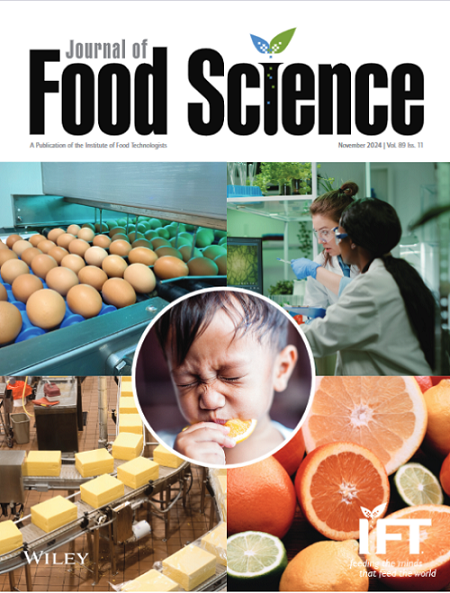
The goal of the Journal of Food Science is to offer scientists, researchers, and other food professionals the opportunity to share knowledge of scientific advancements in the myriad disciplines affecting their work, through a respected peer-reviewed publication. The Journal of Food Science serves as an international forum for vital research and developments in food science.
The range of topics covered in the journal include:
-Concise Reviews and Hypotheses in Food Science
-New Horizons in Food Research
-Integrated Food Science
-Food Chemistry
-Food Engineering, Materials Science, and Nanotechnology
-Food Microbiology and Safety
-Sensory and Consumer Sciences
-Health, Nutrition, and Food
-Toxicology and Chemical Food Safety
The Journal of Food Science publishes peer-reviewed articles that cover all aspects of food science, including safety and nutrition. Reviews should be 15 to 50 typewritten pages (including tables, figures, and references), should provide in-depth coverage of a narrowly defined topic, and should embody careful evaluation (weaknesses, strengths, explanation of discrepancies in results among similar studies) of all pertinent studies, so that insightful interpretations and conclusions can be presented. Hypothesis papers are especially appropriate in pioneering areas of research or important areas that are afflicted by scientific controversy.



 京公网安备 11010802042870号
京ICP备2023020795号-1
京公网安备 11010802042870号
京ICP备2023020795号-1

 分享
分享
 求助内容:
求助内容: 应助结果提醒方式:
 扫码关注我们
