{"title":"Unveiling anomalous strengthening and deformation mechanism evolution in a Mg-Gd-Y-Zr alloy under rate-temperature coupling effects","authors":"Jingli Li , Chen Wen , Xiuzhu Han","doi":"10.1016/j.jma.2025.03.018","DOIUrl":null,"url":null,"abstract":"<div><div>While the deformation behavior of rare-earth magnesium alloys at high temperatures has been extensively studied, the deformation mechanisms under moderate-to-low temperatures and high strain rates remain insufficiently understood. To address this gap, hot compression tests were conducted on a Mg-11Gd-3Y-0.5Zr (wt.%) alloy over a temperature range of 150 °C–450 °C under strain rates of 10⁻³ s⁻¹ (low strain rate (LSR)) and 10 s⁻¹ (high strain rate (HSR)) to explore the strain rate-temperature coupling effects during hot deformation. The results revealed an anomalous increase in peak stress at 150 °C–250 °C as the strain rate decreased, attributed to the combined effects of nano-precipitates, dislocation cell structures, and serrated flow induced by dynamic strain aging. At higher temperatures, strain rate influences softening pathways: under HSR at 450 °C, the effect of twinning shifts from strengthening to facilitating dynamic recrystallization (DRX), resulting in substantial grain refinement (∼4 µm, 81% area fraction at a strain of 0.6). In contrast, at LSR, softening is dominated by dynamic recovery at 350 °C, with limited DRX (∼4 µm grains, 10% area fraction at a strain of 0.6) occurs at 400 °C. These findings clarify the dual role of twinning and its interaction with rate-temperature conditions, providing valuable insights into optimizing the hot processing of rare-earth magnesium alloys.</div></div>","PeriodicalId":16214,"journal":{"name":"Journal of Magnesium and Alloys","volume":"13 6","pages":"Pages 2913-2926"},"PeriodicalIF":13.8000,"publicationDate":"2025-06-01","publicationTypes":"Journal Article","fieldsOfStudy":null,"isOpenAccess":false,"openAccessPdf":"","citationCount":"0","resultStr":null,"platform":"Semanticscholar","paperid":null,"PeriodicalName":"Journal of Magnesium and Alloys","FirstCategoryId":"88","ListUrlMain":"https://www.sciencedirect.com/science/article/pii/S2213956725001112","RegionNum":1,"RegionCategory":"材料科学","ArticlePicture":[],"TitleCN":null,"AbstractTextCN":null,"PMCID":null,"EPubDate":"2025/4/15 0:00:00","PubModel":"Epub","JCR":"Q1","JCRName":"METALLURGY & METALLURGICAL ENGINEERING","Score":null,"Total":0}
引用次数: 0
Abstract
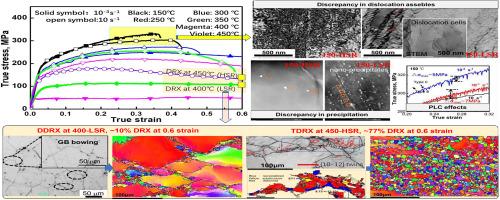
While the deformation behavior of rare-earth magnesium alloys at high temperatures has been extensively studied, the deformation mechanisms under moderate-to-low temperatures and high strain rates remain insufficiently understood. To address this gap, hot compression tests were conducted on a Mg-11Gd-3Y-0.5Zr (wt.%) alloy over a temperature range of 150 °C–450 °C under strain rates of 10⁻³ s⁻¹ (low strain rate (LSR)) and 10 s⁻¹ (high strain rate (HSR)) to explore the strain rate-temperature coupling effects during hot deformation. The results revealed an anomalous increase in peak stress at 150 °C–250 °C as the strain rate decreased, attributed to the combined effects of nano-precipitates, dislocation cell structures, and serrated flow induced by dynamic strain aging. At higher temperatures, strain rate influences softening pathways: under HSR at 450 °C, the effect of twinning shifts from strengthening to facilitating dynamic recrystallization (DRX), resulting in substantial grain refinement (∼4 µm, 81% area fraction at a strain of 0.6). In contrast, at LSR, softening is dominated by dynamic recovery at 350 °C, with limited DRX (∼4 µm grains, 10% area fraction at a strain of 0.6) occurs at 400 °C. These findings clarify the dual role of twinning and its interaction with rate-temperature conditions, providing valuable insights into optimizing the hot processing of rare-earth magnesium alloys.
期刊介绍:
The Journal of Magnesium and Alloys serves as a global platform for both theoretical and experimental studies in magnesium science and engineering. It welcomes submissions investigating various scientific and engineering factors impacting the metallurgy, processing, microstructure, properties, and applications of magnesium and alloys. The journal covers all aspects of magnesium and alloy research, including raw materials, alloy casting, extrusion and deformation, corrosion and surface treatment, joining and machining, simulation and modeling, microstructure evolution and mechanical properties, new alloy development, magnesium-based composites, bio-materials and energy materials, applications, and recycling.




 京公网安备 11010802042870号
京ICP备2023020795号-1
京公网安备 11010802042870号
京ICP备2023020795号-1

 分享
分享
 求助内容:
求助内容: 应助结果提醒方式:
 扫码关注我们
