N. Martynenko , N. Anisimova , G. Rybalchenko , E. Lukyanova , O. Rybalchenko , I. Shchetinin , G. Babayeva , N.V. Pashinzeva , A. Gorbenko , D. Temralieva , M. Kiselevskiy , V. Andreev , S. Dobatkin
{"title":"Effect of warm rotary swaging on the mechanical and operational properties of the biodegradable Mg-1 %Zn-0.6 %Ca alloy","authors":"N. Martynenko , N. Anisimova , G. Rybalchenko , E. Lukyanova , O. Rybalchenko , I. Shchetinin , G. Babayeva , N.V. Pashinzeva , A. Gorbenko , D. Temralieva , M. Kiselevskiy , V. Andreev , S. Dobatkin","doi":"10.1016/j.jma.2025.03.019","DOIUrl":null,"url":null,"abstract":"<div><div>A study of the effect of rotary swaging (RS) at 350 °C on mechanical properties, corrosion resistance and biocompatibility in vitro and in vivo of biodegradable Mg-1 %Zn-0.6 %Ca alloy was conducted. It is shown that the formation of a recrystallized microstructure after RS with a grain size of 3.2 ± 0.2 μm leads to an increase in the strength of the alloy without reduction of level of ductility and corrosion resistance. At the same time, aging of the quenched alloy at 100 °C for 8 h leads to a slight increase in strength, but significantly reduces its ductility and corrosion resistance. The study of the degradation process of the alloy in the quenched state and after RS, both under in vitro and in vivo conditions, did not reveal a significant difference between these two microstructural states. However, an increase in the duration of incubation of the alloy in a complete growth medium from 4 h to 24 days leads to a decrease in the degradation rate (DR) by 4 times (from ∼2 to ∼0.5 mm/year) due to the formation of a dense layer of degradation products. The study of biocompatibility in vitro did not reveal a significant effect of RS on the hemolytic and cytotoxic activity of the alloy. No signs of systemic toxicity were observed after subcutaneous implantation of alloy samples into mice before and after RS. However, it was found that RS promotes uniform degradation of the alloy over the entire contact surface. In summary, RS at 350 °С allows to increase the strength of Mg-1 %Zn-0.6 %Ca alloy up to 348 ± 5 MPa at a ductility level of 17.3 ± 2.8 % and a DR<sub>in vivo</sub> equal to 0.56 ± 0.12 mm/year without impairing its biocompatibility in vitro and in vivo.</div></div>","PeriodicalId":16214,"journal":{"name":"Journal of Magnesium and Alloys","volume":"13 5","pages":"Pages 2252-2266"},"PeriodicalIF":13.8000,"publicationDate":"2025-05-01","publicationTypes":"Journal Article","fieldsOfStudy":null,"isOpenAccess":false,"openAccessPdf":"","citationCount":"0","resultStr":null,"platform":"Semanticscholar","paperid":null,"PeriodicalName":"Journal of Magnesium and Alloys","FirstCategoryId":"88","ListUrlMain":"https://www.sciencedirect.com/science/article/pii/S2213956725001136","RegionNum":1,"RegionCategory":"材料科学","ArticlePicture":[],"TitleCN":null,"AbstractTextCN":null,"PMCID":null,"EPubDate":"2025/4/16 0:00:00","PubModel":"Epub","JCR":"Q1","JCRName":"METALLURGY & METALLURGICAL ENGINEERING","Score":null,"Total":0}
引用次数: 0
Abstract
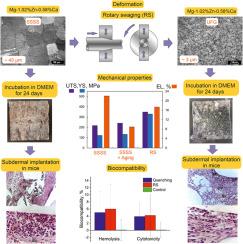
A study of the effect of rotary swaging (RS) at 350 °C on mechanical properties, corrosion resistance and biocompatibility in vitro and in vivo of biodegradable Mg-1 %Zn-0.6 %Ca alloy was conducted. It is shown that the formation of a recrystallized microstructure after RS with a grain size of 3.2 ± 0.2 μm leads to an increase in the strength of the alloy without reduction of level of ductility and corrosion resistance. At the same time, aging of the quenched alloy at 100 °C for 8 h leads to a slight increase in strength, but significantly reduces its ductility and corrosion resistance. The study of the degradation process of the alloy in the quenched state and after RS, both under in vitro and in vivo conditions, did not reveal a significant difference between these two microstructural states. However, an increase in the duration of incubation of the alloy in a complete growth medium from 4 h to 24 days leads to a decrease in the degradation rate (DR) by 4 times (from ∼2 to ∼0.5 mm/year) due to the formation of a dense layer of degradation products. The study of biocompatibility in vitro did not reveal a significant effect of RS on the hemolytic and cytotoxic activity of the alloy. No signs of systemic toxicity were observed after subcutaneous implantation of alloy samples into mice before and after RS. However, it was found that RS promotes uniform degradation of the alloy over the entire contact surface. In summary, RS at 350 °С allows to increase the strength of Mg-1 %Zn-0.6 %Ca alloy up to 348 ± 5 MPa at a ductility level of 17.3 ± 2.8 % and a DRin vivo equal to 0.56 ± 0.12 mm/year without impairing its biocompatibility in vitro and in vivo.
期刊介绍:
The Journal of Magnesium and Alloys serves as a global platform for both theoretical and experimental studies in magnesium science and engineering. It welcomes submissions investigating various scientific and engineering factors impacting the metallurgy, processing, microstructure, properties, and applications of magnesium and alloys. The journal covers all aspects of magnesium and alloy research, including raw materials, alloy casting, extrusion and deformation, corrosion and surface treatment, joining and machining, simulation and modeling, microstructure evolution and mechanical properties, new alloy development, magnesium-based composites, bio-materials and energy materials, applications, and recycling.




 京公网安备 11010802042870号
京ICP备2023020795号-1
京公网安备 11010802042870号
京ICP备2023020795号-1

 分享
分享
 求助内容:
求助内容: 应助结果提醒方式:
 扫码关注我们
