Lu Zhang, Mei Deng, Qinghui Wen, Yutong Xie, Qiao Ding, Xing Xie, Quanyuan Xie, Mingshun Chen
{"title":"Effect of Artemisia selengensis Turcz extract on lipid metabolism and gut microbiota in high-fat diet-induced C57BL/6J obese mice","authors":"Lu Zhang, Mei Deng, Qinghui Wen, Yutong Xie, Qiao Ding, Xing Xie, Quanyuan Xie, Mingshun Chen","doi":"10.1111/1750-3841.70162","DOIUrl":null,"url":null,"abstract":"<p>Nowadays, obesity is a global health risk factor, and its development is closely related to the absorption and metabolism of lipids. In this study, the main chemical constituents and antiobesity effect of <i>Artemisia selengensis</i> Turcz extract (ASTE) were investigated by HPLC-QTOF-MS<sup>2</sup> and obese mice models. Twenty-three compounds were identified from ASTE, and caffeoylquinic acid and dicaffeoylquinic acid are the dominant bioactive compounds. ASTE administration reduced body weight (9.8%), improved glucose tolerance (14.2%), corrected dyslipidemia (the levels of total cholesterol, total triglyceride, and low-density lipoprotein cholesterol dropped by 19.8%, 24.4%, and 27.2%, respectively, and the high-density lipoprotein cholesterol level rose by 27.6%), and alleviated hepatic lipid accumulation. ASTE improved the gut microbiota dysbiosis caused by High-Fat Diet (HFD), mainly by increasing the relative abundance of <i>Odoribacter</i>, <i>Candidatus_Saccharimonas</i>, <i>Bacteroides</i>, and <i>unclassified_f__Lachnospiraceae</i>, and reducing the relative abundance of <i>Faecalibaculum</i>. Gene expression heatmaps and pathway enrichment analyses based on transcriptomics indicated that ASTE significantly reduced HFD-induced increases in fatty acid uptake, triglyceride synthesis, and cholesterol synthesis. Our findings indicated that ASTE holds significant potential as a candidate for modulating lipid metabolism and preventing or treating obesity, meriting further investigation.</p>","PeriodicalId":193,"journal":{"name":"Journal of Food Science","volume":"90 4","pages":""},"PeriodicalIF":3.4000,"publicationDate":"2025-04-22","publicationTypes":"Journal Article","fieldsOfStudy":null,"isOpenAccess":false,"openAccessPdf":"","citationCount":"0","resultStr":null,"platform":"Semanticscholar","paperid":null,"PeriodicalName":"Journal of Food Science","FirstCategoryId":"97","ListUrlMain":"https://ift.onlinelibrary.wiley.com/doi/10.1111/1750-3841.70162","RegionNum":2,"RegionCategory":"农林科学","ArticlePicture":[],"TitleCN":null,"AbstractTextCN":null,"PMCID":null,"EPubDate":"","PubModel":"","JCR":"Q2","JCRName":"FOOD SCIENCE & TECHNOLOGY","Score":null,"Total":0}
引用次数: 0
Abstract
Nowadays, obesity is a global health risk factor, and its development is closely related to the absorption and metabolism of lipids. In this study, the main chemical constituents and antiobesity effect of Artemisia selengensis Turcz extract (ASTE) were investigated by HPLC-QTOF-MS2 and obese mice models. Twenty-three compounds were identified from ASTE, and caffeoylquinic acid and dicaffeoylquinic acid are the dominant bioactive compounds. ASTE administration reduced body weight (9.8%), improved glucose tolerance (14.2%), corrected dyslipidemia (the levels of total cholesterol, total triglyceride, and low-density lipoprotein cholesterol dropped by 19.8%, 24.4%, and 27.2%, respectively, and the high-density lipoprotein cholesterol level rose by 27.6%), and alleviated hepatic lipid accumulation. ASTE improved the gut microbiota dysbiosis caused by High-Fat Diet (HFD), mainly by increasing the relative abundance of Odoribacter, Candidatus_Saccharimonas, Bacteroides, and unclassified_f__Lachnospiraceae, and reducing the relative abundance of Faecalibaculum. Gene expression heatmaps and pathway enrichment analyses based on transcriptomics indicated that ASTE significantly reduced HFD-induced increases in fatty acid uptake, triglyceride synthesis, and cholesterol synthesis. Our findings indicated that ASTE holds significant potential as a candidate for modulating lipid metabolism and preventing or treating obesity, meriting further investigation.
期刊介绍:
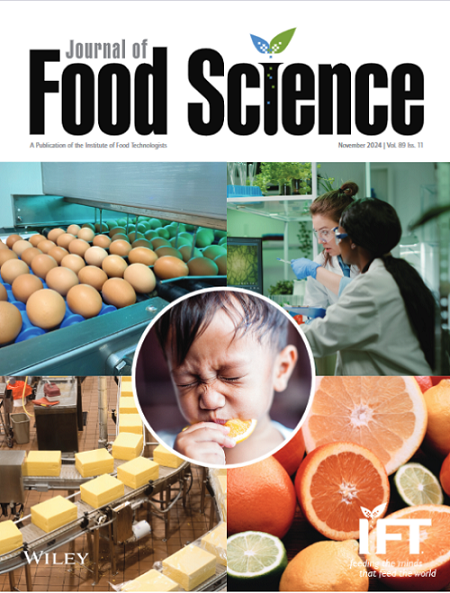
The goal of the Journal of Food Science is to offer scientists, researchers, and other food professionals the opportunity to share knowledge of scientific advancements in the myriad disciplines affecting their work, through a respected peer-reviewed publication. The Journal of Food Science serves as an international forum for vital research and developments in food science.
The range of topics covered in the journal include:
-Concise Reviews and Hypotheses in Food Science
-New Horizons in Food Research
-Integrated Food Science
-Food Chemistry
-Food Engineering, Materials Science, and Nanotechnology
-Food Microbiology and Safety
-Sensory and Consumer Sciences
-Health, Nutrition, and Food
-Toxicology and Chemical Food Safety
The Journal of Food Science publishes peer-reviewed articles that cover all aspects of food science, including safety and nutrition. Reviews should be 15 to 50 typewritten pages (including tables, figures, and references), should provide in-depth coverage of a narrowly defined topic, and should embody careful evaluation (weaknesses, strengths, explanation of discrepancies in results among similar studies) of all pertinent studies, so that insightful interpretations and conclusions can be presented. Hypothesis papers are especially appropriate in pioneering areas of research or important areas that are afflicted by scientific controversy.




 京公网安备 11010802042870号
京ICP备2023020795号-1
京公网安备 11010802042870号
京ICP备2023020795号-1

 分享
分享
 求助内容:
求助内容: 应助结果提醒方式:
 扫码关注我们
