Hoang Huy Nguyen, Thi Thu Trang Nguyen, Valentina Olegovna Mittova, Elena Viktorovna Tomina, Anh Thi Ngoc Vu, Anh Tien Nguyen
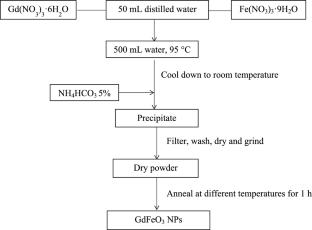
{"title":"Structural, thermal, optical, and magnetic behavior of the nanosized perovskite-like GdFeO3 synthesized by modified co-precipitation method","authors":"Hoang Huy Nguyen, Thi Thu Trang Nguyen, Valentina Olegovna Mittova, Elena Viktorovna Tomina, Anh Thi Ngoc Vu, Anh Tien Nguyen","doi":"10.1007/s10854-025-14805-z","DOIUrl":null,"url":null,"abstract":"<div><p>GdFeO<sub>3</sub> nanoparticles were synthesized using an improved co-precipitation method using a 5% ammonium hydrogen carbonate solution, followed by annealing for 1 h at 750, 850, and 950 °C. The synthesized samples were characterized using DSC/TGA, FTIR, PXRD, TEM, EDX/EDX-mapping, UV–Vis, and VSM analyses. The DSC curve exhibited two endothermic peaks (70.45 and 141.30 °C) and three exothermic peaks (333.01, 480.93, and 723.41 °C), while TGA analysis indicated that mass loss ceased at approximately 750 °C. PXRD patterns of all calcined samples confirmed a perovskite structure with space group <i>Pbnm</i>, and the average crystalline size and lattice volume increased with rising annealing temperatures. TEM images revealed that the synthesized GdFeO<sub>3</sub> nanoparticles were weakly angular spherical particles ranging from approximately 20–55 nm. Magnetic analysis showed that the GdFeO<sub>3</sub> orthoferrite nanopowder exhibited paramagnetic behavior, with net magnetization (<i>M</i><sub><i>n</i></sub> ~ 1.4 – 2.0 emu·g<sup>−1</sup>) increasing with calcination temperature while maintaining negligible remanence and coercivity. Additionally, the nanoparticles displayed strong optical absorption in the UV (λ ~ 200 – 400 nm) and visible (λ ~ 400 – 600 nm) regions. Compared to certain reported RFeO<sub>3</sub> perovskites (R = Gd, Nd, Y, La, Ho), the synthesized GdFeO<sub>3</sub> nanopowder demonstrated both higher magnetization and a significantly lower band gap energy.</p></div>","PeriodicalId":646,"journal":{"name":"Journal of Materials Science: Materials in Electronics","volume":"36 12","pages":""},"PeriodicalIF":2.8000,"publicationDate":"2025-04-23","publicationTypes":"Journal Article","fieldsOfStudy":null,"isOpenAccess":false,"openAccessPdf":"","citationCount":"0","resultStr":null,"platform":"Semanticscholar","paperid":null,"PeriodicalName":"Journal of Materials Science: Materials in Electronics","FirstCategoryId":"5","ListUrlMain":"https://link.springer.com/article/10.1007/s10854-025-14805-z","RegionNum":4,"RegionCategory":"工程技术","ArticlePicture":[],"TitleCN":null,"AbstractTextCN":null,"PMCID":null,"EPubDate":"","PubModel":"","JCR":"Q2","JCRName":"ENGINEERING, ELECTRICAL & ELECTRONIC","Score":null,"Total":0}
引用次数: 0
Abstract
GdFeO3 nanoparticles were synthesized using an improved co-precipitation method using a 5% ammonium hydrogen carbonate solution, followed by annealing for 1 h at 750, 850, and 950 °C. The synthesized samples were characterized using DSC/TGA, FTIR, PXRD, TEM, EDX/EDX-mapping, UV–Vis, and VSM analyses. The DSC curve exhibited two endothermic peaks (70.45 and 141.30 °C) and three exothermic peaks (333.01, 480.93, and 723.41 °C), while TGA analysis indicated that mass loss ceased at approximately 750 °C. PXRD patterns of all calcined samples confirmed a perovskite structure with space group Pbnm, and the average crystalline size and lattice volume increased with rising annealing temperatures. TEM images revealed that the synthesized GdFeO3 nanoparticles were weakly angular spherical particles ranging from approximately 20–55 nm. Magnetic analysis showed that the GdFeO3 orthoferrite nanopowder exhibited paramagnetic behavior, with net magnetization (Mn ~ 1.4 – 2.0 emu·g−1) increasing with calcination temperature while maintaining negligible remanence and coercivity. Additionally, the nanoparticles displayed strong optical absorption in the UV (λ ~ 200 – 400 nm) and visible (λ ~ 400 – 600 nm) regions. Compared to certain reported RFeO3 perovskites (R = Gd, Nd, Y, La, Ho), the synthesized GdFeO3 nanopowder demonstrated both higher magnetization and a significantly lower band gap energy.
期刊介绍:
The Journal of Materials Science: Materials in Electronics is an established refereed companion to the Journal of Materials Science. It publishes papers on materials and their applications in modern electronics, covering the ground between fundamental science, such as semiconductor physics, and work concerned specifically with applications. It explores the growth and preparation of new materials, as well as their processing, fabrication, bonding and encapsulation, together with the reliability, failure analysis, quality assurance and characterization related to the whole range of applications in electronics. The Journal presents papers in newly developing fields such as low dimensional structures and devices, optoelectronics including III-V compounds, glasses and linear/non-linear crystal materials and lasers, high Tc superconductors, conducting polymers, thick film materials and new contact technologies, as well as the established electronics device and circuit materials.



 京公网安备 11010802042870号
京ICP备2023020795号-1
京公网安备 11010802042870号
京ICP备2023020795号-1

 分享
分享
 求助内容:
求助内容: 应助结果提醒方式:
 扫码关注我们
