Fangfang Huang, Qingfei Dai, Qingbao Ma, Kewei Zheng, Yuanyuan Wu, Di Sun, Zhongjie Yu, Yu Liu, Wei Jiang, Xiaojun Yan
{"title":"Skipjack Tuna (Katsuwonus pelamis) Dark Muscle Hydrolysate Ameliorates Hyperuricemia in Mice via Regulating Gut Microbiota and Serum Metabolism","authors":"Fangfang Huang, Qingfei Dai, Qingbao Ma, Kewei Zheng, Yuanyuan Wu, Di Sun, Zhongjie Yu, Yu Liu, Wei Jiang, Xiaojun Yan","doi":"10.1111/1750-3841.70232","DOIUrl":null,"url":null,"abstract":"<div>\n \n <p>Peptides have emerged as promising agents for ameliorating hyperuricemia (HUA), a condition that poses significant risks to human health. This study evaluated the HUA-alleviating potential of skipjack tuna dark muscle hydrolysate (STDH) in a mouse model of HUA induced by potassium oxonate (PO) and hypoxanthine (Hx). The results demonstrated elevated serum uric acid (SUA) levels, increased xanthine oxidase (XOD) activity in the serum and liver, and kidney and intestinal damage in HUA mice. Although the standard drug allopurinol (AP) effectively reduced SUA levels and lowered XOD activity in the serum and liver, it exacerbated kidney damage and caused significant weight loss. In contrast, STDH intervention not only significantly lowered SUA, serum creatinine (SCr), and blood urea nitrogen (BUN) levels but also inhibited XOD activity in serum and liver. Notably, STDH ameliorated renal and intestinal morphological damage, as evidenced by hematoxylin–eosin (HE) staining. Gut microbiome analysis further revealed that STDH normalized the HUA-associated elevation of the Bacteroidetes/Firmicutes ratio. Untargeted metabolomics identified STDH's regulatory effects on glycine, serine, and threonine metabolism; arginine and proline metabolism; and glycerophospholipid metabolism, with glutamine implicated as a key player in HUA pathogenesis. These findings demonstrate that STDH effectively alleviates HUA while avoiding adverse effects associated with conventional therapy, positioning it as a safe and cost-effective functional food candidate for HUA management.</p>\n </div>","PeriodicalId":193,"journal":{"name":"Journal of Food Science","volume":"90 4","pages":""},"PeriodicalIF":3.4000,"publicationDate":"2025-04-24","publicationTypes":"Journal Article","fieldsOfStudy":null,"isOpenAccess":false,"openAccessPdf":"","citationCount":"0","resultStr":null,"platform":"Semanticscholar","paperid":null,"PeriodicalName":"Journal of Food Science","FirstCategoryId":"97","ListUrlMain":"https://ift.onlinelibrary.wiley.com/doi/10.1111/1750-3841.70232","RegionNum":2,"RegionCategory":"农林科学","ArticlePicture":[],"TitleCN":null,"AbstractTextCN":null,"PMCID":null,"EPubDate":"","PubModel":"","JCR":"Q2","JCRName":"FOOD SCIENCE & TECHNOLOGY","Score":null,"Total":0}
引用次数: 0
Abstract
Peptides have emerged as promising agents for ameliorating hyperuricemia (HUA), a condition that poses significant risks to human health. This study evaluated the HUA-alleviating potential of skipjack tuna dark muscle hydrolysate (STDH) in a mouse model of HUA induced by potassium oxonate (PO) and hypoxanthine (Hx). The results demonstrated elevated serum uric acid (SUA) levels, increased xanthine oxidase (XOD) activity in the serum and liver, and kidney and intestinal damage in HUA mice. Although the standard drug allopurinol (AP) effectively reduced SUA levels and lowered XOD activity in the serum and liver, it exacerbated kidney damage and caused significant weight loss. In contrast, STDH intervention not only significantly lowered SUA, serum creatinine (SCr), and blood urea nitrogen (BUN) levels but also inhibited XOD activity in serum and liver. Notably, STDH ameliorated renal and intestinal morphological damage, as evidenced by hematoxylin–eosin (HE) staining. Gut microbiome analysis further revealed that STDH normalized the HUA-associated elevation of the Bacteroidetes/Firmicutes ratio. Untargeted metabolomics identified STDH's regulatory effects on glycine, serine, and threonine metabolism; arginine and proline metabolism; and glycerophospholipid metabolism, with glutamine implicated as a key player in HUA pathogenesis. These findings demonstrate that STDH effectively alleviates HUA while avoiding adverse effects associated with conventional therapy, positioning it as a safe and cost-effective functional food candidate for HUA management.
期刊介绍:
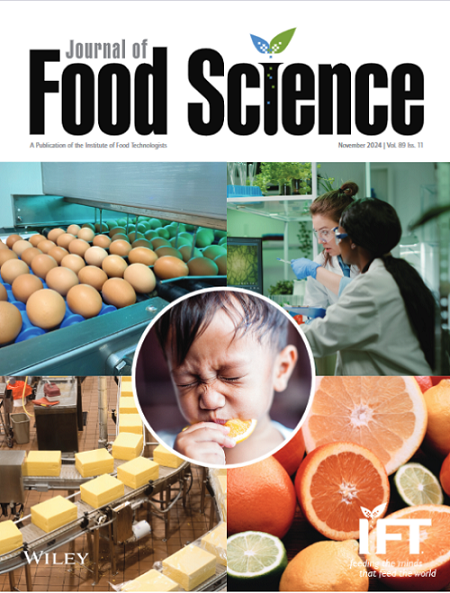
The goal of the Journal of Food Science is to offer scientists, researchers, and other food professionals the opportunity to share knowledge of scientific advancements in the myriad disciplines affecting their work, through a respected peer-reviewed publication. The Journal of Food Science serves as an international forum for vital research and developments in food science.
The range of topics covered in the journal include:
-Concise Reviews and Hypotheses in Food Science
-New Horizons in Food Research
-Integrated Food Science
-Food Chemistry
-Food Engineering, Materials Science, and Nanotechnology
-Food Microbiology and Safety
-Sensory and Consumer Sciences
-Health, Nutrition, and Food
-Toxicology and Chemical Food Safety
The Journal of Food Science publishes peer-reviewed articles that cover all aspects of food science, including safety and nutrition. Reviews should be 15 to 50 typewritten pages (including tables, figures, and references), should provide in-depth coverage of a narrowly defined topic, and should embody careful evaluation (weaknesses, strengths, explanation of discrepancies in results among similar studies) of all pertinent studies, so that insightful interpretations and conclusions can be presented. Hypothesis papers are especially appropriate in pioneering areas of research or important areas that are afflicted by scientific controversy.



 京公网安备 11010802042870号
京ICP备2023020795号-1
京公网安备 11010802042870号
京ICP备2023020795号-1

 分享
分享
 求助内容:
求助内容: 应助结果提醒方式:
 扫码关注我们
