Yu-Hsuan Lee , Daan Ren , Byungsun Jeon , Hung-wen Liu
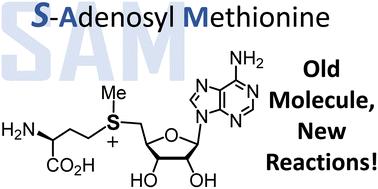
{"title":"S-Adenosylmethionine: more than just a methyl donor","authors":"Yu-Hsuan Lee , Daan Ren , Byungsun Jeon , Hung-wen Liu","doi":"10.1039/d2np00086e","DOIUrl":null,"url":null,"abstract":"<div><div>Covering: from 2000 up to the very early part of 2023</div></div><div><div> <em>S</em>-Adenosyl-<span>l</span>-methionine (SAM) is a naturally occurring trialkyl sulfonium molecule that is typically associated with biological methyltransfer reactions. However, SAM is also known to donate methylene, aminocarboxypropyl, adenosyl and amino moieties during natural product biosynthetic reactions. The reaction scope is further expanded as SAM itself can be modified prior to the group transfer such that a SAM-derived carboxymethyl or aminopropyl moiety can also be transferred. Moreover, the sulfonium cation in SAM has itself been found to be critical for several other enzymatic transformations. Thus, while many SAM-dependent enzymes are characterized by a methyltransferase fold, not all of them are necessarily methyltransferases. Furthermore, other SAM-dependent enzymes do not possess such a structural feature suggesting diversification along different evolutionary lineages. Despite the biological versatility of SAM, it nevertheless parallels the chemistry of sulfonium compounds used in organic synthesis. The question thus becomes how enzymes catalyze distinct transformations <em>via</em> subtle differences in their active sites. This review summarizes recent advances in the discovery of novel SAM utilizing enzymes that rely on Lewis acid/base chemistry as opposed to radical mechanisms of catalysis. The examples are categorized based on the presence of a methyltransferase fold and the role played by SAM within the context of known sulfonium chemistry.</div></div>","PeriodicalId":94,"journal":{"name":"Natural Product Reports","volume":"40 9","pages":"Pages 1521-1549"},"PeriodicalIF":10.6000,"publicationDate":"2023-09-20","publicationTypes":"Journal Article","fieldsOfStudy":null,"isOpenAccess":false,"openAccessPdf":"https://pubs.rsc.org/en/content/articlepdf/2023/np/d2np00086e?page=search","citationCount":"0","resultStr":null,"platform":"Semanticscholar","paperid":null,"PeriodicalName":"Natural Product Reports","FirstCategoryId":"92","ListUrlMain":"https://www.sciencedirect.com/org/science/article/pii/S0265056823001216","RegionNum":1,"RegionCategory":"化学","ArticlePicture":[],"TitleCN":null,"AbstractTextCN":null,"PMCID":null,"EPubDate":"","PubModel":"","JCR":"Q1","JCRName":"BIOCHEMISTRY & MOLECULAR BIOLOGY","Score":null,"Total":0}
引用次数: 0
Abstract
Covering: from 2000 up to the very early part of 2023
S-Adenosyl-l-methionine (SAM) is a naturally occurring trialkyl sulfonium molecule that is typically associated with biological methyltransfer reactions. However, SAM is also known to donate methylene, aminocarboxypropyl, adenosyl and amino moieties during natural product biosynthetic reactions. The reaction scope is further expanded as SAM itself can be modified prior to the group transfer such that a SAM-derived carboxymethyl or aminopropyl moiety can also be transferred. Moreover, the sulfonium cation in SAM has itself been found to be critical for several other enzymatic transformations. Thus, while many SAM-dependent enzymes are characterized by a methyltransferase fold, not all of them are necessarily methyltransferases. Furthermore, other SAM-dependent enzymes do not possess such a structural feature suggesting diversification along different evolutionary lineages. Despite the biological versatility of SAM, it nevertheless parallels the chemistry of sulfonium compounds used in organic synthesis. The question thus becomes how enzymes catalyze distinct transformations via subtle differences in their active sites. This review summarizes recent advances in the discovery of novel SAM utilizing enzymes that rely on Lewis acid/base chemistry as opposed to radical mechanisms of catalysis. The examples are categorized based on the presence of a methyltransferase fold and the role played by SAM within the context of known sulfonium chemistry.
期刊介绍:
Natural Product Reports (NPR) serves as a pivotal critical review journal propelling advancements in all facets of natural products research, encompassing isolation, structural and stereochemical determination, biosynthesis, biological activity, and synthesis.
With a broad scope, NPR extends its influence into the wider bioinorganic, bioorganic, and chemical biology communities. Covering areas such as enzymology, nucleic acids, genetics, chemical ecology, carbohydrates, primary and secondary metabolism, and analytical techniques, the journal provides insightful articles focusing on key developments shaping the field, rather than offering exhaustive overviews of all results.
NPR encourages authors to infuse their perspectives on developments, trends, and future directions, fostering a dynamic exchange of ideas within the natural products research community.



 京公网安备 11010802042870号
京ICP备2023020795号-1
京公网安备 11010802042870号
京ICP备2023020795号-1

 分享
分享
 求助内容:
求助内容: 应助结果提醒方式:
 扫码关注我们
