Abbie M Fall, Russell Johnsen, Kaite Honeyman, Pat Iversen, Susan Fletcher, Stephen D Wilton
{"title":"Induction of revertant fibres in the mdx mouse using antisense oligonucleotides.","authors":"Abbie M Fall, Russell Johnsen, Kaite Honeyman, Pat Iversen, Susan Fletcher, Stephen D Wilton","doi":"10.1186/1479-0556-4-3","DOIUrl":null,"url":null,"abstract":"<p><strong>Background: </strong>Duchenne muscular dystrophy is a fatal genetic disorder caused by dystrophin gene mutations that result in premature termination of translation and the absence of functional protein. Despite the primary dystrophin gene lesion, immunostaining studies have shown that at least 50% of DMD patients, mdx mice and a canine model of DMD have rare dystrophin-positive or 'revertant' fibres. Fine epitope mapping has shown that the majority of transcripts responsible for revertant fibres exclude multiple exons, one of which includes the dystrophin mutation.</p><p><strong>Methods: </strong>The mdx mouse model of muscular dystrophy has a nonsense mutation in exon 23 of the dystrophin gene. We have shown that antisense oligonucleotides (AOs) can induce the removal of this exon, resulting in an in-frame mRNA transcript encoding a shortened but functional dystrophin protein. To emulate one exonic combination associated with revertant fibres, we target multiple exons for removal by the application of a group of AOs combined as a \"cocktail\".</p><p><strong>Results: </strong>Exons 19-25 were consistently excluded from the dystrophin gene transcript using a cocktail of AOs. This corresponds to an alternatively processed gene transcript that has been sporadically detected in untreated dystrophic mouse muscle, and is presumed to give rise to a revertant dystrophin isoform. The transcript and the resultant correctly localised smaller protein were confirmed by RT-PCR, immunohistochemistry and western blot analysis.</p><p><strong>Conclusion: </strong>This work demonstrates the feasibility of AO cocktails to by-pass dystrophin mutation hotspots through multi-exon skipping. Multi-exon skipping could be important in expediting an exon skipping therapy to treat DMD, so that the same AO formulations may be applied to several different mutations within particular domains of the dystrophin gene.</p>","PeriodicalId":12596,"journal":{"name":"Genetic Vaccines and Therapy","volume":"4 ","pages":"3"},"PeriodicalIF":0.0000,"publicationDate":"2006-05-24","publicationTypes":"Journal Article","fieldsOfStudy":null,"isOpenAccess":false,"openAccessPdf":"https://sci-hub-pdf.com/10.1186/1479-0556-4-3","citationCount":"66","resultStr":null,"platform":"Semanticscholar","paperid":null,"PeriodicalName":"Genetic Vaccines and Therapy","FirstCategoryId":"1085","ListUrlMain":"https://doi.org/10.1186/1479-0556-4-3","RegionNum":0,"RegionCategory":null,"ArticlePicture":[],"TitleCN":null,"AbstractTextCN":null,"PMCID":null,"EPubDate":"","PubModel":"","JCR":"","JCRName":"","Score":null,"Total":0}
引用次数: 66
Abstract
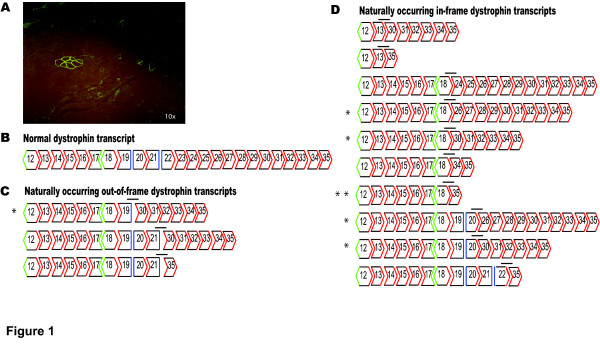
Background: Duchenne muscular dystrophy is a fatal genetic disorder caused by dystrophin gene mutations that result in premature termination of translation and the absence of functional protein. Despite the primary dystrophin gene lesion, immunostaining studies have shown that at least 50% of DMD patients, mdx mice and a canine model of DMD have rare dystrophin-positive or 'revertant' fibres. Fine epitope mapping has shown that the majority of transcripts responsible for revertant fibres exclude multiple exons, one of which includes the dystrophin mutation.
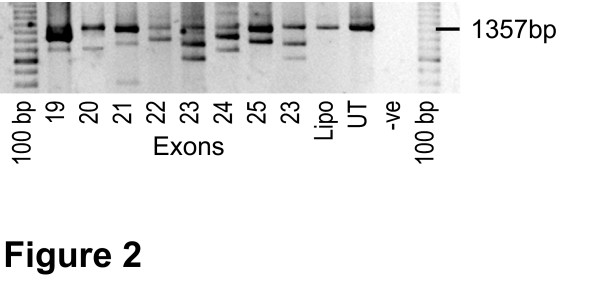
Methods: The mdx mouse model of muscular dystrophy has a nonsense mutation in exon 23 of the dystrophin gene. We have shown that antisense oligonucleotides (AOs) can induce the removal of this exon, resulting in an in-frame mRNA transcript encoding a shortened but functional dystrophin protein. To emulate one exonic combination associated with revertant fibres, we target multiple exons for removal by the application of a group of AOs combined as a "cocktail".
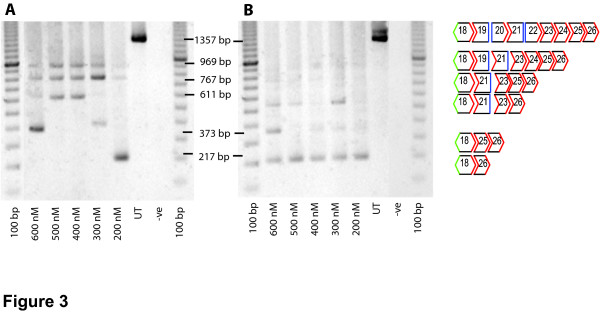
Results: Exons 19-25 were consistently excluded from the dystrophin gene transcript using a cocktail of AOs. This corresponds to an alternatively processed gene transcript that has been sporadically detected in untreated dystrophic mouse muscle, and is presumed to give rise to a revertant dystrophin isoform. The transcript and the resultant correctly localised smaller protein were confirmed by RT-PCR, immunohistochemistry and western blot analysis.
Conclusion: This work demonstrates the feasibility of AO cocktails to by-pass dystrophin mutation hotspots through multi-exon skipping. Multi-exon skipping could be important in expediting an exon skipping therapy to treat DMD, so that the same AO formulations may be applied to several different mutations within particular domains of the dystrophin gene.



 京公网安备 11010802042870号
京ICP备2023020795号-1
京公网安备 11010802042870号
京ICP备2023020795号-1

 分享
分享

 求助内容:
求助内容: 应助结果提醒方式:
 扫码关注我们
