Eun Hee Kim, Eun Hee Koh, Joong-Yeol Park, Ki-Up Lee
{"title":"Adenine nucleotide translocator as a regulator of mitochondrial function: implication in the pathogenesis of metabolic syndrome.","authors":"Eun Hee Kim, Eun Hee Koh, Joong-Yeol Park, Ki-Up Lee","doi":"10.4093/kdj.2010.34.3.146","DOIUrl":null,"url":null,"abstract":"<p><p>Mitochondria play key roles in energy production and intracellular reactive oxygen species (ROS) generation. Lines of evidence have shown that mitochondrial dysfunction contributes to the development of metabolic syndrome. The causes of mitochondrial dysfunction are complex, but overnutrition and sedentary living are among the best known causes of mitochondrial dysfunction. ATP synthesized in the mitochondria is exchanged for cytosolic ADP by adenine nucleotide translocator (ANT) to provide a continuous supply of ADP to mitochondria. We recently found that ANT function is essential for peroxisome proliferator-activated receptor-gamma coactivator 1-alpha (PGC-1alpha)'s action on endothelial cells. PGC-1alpha is a transcriptional coactivator of nuclear receptors, playing an important role in fatty acid oxidation and mitochondrial biogenesis. Recent studies have shown that PGC-1alpha decreases intracellular ROS generation by increasing the expression of antioxidant genes. In our study, PGC-1alpha reduced cell apoptosis and ROS generation in endothelial cells by increasing ATP/ADP translocase activity of ANT and ANT1 expression. Here we review the role of ANT in maintaining proper mitochondrial function, and possible role of ANT dysfunction in the pathogenesis of metabolic syndrome.</p>","PeriodicalId":88924,"journal":{"name":"Korean diabetes journal","volume":"34 3","pages":"146-53"},"PeriodicalIF":0.0000,"publicationDate":"2010-06-01","publicationTypes":"Journal Article","fieldsOfStudy":null,"isOpenAccess":false,"openAccessPdf":"https://sci-hub-pdf.com/10.4093/kdj.2010.34.3.146","citationCount":"39","resultStr":null,"platform":"Semanticscholar","paperid":null,"PeriodicalName":"Korean diabetes journal","FirstCategoryId":"1085","ListUrlMain":"https://doi.org/10.4093/kdj.2010.34.3.146","RegionNum":0,"RegionCategory":null,"ArticlePicture":[],"TitleCN":null,"AbstractTextCN":null,"PMCID":null,"EPubDate":"2010/6/30 0:00:00","PubModel":"Epub","JCR":"","JCRName":"","Score":null,"Total":0}
引用次数: 39
Abstract
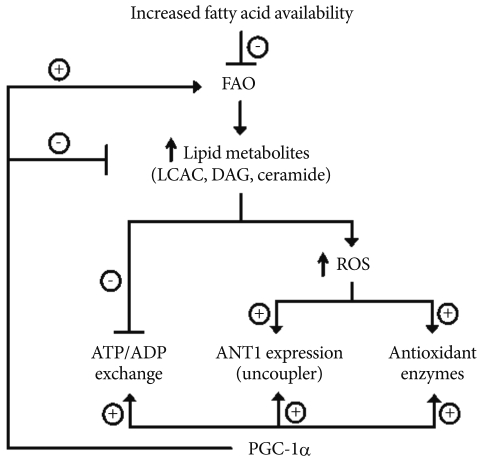
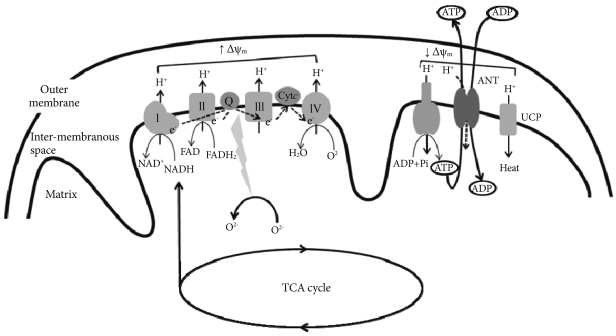
Mitochondria play key roles in energy production and intracellular reactive oxygen species (ROS) generation. Lines of evidence have shown that mitochondrial dysfunction contributes to the development of metabolic syndrome. The causes of mitochondrial dysfunction are complex, but overnutrition and sedentary living are among the best known causes of mitochondrial dysfunction. ATP synthesized in the mitochondria is exchanged for cytosolic ADP by adenine nucleotide translocator (ANT) to provide a continuous supply of ADP to mitochondria. We recently found that ANT function is essential for peroxisome proliferator-activated receptor-gamma coactivator 1-alpha (PGC-1alpha)'s action on endothelial cells. PGC-1alpha is a transcriptional coactivator of nuclear receptors, playing an important role in fatty acid oxidation and mitochondrial biogenesis. Recent studies have shown that PGC-1alpha decreases intracellular ROS generation by increasing the expression of antioxidant genes. In our study, PGC-1alpha reduced cell apoptosis and ROS generation in endothelial cells by increasing ATP/ADP translocase activity of ANT and ANT1 expression. Here we review the role of ANT in maintaining proper mitochondrial function, and possible role of ANT dysfunction in the pathogenesis of metabolic syndrome.




 京公网安备 11010802042870号
京ICP备2023020795号-1
京公网安备 11010802042870号
京ICP备2023020795号-1

 分享
分享

 求助内容:
求助内容: 应助结果提醒方式:
 扫码关注我们
