Elio Hajj Assaf, Cornelius von Einem, Cesar Cadena, Roland Siegwart, Florian Tschopp
{"title":"High-Precision Low-Cost Gimballing Platform for Long-Range Railway Obstacle Detection.","authors":"Elio Hajj Assaf, Cornelius von Einem, Cesar Cadena, Roland Siegwart, Florian Tschopp","doi":"10.3390/s22020474","DOIUrl":null,"url":null,"abstract":"<p><p>Increasing demand for rail transportation results in denser and more high-speed usage of the existing railway network, making new and more advanced vehicle safety systems necessary. Furthermore, high traveling speeds and the large weights of trains lead to long braking distances-all of which necessitates a Long-Range Obstacle Detection (LROD) system, capable of detecting humans and other objects more than 1000 m in advance. According to current research, only a few sensor modalities are capable of reaching this far and recording sufficiently accurate data to distinguish individual objects. The limitation of these sensors, such as a 1D-Light Detection and Ranging (LiDAR), is however a very narrow Field of View (FoV), making it necessary to use high-precision means of orienting to target them at possible areas of interest. To close this research gap, this paper presents a high-precision pointing mechanism, for the use in a future novel railway obstacle detection system, capable of targeting a 1D-LiDAR at humans or objects at the required distance. This approach addresses the challenges of a low target price, restricted access to high-precision machinery and equipment as well as unique requirements of our target application. By combining established elements from 3D printers and Computer Numerical Control (CNC) machines with a double-hinged lever system, simple and low-cost components are capable of precisely orienting an arbitrary sensor platform. The system's actual pointing accuracy has been evaluated using a controlled, in-door, long-range experiment. The device was able to demonstrate a precision of 6.179 mdeg, which is at the limit of the measurable precision of the designed experiment.</p>","PeriodicalId":221960,"journal":{"name":"Sensors (Basel, Switzerland)","volume":" ","pages":""},"PeriodicalIF":0.0000,"publicationDate":"2022-01-09","publicationTypes":"Journal Article","fieldsOfStudy":null,"isOpenAccess":false,"openAccessPdf":"https://www.ncbi.nlm.nih.gov/pmc/articles/PMC8781877/pdf/","citationCount":"3","resultStr":null,"platform":"Semanticscholar","paperid":null,"PeriodicalName":"Sensors (Basel, Switzerland)","FirstCategoryId":"103","ListUrlMain":"https://doi.org/10.3390/s22020474","RegionNum":0,"RegionCategory":null,"ArticlePicture":[],"TitleCN":null,"AbstractTextCN":null,"PMCID":null,"EPubDate":"","PubModel":"","JCR":"","JCRName":"","Score":null,"Total":0}
引用次数: 3
Abstract
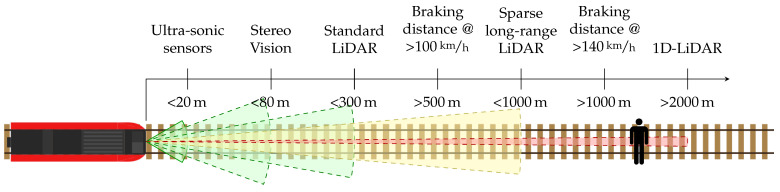
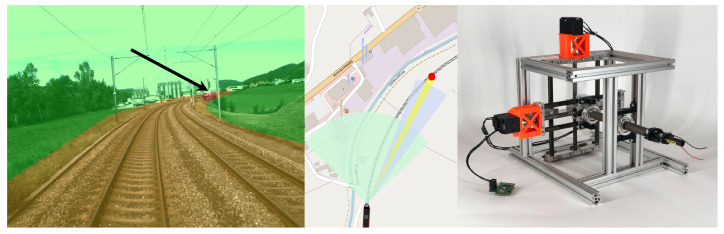
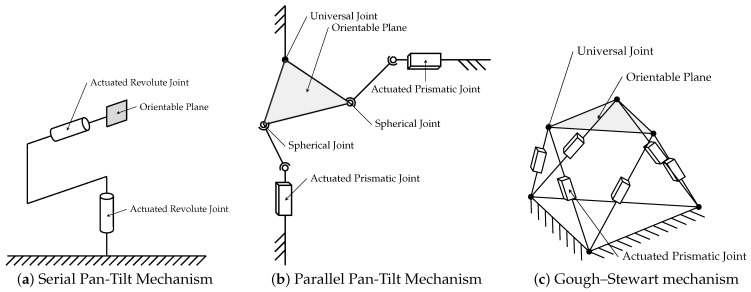
Increasing demand for rail transportation results in denser and more high-speed usage of the existing railway network, making new and more advanced vehicle safety systems necessary. Furthermore, high traveling speeds and the large weights of trains lead to long braking distances-all of which necessitates a Long-Range Obstacle Detection (LROD) system, capable of detecting humans and other objects more than 1000 m in advance. According to current research, only a few sensor modalities are capable of reaching this far and recording sufficiently accurate data to distinguish individual objects. The limitation of these sensors, such as a 1D-Light Detection and Ranging (LiDAR), is however a very narrow Field of View (FoV), making it necessary to use high-precision means of orienting to target them at possible areas of interest. To close this research gap, this paper presents a high-precision pointing mechanism, for the use in a future novel railway obstacle detection system, capable of targeting a 1D-LiDAR at humans or objects at the required distance. This approach addresses the challenges of a low target price, restricted access to high-precision machinery and equipment as well as unique requirements of our target application. By combining established elements from 3D printers and Computer Numerical Control (CNC) machines with a double-hinged lever system, simple and low-cost components are capable of precisely orienting an arbitrary sensor platform. The system's actual pointing accuracy has been evaluated using a controlled, in-door, long-range experiment. The device was able to demonstrate a precision of 6.179 mdeg, which is at the limit of the measurable precision of the designed experiment.



 京公网安备 11010802042870号
京ICP备2023020795号-1
京公网安备 11010802042870号
京ICP备2023020795号-1

 分享
分享

 求助内容:
求助内容: 应助结果提醒方式:
 扫码关注我们
