Molecular networking-based lipid profiling and multi-omics approaches reveal new contributions of functional vanilloids to gut microbiota and lipometabolism changes
{"title":"Molecular networking-based lipid profiling and multi-omics approaches reveal new contributions of functional vanilloids to gut microbiota and lipometabolism changes","authors":"Hiroyuki Hattori , Akihiro Moriyama , Tomoki Ohno , Takahiro Shibata , Hitoshi Iwahashi , Tohru Mitsunaga","doi":"10.1016/j.fochms.2022.100123","DOIUrl":null,"url":null,"abstract":"<div><p>Obesity is now recognized as an epidemic, requiring rapid intervention. We previously demonstrated that vanilloids from the African spice known as Grains of Paradise (GOP) exhibit strong anti-obesity effects. Here, the molecular mechanism behind the obesity prevention property of the GOP extract was investigated by employing molecular networking-based lipid profiling and 16S rRNA sequencing. Administration of either GOP extract or two of its components, 6-paradol and 6-gingerol, reversed the unbalanced gut microbiota composition induced by a high-fat diet (HFD) with a decrease in Firmicutes / Bacteroidetes ratio and increase in genera <em>Bifidobacterium</em> and <em>Akkermansia</em>. Moreover, GOP extract ameliorated abnormal fatty acid metabolism in gut bacteria. Furthermore, lipid molecular networking revealed differences in lipid composition, such as triglycerides and bile acids, in the feces. These results suggest that 6-paradol and 6-gingerol can restore an unhealthy gut environment and prevent lipid absorption, a possible consequence of the reconstruction of the gut microbiota.</p></div>","PeriodicalId":34477,"journal":{"name":"Food Chemistry Molecular Sciences","volume":"5 ","pages":"Article 100123"},"PeriodicalIF":4.7000,"publicationDate":"2022-12-30","publicationTypes":"Journal Article","fieldsOfStudy":null,"isOpenAccess":false,"openAccessPdf":"https://www.ncbi.nlm.nih.gov/pmc/articles/PMC9309231/pdf/","citationCount":"1","resultStr":null,"platform":"Semanticscholar","paperid":null,"PeriodicalName":"Food Chemistry Molecular Sciences","FirstCategoryId":"1085","ListUrlMain":"https://www.sciencedirect.com/science/article/pii/S266656622200051X","RegionNum":0,"RegionCategory":null,"ArticlePicture":[],"TitleCN":null,"AbstractTextCN":null,"PMCID":null,"EPubDate":"","PubModel":"","JCR":"Q2","JCRName":"FOOD SCIENCE & TECHNOLOGY","Score":null,"Total":0}
引用次数: 1
Abstract
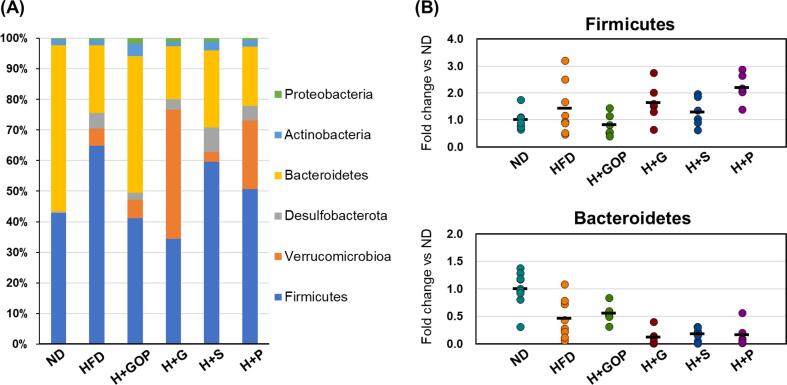
Obesity is now recognized as an epidemic, requiring rapid intervention. We previously demonstrated that vanilloids from the African spice known as Grains of Paradise (GOP) exhibit strong anti-obesity effects. Here, the molecular mechanism behind the obesity prevention property of the GOP extract was investigated by employing molecular networking-based lipid profiling and 16S rRNA sequencing. Administration of either GOP extract or two of its components, 6-paradol and 6-gingerol, reversed the unbalanced gut microbiota composition induced by a high-fat diet (HFD) with a decrease in Firmicutes / Bacteroidetes ratio and increase in genera Bifidobacterium and Akkermansia. Moreover, GOP extract ameliorated abnormal fatty acid metabolism in gut bacteria. Furthermore, lipid molecular networking revealed differences in lipid composition, such as triglycerides and bile acids, in the feces. These results suggest that 6-paradol and 6-gingerol can restore an unhealthy gut environment and prevent lipid absorption, a possible consequence of the reconstruction of the gut microbiota.
期刊介绍:
Food Chemistry: Molecular Sciences is one of three companion journals to the highly respected Food Chemistry.
Food Chemistry: Molecular Sciences is an open access journal publishing research advancing the theory and practice of molecular sciences of foods.
The types of articles considered are original research articles, analytical methods, comprehensive reviews and commentaries.
Topics include:
Molecular sciences relating to major and minor components of food (nutrients and bioactives) and their physiological, sensory, flavour, and microbiological aspects; data must be sufficient to demonstrate relevance to foods and as consumed by humans
Changes in molecular composition or structure in foods occurring or induced during growth, distribution and processing (industrial or domestic) or as a result of human metabolism
Quality, safety, authenticity and traceability of foods and packaging materials
Valorisation of food waste arising from processing and exploitation of by-products
Molecular sciences of additives, contaminants including agro-chemicals, together with their metabolism, food fate and benefit: risk to human health
Novel analytical and computational (bioinformatics) methods related to foods as consumed, nutrients and bioactives, sensory, metabolic fate, and origins of foods. Articles must be concerned with new or novel methods or novel uses and must be applied to real-world samples to demonstrate robustness. Those dealing with significant improvements to existing methods or foods and commodities from different regions, and re-use of existing data will be considered, provided authors can establish sufficient originality.



 京公网安备 11010802042870号
京ICP备2023020795号-1
京公网安备 11010802042870号
京ICP备2023020795号-1

 分享
分享
 求助内容:
求助内容: 应助结果提醒方式:
 扫码关注我们
