Sibo Chen , Kai Mei , Yaru Luo , Liang-Xin Ding , Haihui Wang
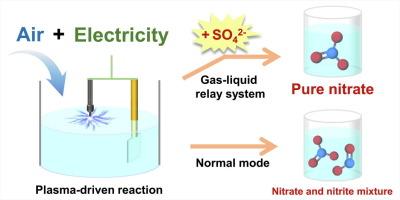
{"title":"Selective synthesis of nitrate from air using a plasma-driven gas-liquid relay reaction system","authors":"Sibo Chen , Kai Mei , Yaru Luo , Liang-Xin Ding , Haihui Wang","doi":"10.1016/j.jechem.2023.06.021","DOIUrl":null,"url":null,"abstract":"<div><p>The direct oxidation of nitrogen is a potential pathway to achieving the zero-carbon-emission synthesis of nitric acid or nitrate, because it does not involve ammonia synthesis and additional ammonia oxidation processes. However, the slow kinetics of nitrogen oxidation and the difficult selective control of oxidation products hinder the development of this process. In this study, a plasma-driven gas-liquid relay reaction system was developed to overcome these limitations. A typical feature of this reaction system is that it can efficiently generate NO<em><sub>x</sub></em> under plasma exposure; moreover, the specific anions in the absorption solution can be oxidized to strong oxidants capable of relay oxidation of low-valence nitrogen oxides. This feature allows for the deep oxidation of nitrogen, thus enabling the oxidation products of nitrogen to exist in high-valence states in the absorption solution. For experimental verification, we achieved the 100% selective synthesis of nitrate under plasma exposure, with air as the supply gas and a sodium sulfate solution as the absorption solution.</p></div>","PeriodicalId":15728,"journal":{"name":"Journal of Energy Chemistry","volume":"85 ","pages":"Pages 439-446"},"PeriodicalIF":14.9000,"publicationDate":"2023-10-01","publicationTypes":"Journal Article","fieldsOfStudy":null,"isOpenAccess":false,"openAccessPdf":"","citationCount":"0","resultStr":null,"platform":"Semanticscholar","paperid":null,"PeriodicalName":"Journal of Energy Chemistry","FirstCategoryId":"1085","ListUrlMain":"https://www.sciencedirect.com/science/article/pii/S2095495623003674","RegionNum":1,"RegionCategory":"化学","ArticlePicture":[],"TitleCN":null,"AbstractTextCN":null,"PMCID":null,"EPubDate":"","PubModel":"","JCR":"Q1","JCRName":"Energy","Score":null,"Total":0}
引用次数: 0
Abstract
The direct oxidation of nitrogen is a potential pathway to achieving the zero-carbon-emission synthesis of nitric acid or nitrate, because it does not involve ammonia synthesis and additional ammonia oxidation processes. However, the slow kinetics of nitrogen oxidation and the difficult selective control of oxidation products hinder the development of this process. In this study, a plasma-driven gas-liquid relay reaction system was developed to overcome these limitations. A typical feature of this reaction system is that it can efficiently generate NOx under plasma exposure; moreover, the specific anions in the absorption solution can be oxidized to strong oxidants capable of relay oxidation of low-valence nitrogen oxides. This feature allows for the deep oxidation of nitrogen, thus enabling the oxidation products of nitrogen to exist in high-valence states in the absorption solution. For experimental verification, we achieved the 100% selective synthesis of nitrate under plasma exposure, with air as the supply gas and a sodium sulfate solution as the absorption solution.
期刊介绍:
The Journal of Energy Chemistry, the official publication of Science Press and the Dalian Institute of Chemical Physics, Chinese Academy of Sciences, serves as a platform for reporting creative research and innovative applications in energy chemistry. It mainly reports on creative researches and innovative applications of chemical conversions of fossil energy, carbon dioxide, electrochemical energy and hydrogen energy, as well as the conversions of biomass and solar energy related with chemical issues to promote academic exchanges in the field of energy chemistry and to accelerate the exploration, research and development of energy science and technologies.
This journal focuses on original research papers covering various topics within energy chemistry worldwide, including:
Optimized utilization of fossil energy
Hydrogen energy
Conversion and storage of electrochemical energy
Capture, storage, and chemical conversion of carbon dioxide
Materials and nanotechnologies for energy conversion and storage
Chemistry in biomass conversion
Chemistry in the utilization of solar energy



 京公网安备 11010802042870号
京ICP备2023020795号-1
京公网安备 11010802042870号
京ICP备2023020795号-1

 分享
分享
 求助内容:
求助内容: 应助结果提醒方式:
 扫码关注我们
