Laura Lavefve, Natacha Cureau, Lindsey Rodhouse, Daya Marasini, Laura M. Walker, Danielle Ashley, Sun-Ok Lee, Pascale Gadonna-Widehem, Pauline M. Anton, Franck Carbonero
{"title":"Microbiota profiles and dynamics in fermented plant-based products and preliminary assessment of their in vitro gut microbiota modulation","authors":"Laura Lavefve, Natacha Cureau, Lindsey Rodhouse, Daya Marasini, Laura M. Walker, Danielle Ashley, Sun-Ok Lee, Pascale Gadonna-Widehem, Pauline M. Anton, Franck Carbonero","doi":"10.1002/fft2.75","DOIUrl":null,"url":null,"abstract":"<p>Consumption of fermented food has long been associated with health benefits, but there is still limited knowledge on the bacterial dynamics in plant-based food fermentation outside of culture-based studies. Different fermented plant-based products were assessed for the presence of Archaea and their microbiota bacterial dynamics during the fermentation. Archaea were consistently detected in the brine of the vegetables, and constant increase in gene copy number throughout the fermentation of kraut indicated that Archaea were not only viable but actively growing. The plant-associated bacterial microbiota of cabbage and jalapeno were dominated by Proteobacteria, specifically <i>Pseudomonas</i> (51% and 39% respectively), while the okra harbored roughly equal numbers of firmicutes and proteobacteria. In cabbage and jalapeno fermentations, lactic acid bacteria (LAB), which were detected in extremely low levels in raw products, became dominant with expected succession of heterofermentative and homofermentative species. These two stages were not detected in the fermentation of okra, and <i>Lactobacillus</i> remained the most abundant genera. The kombucha fermentation was dominated by <i>Gluconacetobacter</i> as reported previously, but also characterized by high abundance of <i>Bacteroides</i>. Intriguingly, the microbiota composition and dynamics were very different between the two kombucha batches tested, suggesting redundancy in microorganisms’ fermentative roles. Finally, a preliminary in vitro fermentation study was indicative of a potential bifidogenic effect of microbial metabolites from kombucha. Collectively, these data indicate that fermented plant products harbor a highly diverse microbiota, bacteria, and archaea, even after the end of the fermentation.</p>","PeriodicalId":73042,"journal":{"name":"Food frontiers","volume":"2 3","pages":"268-281"},"PeriodicalIF":6.9000,"publicationDate":"2021-04-07","publicationTypes":"Journal Article","fieldsOfStudy":null,"isOpenAccess":false,"openAccessPdf":"https://sci-hub-pdf.com/10.1002/fft2.75","citationCount":"11","resultStr":null,"platform":"Semanticscholar","paperid":null,"PeriodicalName":"Food frontiers","FirstCategoryId":"1085","ListUrlMain":"https://onlinelibrary.wiley.com/doi/10.1002/fft2.75","RegionNum":0,"RegionCategory":null,"ArticlePicture":[],"TitleCN":null,"AbstractTextCN":null,"PMCID":null,"EPubDate":"","PubModel":"","JCR":"Q1","JCRName":"FOOD SCIENCE & TECHNOLOGY","Score":null,"Total":0}
引用次数: 11
Abstract
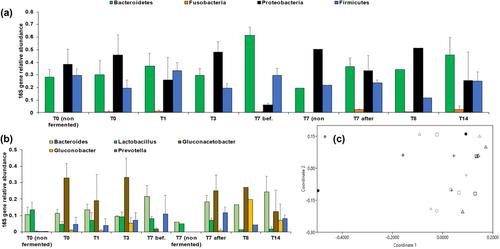
Consumption of fermented food has long been associated with health benefits, but there is still limited knowledge on the bacterial dynamics in plant-based food fermentation outside of culture-based studies. Different fermented plant-based products were assessed for the presence of Archaea and their microbiota bacterial dynamics during the fermentation. Archaea were consistently detected in the brine of the vegetables, and constant increase in gene copy number throughout the fermentation of kraut indicated that Archaea were not only viable but actively growing. The plant-associated bacterial microbiota of cabbage and jalapeno were dominated by Proteobacteria, specifically Pseudomonas (51% and 39% respectively), while the okra harbored roughly equal numbers of firmicutes and proteobacteria. In cabbage and jalapeno fermentations, lactic acid bacteria (LAB), which were detected in extremely low levels in raw products, became dominant with expected succession of heterofermentative and homofermentative species. These two stages were not detected in the fermentation of okra, and Lactobacillus remained the most abundant genera. The kombucha fermentation was dominated by Gluconacetobacter as reported previously, but also characterized by high abundance of Bacteroides. Intriguingly, the microbiota composition and dynamics were very different between the two kombucha batches tested, suggesting redundancy in microorganisms’ fermentative roles. Finally, a preliminary in vitro fermentation study was indicative of a potential bifidogenic effect of microbial metabolites from kombucha. Collectively, these data indicate that fermented plant products harbor a highly diverse microbiota, bacteria, and archaea, even after the end of the fermentation.



 京公网安备 11010802042870号
京ICP备2023020795号-1
京公网安备 11010802042870号
京ICP备2023020795号-1

 分享
分享

 求助内容:
求助内容: 应助结果提醒方式:
 扫码关注我们
