Jun-nan Wu , Si-wei Song , Xiao-lan Tian , Yi Wang , Xiu-juan Qi
{"title":"Machine learning-based prediction and interpretation of decomposition temperatures of energetic materials","authors":"Jun-nan Wu , Si-wei Song , Xiao-lan Tian , Yi Wang , Xiu-juan Qi","doi":"10.1016/j.enmf.2023.09.001","DOIUrl":null,"url":null,"abstract":"<div><div>Exploring the application of machine learning (ML) in energetic materials (EMs) has been a hot research topic. Accordingly, the prediction of the detonation properties of EMs using ML methods has attracted much attention. However, the predictive models for the thermal decomposition temperatures (<em>T</em><sub>d</sub>) of EMs have been scarcely reported. Furthermore, the small datasets used in these reports lead to a weak generalization ability of the predictive models. This study created a dataset containing 1022 energetic molecules with <em>T</em><sub>d</sub> values of 38–425 °C and determined an optimal predictive model through training. The gradient boost machine for regression (GBR) model yielded a coefficient of determination (<em>R</em><sup><em>2</em></sup>) of 0.65 and a mean absolute error (MAE) of 27.7 for the test set. This study further explored critical features, determining that the prediction accuracy of the models was significantly influenced by descriptors representing molecular bond stability (i.e., the BCUT metrics) and atomic composition (i.e., the Molecular ID). Finally, the analysis of the outlier structure indicated that the model accuracy can be further improved by incorporating features related to molecular interactions. The results of this study help gain a deep understanding of the application of ML in the prediction of EM properties, particularly in dataset construction and feature selection.</div></div>","PeriodicalId":34595,"journal":{"name":"Energetic Materials Frontiers","volume":"4 4","pages":"Pages 254-261"},"PeriodicalIF":3.9000,"publicationDate":"2023-12-01","publicationTypes":"Journal Article","fieldsOfStudy":null,"isOpenAccess":false,"openAccessPdf":"","citationCount":"0","resultStr":null,"platform":"Semanticscholar","paperid":null,"PeriodicalName":"Energetic Materials Frontiers","FirstCategoryId":"1085","ListUrlMain":"https://www.sciencedirect.com/science/article/pii/S2666647223000404","RegionNum":0,"RegionCategory":null,"ArticlePicture":[],"TitleCN":null,"AbstractTextCN":null,"PMCID":null,"EPubDate":"","PubModel":"","JCR":"Q2","JCRName":"CHEMISTRY, MULTIDISCIPLINARY","Score":null,"Total":0}
引用次数: 0
Abstract
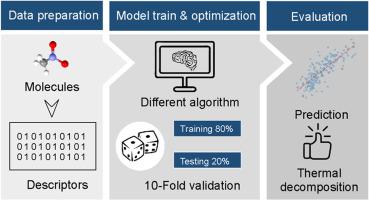
Exploring the application of machine learning (ML) in energetic materials (EMs) has been a hot research topic. Accordingly, the prediction of the detonation properties of EMs using ML methods has attracted much attention. However, the predictive models for the thermal decomposition temperatures (Td) of EMs have been scarcely reported. Furthermore, the small datasets used in these reports lead to a weak generalization ability of the predictive models. This study created a dataset containing 1022 energetic molecules with Td values of 38–425 °C and determined an optimal predictive model through training. The gradient boost machine for regression (GBR) model yielded a coefficient of determination (R2) of 0.65 and a mean absolute error (MAE) of 27.7 for the test set. This study further explored critical features, determining that the prediction accuracy of the models was significantly influenced by descriptors representing molecular bond stability (i.e., the BCUT metrics) and atomic composition (i.e., the Molecular ID). Finally, the analysis of the outlier structure indicated that the model accuracy can be further improved by incorporating features related to molecular interactions. The results of this study help gain a deep understanding of the application of ML in the prediction of EM properties, particularly in dataset construction and feature selection.





 京公网安备 11010802042870号
京ICP备2023020795号-1
京公网安备 11010802042870号
京ICP备2023020795号-1

 分享
分享
 求助内容:
求助内容: 应助结果提醒方式:
 扫码关注我们
