Samuele Di Carmine, Molly M Scott, Mairi H McLean, Henry J McSorley
{"title":"The role of interleukin-33 in organ fibrosis.","authors":"Samuele Di Carmine, Molly M Scott, Mairi H McLean, Henry J McSorley","doi":"10.1093/discim/kyac006","DOIUrl":null,"url":null,"abstract":"<p><p>Interleukin (IL)-33 is highly expressed in the nucleus of cells present at barrier sites and signals via the ST2 receptor. IL-33 signalling via ST2 is essential for return to tissue homeostasis after acute inflammation, promoting fibrinogenesis and wound healing at injury sites. However, this wound-healing response becomes aberrant during chronic or sustained inflammation, leading to transforming growth factor beta (TGF-β) release, excessive extracellular matrix deposition, and fibrosis. This review addresses the role of the IL-33 pathway in fibrotic diseases of the lung, liver, gastrointestinal tract, skin, kidney and heart. In the lung and liver, IL-33 release leads to the activation of pro-fibrotic TGF-β, and in these sites, IL-33 has clear pro-fibrotic roles. In the gastrointestinal tract, skin, and kidney, the role of IL-33 is more complex, being both pro-fibrotic and tissue protective. Finally, in the heart, IL-33 serves cardioprotective functions by favouring tissue healing and preventing cardiomyocyte death. Altogether, this review indicates the presence of an unclear and delicate balance between resolving and pro-fibrotic capabilities of IL-33, which has a central role in the modulation of type 2 inflammation and fibrosis in response to tissue injury.</p>","PeriodicalId":72830,"journal":{"name":"Discovery immunology","volume":" ","pages":"kyac006"},"PeriodicalIF":0.0000,"publicationDate":"2022-09-26","publicationTypes":"Journal Article","fieldsOfStudy":null,"isOpenAccess":false,"openAccessPdf":"https://www.ncbi.nlm.nih.gov/pmc/articles/PMC10917208/pdf/","citationCount":"0","resultStr":null,"platform":"Semanticscholar","paperid":null,"PeriodicalName":"Discovery immunology","FirstCategoryId":"1085","ListUrlMain":"https://doi.org/10.1093/discim/kyac006","RegionNum":0,"RegionCategory":null,"ArticlePicture":[],"TitleCN":null,"AbstractTextCN":null,"PMCID":null,"EPubDate":"2022/1/1 0:00:00","PubModel":"eCollection","JCR":"","JCRName":"","Score":null,"Total":0}
引用次数: 0
Abstract
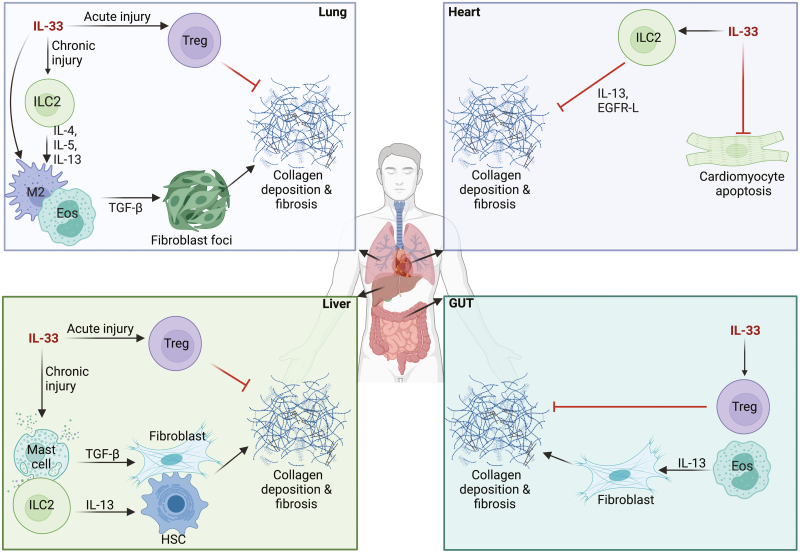
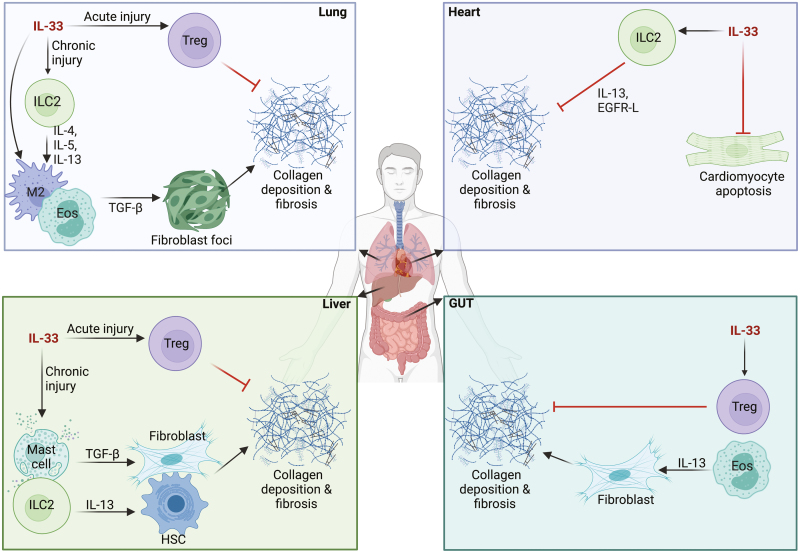
Interleukin (IL)-33 is highly expressed in the nucleus of cells present at barrier sites and signals via the ST2 receptor. IL-33 signalling via ST2 is essential for return to tissue homeostasis after acute inflammation, promoting fibrinogenesis and wound healing at injury sites. However, this wound-healing response becomes aberrant during chronic or sustained inflammation, leading to transforming growth factor beta (TGF-β) release, excessive extracellular matrix deposition, and fibrosis. This review addresses the role of the IL-33 pathway in fibrotic diseases of the lung, liver, gastrointestinal tract, skin, kidney and heart. In the lung and liver, IL-33 release leads to the activation of pro-fibrotic TGF-β, and in these sites, IL-33 has clear pro-fibrotic roles. In the gastrointestinal tract, skin, and kidney, the role of IL-33 is more complex, being both pro-fibrotic and tissue protective. Finally, in the heart, IL-33 serves cardioprotective functions by favouring tissue healing and preventing cardiomyocyte death. Altogether, this review indicates the presence of an unclear and delicate balance between resolving and pro-fibrotic capabilities of IL-33, which has a central role in the modulation of type 2 inflammation and fibrosis in response to tissue injury.



 京公网安备 11010802042870号
京ICP备2023020795号-1
京公网安备 11010802042870号
京ICP备2023020795号-1

 分享
分享

 求助内容:
求助内容: 应助结果提醒方式:
 扫码关注我们
