Zejun Pu, Xu Huang, Lan Chen, Jian Yang, Hailong Tang, Xiaobo Liu
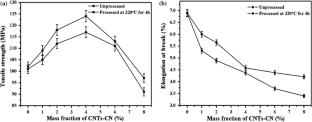
{"title":"Effect of nitrile-functionalization and thermal cross-linking on the dielectric and mechanical properties of PEN/CNTs–CN composites","authors":"Zejun Pu, Xu Huang, Lan Chen, Jian Yang, Hailong Tang, Xiaobo Liu","doi":"10.1007/s10854-013-1190-6","DOIUrl":null,"url":null,"abstract":"<p>In this study, a novel series of composite films consisting of nitrile-functionalized carbon nanotubes (CNTs–CN) and poly(arylene ether nitriles) (PEN) were successfully fabricated by the tape-casting method. The –CN groups in PEN chains and the phthalonitrile groups on CNTs–CN formed the thermally stable triazine rings by thermal cross-linking reaction in the presence of diamino diphenyl sulfone, which was characterized by Fourier transform infrared spectroscopy. The result indicated that the chemical cross-linking reaction occurred accompanied by the emergence of a new absorption peak at 1,361?cm<sup>?1</sup>. Besides, the effect of cross-linking on the morphology, thermal stability, mechanical and dielectric properties of the PEN/CNTs–CN was investigated. The SEM images showed that the phase interface between surface modified CNTs and PEN matrix was indistinct, and the surface modified CNTs presented a better dispersion behavior in PEN matrix. The mechanical properties of the processed films were improved substantially compared with the unprocessed films. Furthermore, the glass-transition temperature (<i>T</i>\n <sub>\n <i>g</i>\n </sub>) of composite films processed at 320?°C for 4?h (about 245?°C) was higher than that of composite films before thermal treatment (about 205?°C). The 5?% weight loss temperature of the composite films (processed at 320?°C for 4?h) increased by about 110?°C compared with the composite films (unprocessed). More importantly, by thermal cross-linking, the dielectric constant (<i>ε</i>) of composite films with 8?wt% CNTs–CN loading was increased from 31.8 to 33.9, and dielectric loss (tan δ) was decreased from 0.90 to 0.61 at 1?kHz.</p>","PeriodicalId":646,"journal":{"name":"Journal of Materials Science: Materials in Electronics","volume":"24 8","pages":"2913 - 2922"},"PeriodicalIF":2.8000,"publicationDate":"2013-03-24","publicationTypes":"Journal Article","fieldsOfStudy":null,"isOpenAccess":false,"openAccessPdf":"https://sci-hub-pdf.com/10.1007/s10854-013-1190-6","citationCount":"17","resultStr":null,"platform":"Semanticscholar","paperid":null,"PeriodicalName":"Journal of Materials Science: Materials in Electronics","FirstCategoryId":"5","ListUrlMain":"https://link.springer.com/article/10.1007/s10854-013-1190-6","RegionNum":4,"RegionCategory":"工程技术","ArticlePicture":[],"TitleCN":null,"AbstractTextCN":null,"PMCID":null,"EPubDate":"","PubModel":"","JCR":"Q2","JCRName":"ENGINEERING, ELECTRICAL & ELECTRONIC","Score":null,"Total":0}
引用次数: 17
Abstract
In this study, a novel series of composite films consisting of nitrile-functionalized carbon nanotubes (CNTs–CN) and poly(arylene ether nitriles) (PEN) were successfully fabricated by the tape-casting method. The –CN groups in PEN chains and the phthalonitrile groups on CNTs–CN formed the thermally stable triazine rings by thermal cross-linking reaction in the presence of diamino diphenyl sulfone, which was characterized by Fourier transform infrared spectroscopy. The result indicated that the chemical cross-linking reaction occurred accompanied by the emergence of a new absorption peak at 1,361?cm?1. Besides, the effect of cross-linking on the morphology, thermal stability, mechanical and dielectric properties of the PEN/CNTs–CN was investigated. The SEM images showed that the phase interface between surface modified CNTs and PEN matrix was indistinct, and the surface modified CNTs presented a better dispersion behavior in PEN matrix. The mechanical properties of the processed films were improved substantially compared with the unprocessed films. Furthermore, the glass-transition temperature (Tg) of composite films processed at 320?°C for 4?h (about 245?°C) was higher than that of composite films before thermal treatment (about 205?°C). The 5?% weight loss temperature of the composite films (processed at 320?°C for 4?h) increased by about 110?°C compared with the composite films (unprocessed). More importantly, by thermal cross-linking, the dielectric constant (ε) of composite films with 8?wt% CNTs–CN loading was increased from 31.8 to 33.9, and dielectric loss (tan δ) was decreased from 0.90 to 0.61 at 1?kHz.
期刊介绍:
The Journal of Materials Science: Materials in Electronics is an established refereed companion to the Journal of Materials Science. It publishes papers on materials and their applications in modern electronics, covering the ground between fundamental science, such as semiconductor physics, and work concerned specifically with applications. It explores the growth and preparation of new materials, as well as their processing, fabrication, bonding and encapsulation, together with the reliability, failure analysis, quality assurance and characterization related to the whole range of applications in electronics. The Journal presents papers in newly developing fields such as low dimensional structures and devices, optoelectronics including III-V compounds, glasses and linear/non-linear crystal materials and lasers, high Tc superconductors, conducting polymers, thick film materials and new contact technologies, as well as the established electronics device and circuit materials.



 京公网安备 11010802042870号
京ICP备2023020795号-1
京公网安备 11010802042870号
京ICP备2023020795号-1

 分享
分享
 求助内容:
求助内容: 应助结果提醒方式:
 扫码关注我们
