{"title":"Climatic niche divergence explains angiosperm diversification across clades in China","authors":"Gui-Lin Wu, De-Xiang Chen, Zhang Zhou, Qing Ye, Andrés Baselga, Hui Liu, Yin Wen, Shou-Qian Nong","doi":"10.1111/jse.12932","DOIUrl":null,"url":null,"abstract":"<p>Diversification rates are critically important for understanding patterns of species richness among clades. However, the effects of climatic niche width on plant diversification rates remain to be elucidated. Based on the phylogenetic, climatic, and distributional information of angiosperms in China, a total of 26 906 species from 182 families were included in this study. We aimed to test relationships between diversification rate and climatic niche width and climatic niche width related variables (including climatic niche divergence, climatic niche position, geographic extent, and climatic niche evolutionary rate) using phylogenetic methods. We found that climatic niche divergence had the largest unique contribution to the diversification rate, while the unique effects of climatic niche width, climatic niche position, geographic extent, and climatic niche evolutionary rate on the diversification rate were negligible. We also observed that the relationship between diversification rate and climatic niche divergence was significantly stronger than the null assumption (artefactual relationship between diversification and clade-level climatic niche width by sampling more species). Our study supports the hypothesis that wider family climatic niche widths explain faster diversification rates through a higher climatic niche divergence rather than through higher geographic extent, higher climatic niche evolutionary rate, or separated climatic niche position. Hence, the results provide a potential explanation for large-scale diversity patterns within families of plants.</p>","PeriodicalId":17087,"journal":{"name":"Journal of Systematics and Evolution","volume":"61 4","pages":"698-708"},"PeriodicalIF":3.2000,"publicationDate":"2022-11-14","publicationTypes":"Journal Article","fieldsOfStudy":null,"isOpenAccess":false,"openAccessPdf":"","citationCount":"1","resultStr":null,"platform":"Semanticscholar","paperid":null,"PeriodicalName":"Journal of Systematics and Evolution","FirstCategoryId":"1089","ListUrlMain":"https://onlinelibrary.wiley.com/doi/10.1111/jse.12932","RegionNum":1,"RegionCategory":"生物学","ArticlePicture":[],"TitleCN":null,"AbstractTextCN":null,"PMCID":null,"EPubDate":"","PubModel":"","JCR":"Q1","JCRName":"Agricultural and Biological Sciences","Score":null,"Total":0}
引用次数: 1
Abstract
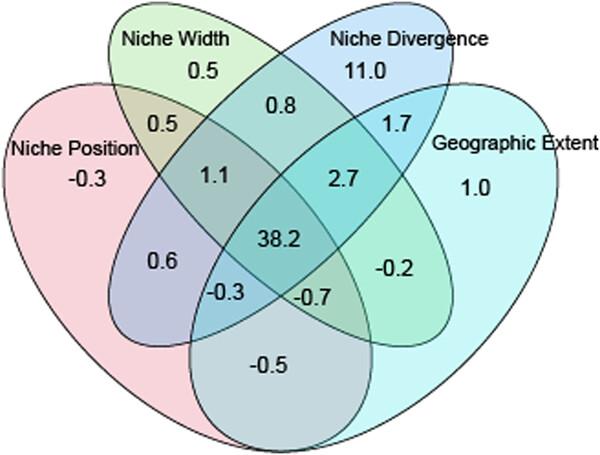
Diversification rates are critically important for understanding patterns of species richness among clades. However, the effects of climatic niche width on plant diversification rates remain to be elucidated. Based on the phylogenetic, climatic, and distributional information of angiosperms in China, a total of 26 906 species from 182 families were included in this study. We aimed to test relationships between diversification rate and climatic niche width and climatic niche width related variables (including climatic niche divergence, climatic niche position, geographic extent, and climatic niche evolutionary rate) using phylogenetic methods. We found that climatic niche divergence had the largest unique contribution to the diversification rate, while the unique effects of climatic niche width, climatic niche position, geographic extent, and climatic niche evolutionary rate on the diversification rate were negligible. We also observed that the relationship between diversification rate and climatic niche divergence was significantly stronger than the null assumption (artefactual relationship between diversification and clade-level climatic niche width by sampling more species). Our study supports the hypothesis that wider family climatic niche widths explain faster diversification rates through a higher climatic niche divergence rather than through higher geographic extent, higher climatic niche evolutionary rate, or separated climatic niche position. Hence, the results provide a potential explanation for large-scale diversity patterns within families of plants.
期刊介绍:
Journal of Systematics and Evolution (JSE, since 2008; formerly Acta Phytotaxonomica Sinica) is a plant-based international journal newly dedicated to the description and understanding of the biological diversity. It covers: description of new taxa, monographic revision, phylogenetics, molecular evolution and genome evolution, evolutionary developmental biology, evolutionary ecology, population biology, conservation biology, biogeography, paleobiology, evolutionary theories, and related subjects.




 京公网安备 11010802042870号
京ICP备2023020795号-1
京公网安备 11010802042870号
京ICP备2023020795号-1

 分享
分享
 求助内容:
求助内容: 应助结果提醒方式:
 扫码关注我们
