Karla Ruiz-Hernández, Nallely Zarahi Ramírez-Rojas, Ezequiel Francisco Meza-Plaza, Cristina García-Mosqueda, Daniel Jauregui-Vázquez, Roberto Rojas-Laguna, María Elena Sosa-Morales
{"title":"UV-C treatments against Salmonella Typhimurium ATCC 14028 in Inoculated Peanuts and Almonds","authors":"Karla Ruiz-Hernández, Nallely Zarahi Ramírez-Rojas, Ezequiel Francisco Meza-Plaza, Cristina García-Mosqueda, Daniel Jauregui-Vázquez, Roberto Rojas-Laguna, María Elena Sosa-Morales","doi":"10.1007/s12393-020-09272-7","DOIUrl":null,"url":null,"abstract":"<div><p>Ultraviolet light C-region (UV-C) has been used for the disinfection of surfaces, water, and foods. Recently, Salmonellosis cases have been associated with the consumption of low moisture products, such as wheat flour and nuts. In this study, peanuts and almonds inoculated with around 10<sup>7</sup> CFU/g of <i>Salmonella enterica</i> serovar Typhimurium ATCC 14028 were subjected to 2.5–30 min UV-C treatments (254 nm, 10 mW/cm<sup>2</sup>, 10 cm between food and lamp). No reduction in the bacterium population was observed after 2.5 and 5 min for both nuts. Reductions of 0.68 and 2.39 log-cycles were observed after 30 min of treatment of peanuts and almonds, respectively. Weibull distribution described the inactivation of <i>S.</i> Typhimurium. After 30 min UV-C treatment, the temperature of peanuts and almonds increased 7.3 and 8.0°C, respectively, confirming that UV-C treatment is a non-thermal process. Water activity, color, and peroxides values were not affected by UV-C treatments (<i>p</i> > 0.05). UV-C light under the studied conditions was more effective for the treatment of almonds than peanuts. However, for both nuts, additional treatment conditions should be assessed to reach higher <i>Salmonella</i> inactivation values.</p></div>","PeriodicalId":565,"journal":{"name":"Food Engineering Reviews","volume":"13 3","pages":"706 - 712"},"PeriodicalIF":7.6000,"publicationDate":"2021-05-27","publicationTypes":"Journal Article","fieldsOfStudy":null,"isOpenAccess":false,"openAccessPdf":"https://sci-hub-pdf.com/10.1007/s12393-020-09272-7","citationCount":"7","resultStr":null,"platform":"Semanticscholar","paperid":null,"PeriodicalName":"Food Engineering Reviews","FirstCategoryId":"97","ListUrlMain":"https://link.springer.com/article/10.1007/s12393-020-09272-7","RegionNum":2,"RegionCategory":"农林科学","ArticlePicture":[],"TitleCN":null,"AbstractTextCN":null,"PMCID":null,"EPubDate":"","PubModel":"","JCR":"Q1","JCRName":"FOOD SCIENCE & TECHNOLOGY","Score":null,"Total":0}
引用次数: 7
Abstract
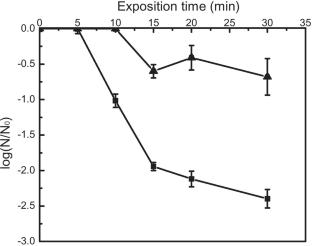
Ultraviolet light C-region (UV-C) has been used for the disinfection of surfaces, water, and foods. Recently, Salmonellosis cases have been associated with the consumption of low moisture products, such as wheat flour and nuts. In this study, peanuts and almonds inoculated with around 107 CFU/g of Salmonella enterica serovar Typhimurium ATCC 14028 were subjected to 2.5–30 min UV-C treatments (254 nm, 10 mW/cm2, 10 cm between food and lamp). No reduction in the bacterium population was observed after 2.5 and 5 min for both nuts. Reductions of 0.68 and 2.39 log-cycles were observed after 30 min of treatment of peanuts and almonds, respectively. Weibull distribution described the inactivation of S. Typhimurium. After 30 min UV-C treatment, the temperature of peanuts and almonds increased 7.3 and 8.0°C, respectively, confirming that UV-C treatment is a non-thermal process. Water activity, color, and peroxides values were not affected by UV-C treatments (p > 0.05). UV-C light under the studied conditions was more effective for the treatment of almonds than peanuts. However, for both nuts, additional treatment conditions should be assessed to reach higher Salmonella inactivation values.
期刊介绍:
Food Engineering Reviews publishes articles encompassing all engineering aspects of today’s scientific food research. The journal focuses on both classic and modern food engineering topics, exploring essential factors such as the health, nutritional, and environmental aspects of food processing. Trends that will drive the discipline over time, from the lab to industrial implementation, are identified and discussed. The scope of topics addressed is broad, including transport phenomena in food processing; food process engineering; physical properties of foods; food nano-science and nano-engineering; food equipment design; food plant design; modeling food processes; microbial inactivation kinetics; preservation technologies; engineering aspects of food packaging; shelf-life, storage and distribution of foods; instrumentation, control and automation in food processing; food engineering, health and nutrition; energy and economic considerations in food engineering; sustainability; and food engineering education.



 京公网安备 11010802042870号
京ICP备2023020795号-1
京公网安备 11010802042870号
京ICP备2023020795号-1

 分享
分享
 求助内容:
求助内容: 应助结果提醒方式:
 扫码关注我们
