{"title":"SPECTRAL STUDIES ON THE ROLE OF IONIZING RADIATION IN COLOR CHANGES OF RADAPPERTIZED BEEF","authors":"A. R. KAMAREI, M. KAREL, E. WIERBICKI","doi":"10.1111/j.1365-2621.1979.tb09996.x","DOIUrl":null,"url":null,"abstract":"<div>\n \n <p>Effects of ionizing radiation on beef pigments were studied by determining the absorption spectra of myoglobin solutions and the reflectance spectra of radiation-sterilized beef slices. Bovine and ovine oxymyoglobin (MbO<sub>2</sub>) and met(ferri)myoglobin (metMb) were extracted, purified, and treated with gamma radiation. Increasing dose and temperature of gamma radiation produced increasing shifts in characteristic peaks and progressive decreases in the Soret bands of these pigments. The total color difference (▵E), computed from tri-stimulus values of reflectance spectra of radiation-sterilized beef, showed similar dependence of color on radiation dose and temperature. Re-irradiation of beef allowed to brown in air caused the unstable red pigment to re-form. The presence of oxygen in the container during radiation-sterilization reduced the red color formation. The results show that ionizing radiation reduces the heme iron of the brown pigment of cooked meat (globin myohemichromogen) to an unstable red pigment (globin myohemochromogen), which, upon exposure to air, reverts to the original ferric (brown) pigment.</p>\n </div>","PeriodicalId":193,"journal":{"name":"Journal of Food Science","volume":"44 1","pages":"25-32"},"PeriodicalIF":3.4000,"publicationDate":"1979-01-01","publicationTypes":"Journal Article","fieldsOfStudy":null,"isOpenAccess":false,"openAccessPdf":"https://sci-hub-pdf.com/10.1111/j.1365-2621.1979.tb09996.x","citationCount":"26","resultStr":null,"platform":"Semanticscholar","paperid":null,"PeriodicalName":"Journal of Food Science","FirstCategoryId":"97","ListUrlMain":"https://onlinelibrary.wiley.com/doi/10.1111/j.1365-2621.1979.tb09996.x","RegionNum":2,"RegionCategory":"农林科学","ArticlePicture":[],"TitleCN":null,"AbstractTextCN":null,"PMCID":null,"EPubDate":"","PubModel":"","JCR":"Q2","JCRName":"FOOD SCIENCE & TECHNOLOGY","Score":null,"Total":0}
引用次数: 26
Abstract
Effects of ionizing radiation on beef pigments were studied by determining the absorption spectra of myoglobin solutions and the reflectance spectra of radiation-sterilized beef slices. Bovine and ovine oxymyoglobin (MbO2) and met(ferri)myoglobin (metMb) were extracted, purified, and treated with gamma radiation. Increasing dose and temperature of gamma radiation produced increasing shifts in characteristic peaks and progressive decreases in the Soret bands of these pigments. The total color difference (▵E), computed from tri-stimulus values of reflectance spectra of radiation-sterilized beef, showed similar dependence of color on radiation dose and temperature. Re-irradiation of beef allowed to brown in air caused the unstable red pigment to re-form. The presence of oxygen in the container during radiation-sterilization reduced the red color formation. The results show that ionizing radiation reduces the heme iron of the brown pigment of cooked meat (globin myohemichromogen) to an unstable red pigment (globin myohemochromogen), which, upon exposure to air, reverts to the original ferric (brown) pigment.
期刊介绍:
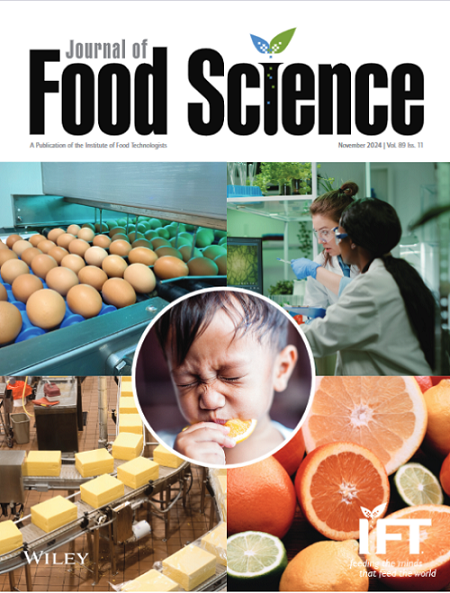
The goal of the Journal of Food Science is to offer scientists, researchers, and other food professionals the opportunity to share knowledge of scientific advancements in the myriad disciplines affecting their work, through a respected peer-reviewed publication. The Journal of Food Science serves as an international forum for vital research and developments in food science.
The range of topics covered in the journal include:
-Concise Reviews and Hypotheses in Food Science
-New Horizons in Food Research
-Integrated Food Science
-Food Chemistry
-Food Engineering, Materials Science, and Nanotechnology
-Food Microbiology and Safety
-Sensory and Consumer Sciences
-Health, Nutrition, and Food
-Toxicology and Chemical Food Safety
The Journal of Food Science publishes peer-reviewed articles that cover all aspects of food science, including safety and nutrition. Reviews should be 15 to 50 typewritten pages (including tables, figures, and references), should provide in-depth coverage of a narrowly defined topic, and should embody careful evaluation (weaknesses, strengths, explanation of discrepancies in results among similar studies) of all pertinent studies, so that insightful interpretations and conclusions can be presented. Hypothesis papers are especially appropriate in pioneering areas of research or important areas that are afflicted by scientific controversy.



 京公网安备 11010802042870号
京ICP备2023020795号-1
京公网安备 11010802042870号
京ICP备2023020795号-1

 分享
分享
 求助内容:
求助内容: 应助结果提醒方式:
 扫码关注我们
