Rama A Vaidya, Sharvari Desai, Panchali Moitra, Sheryl Salis, Shubhada Agashe, Rekha Battalwar, Anushree Mehta, Jagmeet Madan, Soumik Kalita, Shobha A Udipi, Ashok B Vaidya
{"title":"Hyperinsulinemia: an early biomarker of metabolic dysfunction.","authors":"Rama A Vaidya, Sharvari Desai, Panchali Moitra, Sheryl Salis, Shubhada Agashe, Rekha Battalwar, Anushree Mehta, Jagmeet Madan, Soumik Kalita, Shobha A Udipi, Ashok B Vaidya","doi":"10.3389/fcdhc.2023.1159664","DOIUrl":null,"url":null,"abstract":"<p><strong>Introduction: </strong>Hyperinsulinemia in the absence of impaired glucose tolerance and normal HbA1c is considered indicative of pre-diabetes. Very few Indian studies have focused on hyperinsulinemia particularly in young adults. The present study aimed to determine whether hyperinsulinemia may be present despite HbA1c being normal.</p><p><strong>Methods: </strong>This was a cross-sectional study conducted on adolescents and young adults aged 16-25 years living in Mumbai, India. The participants attended various academic institutions and were those who underwent screening as the first step of a clinical trial for studying the efficacy of almond intake in prediabetes.</p><p><strong>Results: </strong>Among this young population (n=1313), 4.2% (n=55) of the participants were found to be prediabetic (ADA criteria) and 19.7% of them had HbA1c levels between 5.7%-6.4%. However, almost, 30.5% had hyperinsulinemia inspite of normal blood glucose levels and normal HbA1c. Among those with HbA1c<5.7 (n=533), 10.5% (n=56) participants had fasting insulin>15 mIU/L and a higher percentage (39.4%, n=260) had stimulated insulin above 80 mIU/L. These participants had higher mean anthropometric markers than those with normal fasting and/or stimulated insulin.</p><p><strong>Conclusion: </strong>Hyperinsulinaemia in the absence of impaired glucose tolerance and normal HbA1c may provide a much earlier indicator of detection for risk of metabolic disease and progression to metabolic syndrome and diabetes mellitus.</p>","PeriodicalId":73075,"journal":{"name":"Frontiers in clinical diabetes and healthcare","volume":"4 ","pages":"1159664"},"PeriodicalIF":2.2000,"publicationDate":"2023-01-01","publicationTypes":"Journal Article","fieldsOfStudy":null,"isOpenAccess":false,"openAccessPdf":"https://www.ncbi.nlm.nih.gov/pmc/articles/PMC10186728/pdf/","citationCount":"2","resultStr":null,"platform":"Semanticscholar","paperid":null,"PeriodicalName":"Frontiers in clinical diabetes and healthcare","FirstCategoryId":"1085","ListUrlMain":"https://doi.org/10.3389/fcdhc.2023.1159664","RegionNum":0,"RegionCategory":null,"ArticlePicture":[],"TitleCN":null,"AbstractTextCN":null,"PMCID":null,"EPubDate":"","PubModel":"","JCR":"","JCRName":"","Score":null,"Total":0}
引用次数: 2
Abstract
Introduction: Hyperinsulinemia in the absence of impaired glucose tolerance and normal HbA1c is considered indicative of pre-diabetes. Very few Indian studies have focused on hyperinsulinemia particularly in young adults. The present study aimed to determine whether hyperinsulinemia may be present despite HbA1c being normal.
Methods: This was a cross-sectional study conducted on adolescents and young adults aged 16-25 years living in Mumbai, India. The participants attended various academic institutions and were those who underwent screening as the first step of a clinical trial for studying the efficacy of almond intake in prediabetes.
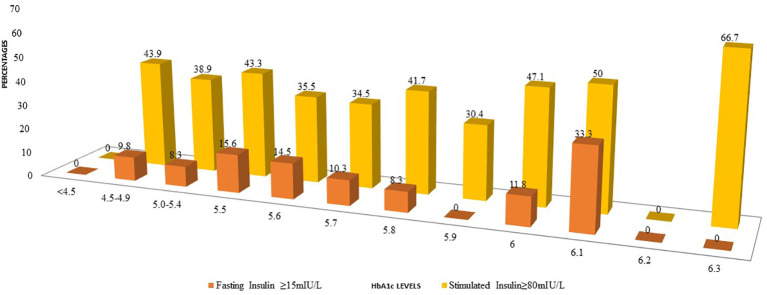
Results: Among this young population (n=1313), 4.2% (n=55) of the participants were found to be prediabetic (ADA criteria) and 19.7% of them had HbA1c levels between 5.7%-6.4%. However, almost, 30.5% had hyperinsulinemia inspite of normal blood glucose levels and normal HbA1c. Among those with HbA1c<5.7 (n=533), 10.5% (n=56) participants had fasting insulin>15 mIU/L and a higher percentage (39.4%, n=260) had stimulated insulin above 80 mIU/L. These participants had higher mean anthropometric markers than those with normal fasting and/or stimulated insulin.
Conclusion: Hyperinsulinaemia in the absence of impaired glucose tolerance and normal HbA1c may provide a much earlier indicator of detection for risk of metabolic disease and progression to metabolic syndrome and diabetes mellitus.



 京公网安备 11010802042870号
京ICP备2023020795号-1
京公网安备 11010802042870号
京ICP备2023020795号-1

 分享
分享

 求助内容:
求助内容: 应助结果提醒方式:
 扫码关注我们
