The Effect of Lieberman Community Return Program on Reducing Positive and Negative Symptoms and Improving Social Skills in Patients with Schizophrenia.
{"title":"The Effect of Lieberman Community Return Program on Reducing Positive and Negative Symptoms and Improving Social Skills in Patients with Schizophrenia.","authors":"Maryam Emami, Gholamreza Kheirabadi, Mona Fallahi","doi":"10.4103/abr.abr_21_21","DOIUrl":null,"url":null,"abstract":"<p><strong>Background: </strong>The aim of this study was to investigate the effect of Lieberman community return program on reducing positive and negative symptoms and improving social skills in people with schizophrenia.</p><p><strong>Materials and methods: </strong>In this clinical trial study, 58 patients with schizophrenia were randomly allocated into two groups of 29. The first group received 16 sessions of Lieberman community return training and the second group received routine care as a control group. All patients were evaluated before intervention and 1 and 3 months after intervention using the Matson Social Skills Questionnaire and Negative and Positive Symptoms Assessment Scale and compared between the two groups.</p><p><strong>Results: </strong>Evaluation of negative symptoms showed that the dimensions of affective flattening, avolition, anhedonia-asociality, attention, and alogia in the intervention group decreased significantly over time (<i>P</i> < 0.05), but no significant difference was seen in the control group. The mean score of positive symptoms such as hallucinations, delusion, inappropriate affect, and formal thinking disorder in the intervention group were decreased significantly (<i>P</i> < 0.05), but no significant difference was seen in the control group. Appropriate social skills and overall skill score were increased significantly in the intervention group over time (<i>P</i> < 0.05).</p><p><strong>Conclusion: </strong>Lieberman community return program is likely to reduce the symptoms of schizophrenia and increase patients' social skills.</p>","PeriodicalId":7225,"journal":{"name":"Advanced Biomedical Research","volume":"12 ","pages":"146"},"PeriodicalIF":0.0000,"publicationDate":"2023-06-28","publicationTypes":"Journal Article","fieldsOfStudy":null,"isOpenAccess":false,"openAccessPdf":"https://ftp.ncbi.nlm.nih.gov/pub/pmc/oa_pdf/d2/b4/ABR-12-146.PMC10410411.pdf","citationCount":"0","resultStr":null,"platform":"Semanticscholar","paperid":null,"PeriodicalName":"Advanced Biomedical Research","FirstCategoryId":"1085","ListUrlMain":"https://doi.org/10.4103/abr.abr_21_21","RegionNum":0,"RegionCategory":null,"ArticlePicture":[],"TitleCN":null,"AbstractTextCN":null,"PMCID":null,"EPubDate":"2023/1/1 0:00:00","PubModel":"eCollection","JCR":"","JCRName":"","Score":null,"Total":0}
引用次数: 0
Abstract
Background: The aim of this study was to investigate the effect of Lieberman community return program on reducing positive and negative symptoms and improving social skills in people with schizophrenia.
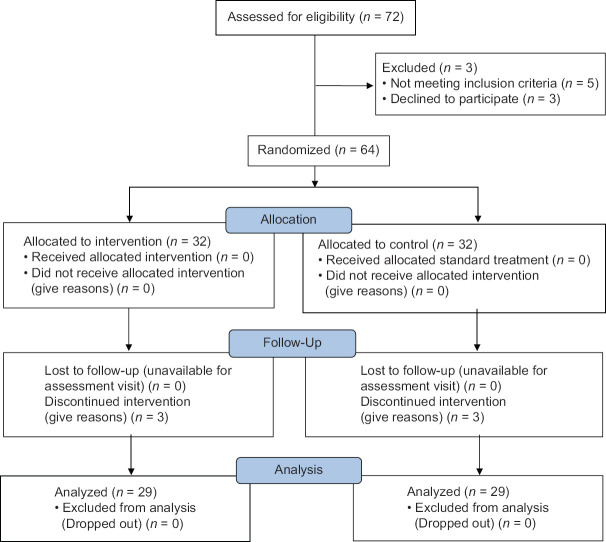
Materials and methods: In this clinical trial study, 58 patients with schizophrenia were randomly allocated into two groups of 29. The first group received 16 sessions of Lieberman community return training and the second group received routine care as a control group. All patients were evaluated before intervention and 1 and 3 months after intervention using the Matson Social Skills Questionnaire and Negative and Positive Symptoms Assessment Scale and compared between the two groups.
Results: Evaluation of negative symptoms showed that the dimensions of affective flattening, avolition, anhedonia-asociality, attention, and alogia in the intervention group decreased significantly over time (P < 0.05), but no significant difference was seen in the control group. The mean score of positive symptoms such as hallucinations, delusion, inappropriate affect, and formal thinking disorder in the intervention group were decreased significantly (P < 0.05), but no significant difference was seen in the control group. Appropriate social skills and overall skill score were increased significantly in the intervention group over time (P < 0.05).
Conclusion: Lieberman community return program is likely to reduce the symptoms of schizophrenia and increase patients' social skills.



 京公网安备 11010802042870号
京ICP备2023020795号-1
京公网安备 11010802042870号
京ICP备2023020795号-1

 分享
分享

 求助内容:
求助内容: 应助结果提醒方式:
 扫码关注我们
