{"title":"这意味着什么?补充者与认识论权威》。","authors":"Rebecca Tollan, Bilge Palaz","doi":"10.1162/opmi_a_00135","DOIUrl":null,"url":null,"abstract":"<p><p>A core goal of research in language is to understand the factors that guide choice of linguistic form where more than one option is syntactically well-formed. We discuss one case of optionality that has generated longstanding discussion: the choice of either using or dropping the English complementizer <i>that</i> in sentences like <i>I think (that) the cat followed the dog</i>. Existing psycholinguistic analyses tie <i>that</i>-usage to production pressures associated with sentence planning (Ferreira & Dell, 2000), avoidance of ambiguity (Hawkins, 2004), and relative information density (Jaeger, 2010). Building on observations from cross-linguistic fieldwork, we present a novel proposal in which English <i>that</i> can serve to mark a speaker's \"epistemic authority\" over the information packaged within the embedded clause; that is, it indicates that the speaker has more knowledge of the embedded proposition compared with their addressee and thus has a perspective that they believe their addressee doesn't share. Testing this proposal with a forced-choice task and a series of corpus surveys, we find that English <i>that</i> is keyed to the use of embedded speaker (first-person) subject pronouns and occurs in sentences containing newsworthy information. Our account of <i>that</i>-optionality takes into account why <i>that</i> is associated with both (i) a dense information signal and (ii) semantic-pragmatic content, as well as extending to cases of non-optionality in subject/sentence-initial clauses (e.g., *<i>(That) the cat is following the dog, I already know</i>) and fragment answers (e.g., <i>What do you already know?</i> *<i>(That) the cat is following the dog</i>), where <i>that</i> is required.</p>","PeriodicalId":32558,"journal":{"name":"Open Mind","volume":"8 ","pages":"366-394"},"PeriodicalIF":0.0000,"publicationDate":"2024-03-26","publicationTypes":"Journal Article","fieldsOfStudy":null,"isOpenAccess":false,"openAccessPdf":"https://www.ncbi.nlm.nih.gov/pmc/articles/PMC10990574/pdf/","citationCount":"0","resultStr":"{\"title\":\"What Does <i>That</i> Mean? Complementizers and Epistemic Authority.\",\"authors\":\"Rebecca Tollan, Bilge Palaz\",\"doi\":\"10.1162/opmi_a_00135\",\"DOIUrl\":null,\"url\":null,\"abstract\":\"<p><p>A core goal of research in language is to understand the factors that guide choice of linguistic form where more than one option is syntactically well-formed. We discuss one case of optionality that has generated longstanding discussion: the choice of either using or dropping the English complementizer <i>that</i> in sentences like <i>I think (that) the cat followed the dog</i>. Existing psycholinguistic analyses tie <i>that</i>-usage to production pressures associated with sentence planning (Ferreira & Dell, 2000), avoidance of ambiguity (Hawkins, 2004), and relative information density (Jaeger, 2010). Building on observations from cross-linguistic fieldwork, we present a novel proposal in which English <i>that</i> can serve to mark a speaker's \\\"epistemic authority\\\" over the information packaged within the embedded clause; that is, it indicates that the speaker has more knowledge of the embedded proposition compared with their addressee and thus has a perspective that they believe their addressee doesn't share. Testing this proposal with a forced-choice task and a series of corpus surveys, we find that English <i>that</i> is keyed to the use of embedded speaker (first-person) subject pronouns and occurs in sentences containing newsworthy information. Our account of <i>that</i>-optionality takes into account why <i>that</i> is associated with both (i) a dense information signal and (ii) semantic-pragmatic content, as well as extending to cases of non-optionality in subject/sentence-initial clauses (e.g., *<i>(That) the cat is following the dog, I already know</i>) and fragment answers (e.g., <i>What do you already know?</i> *<i>(That) the cat is following the dog</i>), where <i>that</i> is required.</p>\",\"PeriodicalId\":32558,\"journal\":{\"name\":\"Open Mind\",\"volume\":\"8 \",\"pages\":\"366-394\"},\"PeriodicalIF\":0.0000,\"publicationDate\":\"2024-03-26\",\"publicationTypes\":\"Journal Article\",\"fieldsOfStudy\":null,\"isOpenAccess\":false,\"openAccessPdf\":\"https://www.ncbi.nlm.nih.gov/pmc/articles/PMC10990574/pdf/\",\"citationCount\":\"0\",\"resultStr\":null,\"platform\":\"Semanticscholar\",\"paperid\":null,\"PeriodicalName\":\"Open Mind\",\"FirstCategoryId\":\"1085\",\"ListUrlMain\":\"https://doi.org/10.1162/opmi_a_00135\",\"RegionNum\":0,\"RegionCategory\":null,\"ArticlePicture\":[],\"TitleCN\":null,\"AbstractTextCN\":null,\"PMCID\":null,\"EPubDate\":\"2024/1/1 0:00:00\",\"PubModel\":\"eCollection\",\"JCR\":\"Q1\",\"JCRName\":\"Social Sciences\",\"Score\":null,\"Total\":0}","platform":"Semanticscholar","paperid":null,"PeriodicalName":"Open Mind","FirstCategoryId":"1085","ListUrlMain":"https://doi.org/10.1162/opmi_a_00135","RegionNum":0,"RegionCategory":null,"ArticlePicture":[],"TitleCN":null,"AbstractTextCN":null,"PMCID":null,"EPubDate":"2024/1/1 0:00:00","PubModel":"eCollection","JCR":"Q1","JCRName":"Social Sciences","Score":null,"Total":0}
引用次数: 0
摘要
语言研究的一个核心目标是了解在句法上有不止一种选择的情况下,指导语言形式选择的因素。我们将讨论一个引起长期讨论的选择性案例:在 I think (that) the cat followed the dog 这样的句子中选择使用或放弃英语补语 that。现有的心理语言学分析将that的使用与句子规划(Ferreira & Dell, 2000)、避免歧义(Hawkins, 2004)和相对信息密度(Jaeger, 2010)相关的生产压力联系起来。基于跨语言实地调查的观察结果,我们提出了一个新颖的建议,即英语中的 "that "可以用来标记说话者对嵌入式分句中的信息的 "认识权威";也就是说,它表明说话者比其收信人对嵌入式命题有更多的了解,因此拥有他们认为收信人所不具备的观点。通过强迫选择任务和一系列语料库调查对这一提议进行检验,我们发现,英语中的that-optionality与嵌入式说话人(第一人称)主语代词的使用有关,并且出现在包含有新闻价值信息的句子中。我们对that-optionality的解释考虑到了为什么that与(i)密集的信息信号和(ii)语义-语用内容相关联,并扩展到主语/句子首句中的非optionality情况(例如:*(That) the cat is following the dog, I already know)和片段回答(例如:What do you already know?*(That) the cat is following the dog)中的主语/句首句和片段回答(如:What do you already know?
What Does That Mean? Complementizers and Epistemic Authority.
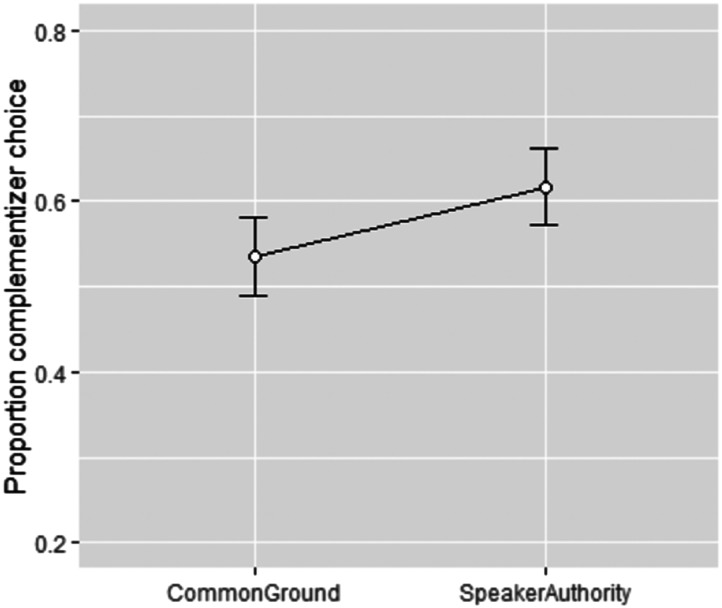
A core goal of research in language is to understand the factors that guide choice of linguistic form where more than one option is syntactically well-formed. We discuss one case of optionality that has generated longstanding discussion: the choice of either using or dropping the English complementizer that in sentences like I think (that) the cat followed the dog. Existing psycholinguistic analyses tie that-usage to production pressures associated with sentence planning (Ferreira & Dell, 2000), avoidance of ambiguity (Hawkins, 2004), and relative information density (Jaeger, 2010). Building on observations from cross-linguistic fieldwork, we present a novel proposal in which English that can serve to mark a speaker's "epistemic authority" over the information packaged within the embedded clause; that is, it indicates that the speaker has more knowledge of the embedded proposition compared with their addressee and thus has a perspective that they believe their addressee doesn't share. Testing this proposal with a forced-choice task and a series of corpus surveys, we find that English that is keyed to the use of embedded speaker (first-person) subject pronouns and occurs in sentences containing newsworthy information. Our account of that-optionality takes into account why that is associated with both (i) a dense information signal and (ii) semantic-pragmatic content, as well as extending to cases of non-optionality in subject/sentence-initial clauses (e.g., *(That) the cat is following the dog, I already know) and fragment answers (e.g., What do you already know? *(That) the cat is following the dog), where that is required.






 京公网安备 11010802042870号
京ICP备2023020795号-1
京公网安备 11010802042870号
京ICP备2023020795号-1

 分享
分享
 求助内容:
求助内容: 应助结果提醒方式:
 扫码关注我们
