Zeyi Wu, Mengyao Su, Xiangyu Song, Denghua Li, Xinyuan Li, Jiajia Liu* and Jiatao Zhang*,
{"title":"在紫外辐照下对二氧化钛纳米片进行简易表面工程改造以增强异丙醇传感能力","authors":"Zeyi Wu, Mengyao Su, Xiangyu Song, Denghua Li, Xinyuan Li, Jiajia Liu* and Jiatao Zhang*, ","doi":"10.1021/acsaelm.4c00444","DOIUrl":null,"url":null,"abstract":"<p >Surface termination and defects of metal oxide semiconductors are crucial in the process of gas adsorption–desorption and signal transduction, thereby determining their sensing performance. Herein, a facile solvent-assisted surface engineering strategy was demonstrated to synthesize anatase TiO<sub>2</sub> nanosheets (TNS) for an ultraviolet (UV) light-activated isopropanol (IPA) gas sensor. Surface-fluorinated TiO<sub>2</sub> nanosheets (F-TNS) were first synthesized by the hydrofluoric acid-assisted hydrothermal method and followed by hydrothermally treating in Na<sub>2</sub>S solutions with different concentrations. The effect of the progressive removal of fluorides was discussed in detail based on X-ray photoelectron spectroscopy (XPS), diffuse reflectance spectroscopy (DRS), electrochemical impedance spectroscopy (EIS), and in situ Fourier transform infrared (FTIR) spectroscopy analyses. Compared with F-TNS, the chemiresistive sensor based on the TNS with a trace amount of fluorine exhibited a 324% increase in the sensitivity to 50 ppm of isopropanol at 50 °C under UV irradiation (λ = 365 nm, 30 mW/cm<sup>2</sup>), while it exhibited a 45% decrease in the recovery time. The enhanced isopropanol sensing performance could be attributed to the high surface area, rational surface terminations, oxygen vacancies, and UV photoexcited charge carriers, which further modulate the surface reaction and charge transfer. These findings offer a facile strategy for the rational design of oxide-based sensing materials, which help in understanding the function of surface terminations and defects in gas sensing.</p>","PeriodicalId":3,"journal":{"name":"ACS Applied Electronic Materials","volume":"6 6","pages":"4356–4368"},"PeriodicalIF":4.7000,"publicationDate":"2024-05-23","publicationTypes":"Journal Article","fieldsOfStudy":null,"isOpenAccess":false,"openAccessPdf":"","citationCount":"0","resultStr":"{\"title\":\"Facile Surface Engineering of TiO2 Nanosheets for Enhanced Isopropanol Sensing under UV Irradiation\",\"authors\":\"Zeyi Wu, Mengyao Su, Xiangyu Song, Denghua Li, Xinyuan Li, Jiajia Liu* and Jiatao Zhang*, \",\"doi\":\"10.1021/acsaelm.4c00444\",\"DOIUrl\":null,\"url\":null,\"abstract\":\"<p >Surface termination and defects of metal oxide semiconductors are crucial in the process of gas adsorption–desorption and signal transduction, thereby determining their sensing performance. Herein, a facile solvent-assisted surface engineering strategy was demonstrated to synthesize anatase TiO<sub>2</sub> nanosheets (TNS) for an ultraviolet (UV) light-activated isopropanol (IPA) gas sensor. Surface-fluorinated TiO<sub>2</sub> nanosheets (F-TNS) were first synthesized by the hydrofluoric acid-assisted hydrothermal method and followed by hydrothermally treating in Na<sub>2</sub>S solutions with different concentrations. The effect of the progressive removal of fluorides was discussed in detail based on X-ray photoelectron spectroscopy (XPS), diffuse reflectance spectroscopy (DRS), electrochemical impedance spectroscopy (EIS), and in situ Fourier transform infrared (FTIR) spectroscopy analyses. Compared with F-TNS, the chemiresistive sensor based on the TNS with a trace amount of fluorine exhibited a 324% increase in the sensitivity to 50 ppm of isopropanol at 50 °C under UV irradiation (λ = 365 nm, 30 mW/cm<sup>2</sup>), while it exhibited a 45% decrease in the recovery time. The enhanced isopropanol sensing performance could be attributed to the high surface area, rational surface terminations, oxygen vacancies, and UV photoexcited charge carriers, which further modulate the surface reaction and charge transfer. These findings offer a facile strategy for the rational design of oxide-based sensing materials, which help in understanding the function of surface terminations and defects in gas sensing.</p>\",\"PeriodicalId\":3,\"journal\":{\"name\":\"ACS Applied Electronic Materials\",\"volume\":\"6 6\",\"pages\":\"4356–4368\"},\"PeriodicalIF\":4.7000,\"publicationDate\":\"2024-05-23\",\"publicationTypes\":\"Journal Article\",\"fieldsOfStudy\":null,\"isOpenAccess\":false,\"openAccessPdf\":\"\",\"citationCount\":\"0\",\"resultStr\":null,\"platform\":\"Semanticscholar\",\"paperid\":null,\"PeriodicalName\":\"ACS Applied Electronic Materials\",\"FirstCategoryId\":\"88\",\"ListUrlMain\":\"https://pubs.acs.org/doi/10.1021/acsaelm.4c00444\",\"RegionNum\":3,\"RegionCategory\":\"材料科学\",\"ArticlePicture\":[],\"TitleCN\":null,\"AbstractTextCN\":null,\"PMCID\":null,\"EPubDate\":\"\",\"PubModel\":\"\",\"JCR\":\"Q1\",\"JCRName\":\"ENGINEERING, ELECTRICAL & ELECTRONIC\",\"Score\":null,\"Total\":0}","platform":"Semanticscholar","paperid":null,"PeriodicalName":"ACS Applied Electronic Materials","FirstCategoryId":"88","ListUrlMain":"https://pubs.acs.org/doi/10.1021/acsaelm.4c00444","RegionNum":3,"RegionCategory":"材料科学","ArticlePicture":[],"TitleCN":null,"AbstractTextCN":null,"PMCID":null,"EPubDate":"","PubModel":"","JCR":"Q1","JCRName":"ENGINEERING, ELECTRICAL & ELECTRONIC","Score":null,"Total":0}
Facile Surface Engineering of TiO2 Nanosheets for Enhanced Isopropanol Sensing under UV Irradiation
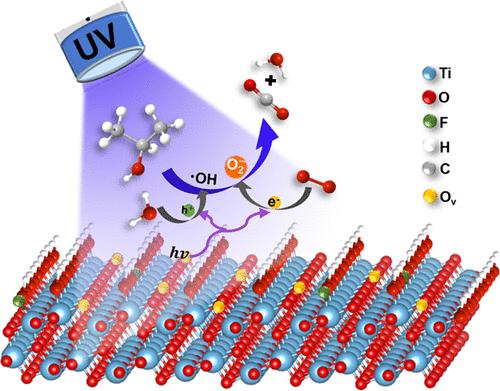
Surface termination and defects of metal oxide semiconductors are crucial in the process of gas adsorption–desorption and signal transduction, thereby determining their sensing performance. Herein, a facile solvent-assisted surface engineering strategy was demonstrated to synthesize anatase TiO2 nanosheets (TNS) for an ultraviolet (UV) light-activated isopropanol (IPA) gas sensor. Surface-fluorinated TiO2 nanosheets (F-TNS) were first synthesized by the hydrofluoric acid-assisted hydrothermal method and followed by hydrothermally treating in Na2S solutions with different concentrations. The effect of the progressive removal of fluorides was discussed in detail based on X-ray photoelectron spectroscopy (XPS), diffuse reflectance spectroscopy (DRS), electrochemical impedance spectroscopy (EIS), and in situ Fourier transform infrared (FTIR) spectroscopy analyses. Compared with F-TNS, the chemiresistive sensor based on the TNS with a trace amount of fluorine exhibited a 324% increase in the sensitivity to 50 ppm of isopropanol at 50 °C under UV irradiation (λ = 365 nm, 30 mW/cm2), while it exhibited a 45% decrease in the recovery time. The enhanced isopropanol sensing performance could be attributed to the high surface area, rational surface terminations, oxygen vacancies, and UV photoexcited charge carriers, which further modulate the surface reaction and charge transfer. These findings offer a facile strategy for the rational design of oxide-based sensing materials, which help in understanding the function of surface terminations and defects in gas sensing.
期刊介绍:
ACS Applied Electronic Materials is an interdisciplinary journal publishing original research covering all aspects of electronic materials. The journal is devoted to reports of new and original experimental and theoretical research of an applied nature that integrate knowledge in the areas of materials science, engineering, optics, physics, and chemistry into important applications of electronic materials. Sample research topics that span the journal's scope are inorganic, organic, ionic and polymeric materials with properties that include conducting, semiconducting, superconducting, insulating, dielectric, magnetic, optoelectronic, piezoelectric, ferroelectric and thermoelectric.
Indexed/Abstracted:
Web of Science SCIE
Scopus
CAS
INSPEC
Portico






 京公网安备 11010802042870号
京ICP备2023020795号-1
京公网安备 11010802042870号
京ICP备2023020795号-1

 分享
分享
 求助内容:
求助内容: 应助结果提醒方式:
 扫码关注我们
