Xiaozhe Cheng, Zhitao Qin, Hongen Guo, Zhitao Dou, Hong Lian*, Jianfeng Fan, Yongquan Qu and Qingchen Dong*,
{"title":"基于金属聚合物晶体管的人工光电突触用于神经形态计算","authors":"Xiaozhe Cheng, Zhitao Qin, Hongen Guo, Zhitao Dou, Hong Lian*, Jianfeng Fan, Yongquan Qu and Qingchen Dong*, ","doi":"10.1021/acsaelm.4c00427","DOIUrl":null,"url":null,"abstract":"<p >Mimicking the human brain to achieve neuromorphic computing holds promise in the field of artificial intelligence (AI). Optoelectronic synapses are regarded as the crucial foundation stone in neuromorphic computing due to their capability to intelligently process optoelectronic input signals. Herein, two donor–acceptor (D–A)-type metallopolymers, <b>P-Cu</b> and <b>P-Zn</b>, containing porphyrin moieties are designed and synthesized, which are utilized as a resistive switching layer for preparation of memristors. The resulting memristors exhibit significantly enhanced electrical characteristics, displaying a high ON/OFF ratio, a low threshold voltage (<i>V</i><sub>th</sub>), and superior cycle-to-cycle reproducibility. This enhancement is attributed to the formation and dissociation of charge transfer (CT) states induced by inserted metal ions. Importantly, the <b>P-Cu</b>-based memristor demonstrates the capability to co-modulate optoelectronic signals, effectively emulating versatile synaptic functions of the nervous system. These functions include excitatory postsynaptic current (EPSC), paired-pulse facilitation (PPF), short-term plasticity (STP), long-term plasticity (LTP), transition from short-term memory (STM) to long-term memory (LTM), and learning-experience behavior. Moreover, multiple Boolean logical functions were successfully implemented using the paired stimuli of electrical pulses. The neuromorphic computing function was also proven through pattern recognition, achieving a recognition rate of up to 86.08% for handwritten digits. This study offers a potent approach for developing multifunctional artificial synaptic devices and artificial neural network platforms and opens up the innovative application of metallopolymers in the fields of optoelectronics and AI.</p>","PeriodicalId":3,"journal":{"name":"ACS Applied Electronic Materials","volume":"6 6","pages":"4345–4355"},"PeriodicalIF":4.7000,"publicationDate":"2024-05-22","publicationTypes":"Journal Article","fieldsOfStudy":null,"isOpenAccess":false,"openAccessPdf":"","citationCount":"0","resultStr":"{\"title\":\"Metallopolymeric Memristor Based Artificial Optoelectronic Synapse for Neuromorphic Computing\",\"authors\":\"Xiaozhe Cheng, Zhitao Qin, Hongen Guo, Zhitao Dou, Hong Lian*, Jianfeng Fan, Yongquan Qu and Qingchen Dong*, \",\"doi\":\"10.1021/acsaelm.4c00427\",\"DOIUrl\":null,\"url\":null,\"abstract\":\"<p >Mimicking the human brain to achieve neuromorphic computing holds promise in the field of artificial intelligence (AI). Optoelectronic synapses are regarded as the crucial foundation stone in neuromorphic computing due to their capability to intelligently process optoelectronic input signals. Herein, two donor–acceptor (D–A)-type metallopolymers, <b>P-Cu</b> and <b>P-Zn</b>, containing porphyrin moieties are designed and synthesized, which are utilized as a resistive switching layer for preparation of memristors. The resulting memristors exhibit significantly enhanced electrical characteristics, displaying a high ON/OFF ratio, a low threshold voltage (<i>V</i><sub>th</sub>), and superior cycle-to-cycle reproducibility. This enhancement is attributed to the formation and dissociation of charge transfer (CT) states induced by inserted metal ions. Importantly, the <b>P-Cu</b>-based memristor demonstrates the capability to co-modulate optoelectronic signals, effectively emulating versatile synaptic functions of the nervous system. These functions include excitatory postsynaptic current (EPSC), paired-pulse facilitation (PPF), short-term plasticity (STP), long-term plasticity (LTP), transition from short-term memory (STM) to long-term memory (LTM), and learning-experience behavior. Moreover, multiple Boolean logical functions were successfully implemented using the paired stimuli of electrical pulses. The neuromorphic computing function was also proven through pattern recognition, achieving a recognition rate of up to 86.08% for handwritten digits. This study offers a potent approach for developing multifunctional artificial synaptic devices and artificial neural network platforms and opens up the innovative application of metallopolymers in the fields of optoelectronics and AI.</p>\",\"PeriodicalId\":3,\"journal\":{\"name\":\"ACS Applied Electronic Materials\",\"volume\":\"6 6\",\"pages\":\"4345–4355\"},\"PeriodicalIF\":4.7000,\"publicationDate\":\"2024-05-22\",\"publicationTypes\":\"Journal Article\",\"fieldsOfStudy\":null,\"isOpenAccess\":false,\"openAccessPdf\":\"\",\"citationCount\":\"0\",\"resultStr\":null,\"platform\":\"Semanticscholar\",\"paperid\":null,\"PeriodicalName\":\"ACS Applied Electronic Materials\",\"FirstCategoryId\":\"88\",\"ListUrlMain\":\"https://pubs.acs.org/doi/10.1021/acsaelm.4c00427\",\"RegionNum\":3,\"RegionCategory\":\"材料科学\",\"ArticlePicture\":[],\"TitleCN\":null,\"AbstractTextCN\":null,\"PMCID\":null,\"EPubDate\":\"\",\"PubModel\":\"\",\"JCR\":\"Q1\",\"JCRName\":\"ENGINEERING, ELECTRICAL & ELECTRONIC\",\"Score\":null,\"Total\":0}","platform":"Semanticscholar","paperid":null,"PeriodicalName":"ACS Applied Electronic Materials","FirstCategoryId":"88","ListUrlMain":"https://pubs.acs.org/doi/10.1021/acsaelm.4c00427","RegionNum":3,"RegionCategory":"材料科学","ArticlePicture":[],"TitleCN":null,"AbstractTextCN":null,"PMCID":null,"EPubDate":"","PubModel":"","JCR":"Q1","JCRName":"ENGINEERING, ELECTRICAL & ELECTRONIC","Score":null,"Total":0}
Metallopolymeric Memristor Based Artificial Optoelectronic Synapse for Neuromorphic Computing
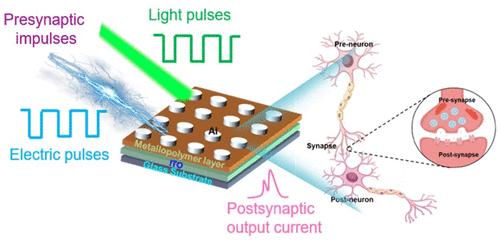
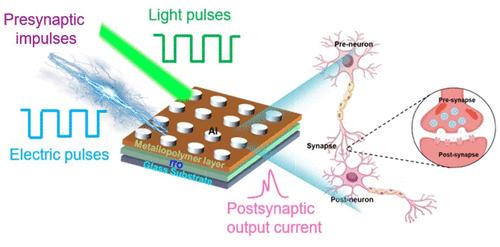
Mimicking the human brain to achieve neuromorphic computing holds promise in the field of artificial intelligence (AI). Optoelectronic synapses are regarded as the crucial foundation stone in neuromorphic computing due to their capability to intelligently process optoelectronic input signals. Herein, two donor–acceptor (D–A)-type metallopolymers, P-Cu and P-Zn, containing porphyrin moieties are designed and synthesized, which are utilized as a resistive switching layer for preparation of memristors. The resulting memristors exhibit significantly enhanced electrical characteristics, displaying a high ON/OFF ratio, a low threshold voltage (Vth), and superior cycle-to-cycle reproducibility. This enhancement is attributed to the formation and dissociation of charge transfer (CT) states induced by inserted metal ions. Importantly, the P-Cu-based memristor demonstrates the capability to co-modulate optoelectronic signals, effectively emulating versatile synaptic functions of the nervous system. These functions include excitatory postsynaptic current (EPSC), paired-pulse facilitation (PPF), short-term plasticity (STP), long-term plasticity (LTP), transition from short-term memory (STM) to long-term memory (LTM), and learning-experience behavior. Moreover, multiple Boolean logical functions were successfully implemented using the paired stimuli of electrical pulses. The neuromorphic computing function was also proven through pattern recognition, achieving a recognition rate of up to 86.08% for handwritten digits. This study offers a potent approach for developing multifunctional artificial synaptic devices and artificial neural network platforms and opens up the innovative application of metallopolymers in the fields of optoelectronics and AI.
期刊介绍:
ACS Applied Electronic Materials is an interdisciplinary journal publishing original research covering all aspects of electronic materials. The journal is devoted to reports of new and original experimental and theoretical research of an applied nature that integrate knowledge in the areas of materials science, engineering, optics, physics, and chemistry into important applications of electronic materials. Sample research topics that span the journal's scope are inorganic, organic, ionic and polymeric materials with properties that include conducting, semiconducting, superconducting, insulating, dielectric, magnetic, optoelectronic, piezoelectric, ferroelectric and thermoelectric.
Indexed/Abstracted:
Web of Science SCIE
Scopus
CAS
INSPEC
Portico





 京公网安备 11010802042870号
京ICP备2023020795号-1
京公网安备 11010802042870号
京ICP备2023020795号-1

 分享
分享
 求助内容:
求助内容: 应助结果提醒方式:
 扫码关注我们
