Huafeng Liu , Taiki Nakata , Chao Xu , Guangze Tang , Danyang Li , Xiaojun Wang , Guisong Wang , Shigeharu Kamado , Lin Geng
{"title":"La 和 Ce 对挤压成型 Mg-Mn-RE 合金的微观结构、热导率和强度协同作用的影响","authors":"Huafeng Liu , Taiki Nakata , Chao Xu , Guangze Tang , Danyang Li , Xiaojun Wang , Guisong Wang , Shigeharu Kamado , Lin Geng","doi":"10.1016/j.jma.2024.05.022","DOIUrl":null,"url":null,"abstract":"<div><div>High thermal conductivity and high strength Mg-1.5Mn-2.5Ce alloy with a tensile yield strength of 387.0 MPa, ultimate tensile strength of 395.8 MPa, and thermal conductivity of 142.1 W/(m·K) was successfully fabricated via hot extrusion. The effects of La and Ce additions on the microstructure, thermal conductivity, and mechanical properties of the Mg-1.5Mn alloy were investigated. The results indicated that both the as-extruded Mg-1.5Mn-2.5La and Mg-1.5Mn-2.5Ce alloys exhibited a bimodal grain structure, with dynamically precipitated nano-scale α-Mn phases. In comparison with La, the addition of Ce enhanced the dynamic precipitation more effectively during hot extrusion, while its influence on promoting the dynamic recrystallization was relatively weaker. The high tensile strength obtained in the as-extruded Mg-1.5Mn-2.5RE alloys can be attributed to the combined influence of the bimodal grain structure (with fine dynamic recrystallized (DRXed) grain size and high proportion of un-dynamic recrystallized (unDRXed) grains), dense nano-scale precipitates, and broken Mg<sub>12</sub>RE phases, while the remarkable thermal conductivity was due to the precipitation of Mn-rich phases from the Mg matrix.</div></div>","PeriodicalId":16214,"journal":{"name":"Journal of Magnesium and Alloys","volume":"13 2","pages":"Pages 654-667"},"PeriodicalIF":15.8000,"publicationDate":"2025-02-01","publicationTypes":"Journal Article","fieldsOfStudy":null,"isOpenAccess":false,"openAccessPdf":"","citationCount":"0","resultStr":"{\"title\":\"Effects of La and Ce on the microstructure, thermal conductivity and strength synergy of the as-extruded Mg-Mn-RE alloys\",\"authors\":\"Huafeng Liu , Taiki Nakata , Chao Xu , Guangze Tang , Danyang Li , Xiaojun Wang , Guisong Wang , Shigeharu Kamado , Lin Geng\",\"doi\":\"10.1016/j.jma.2024.05.022\",\"DOIUrl\":null,\"url\":null,\"abstract\":\"<div><div>High thermal conductivity and high strength Mg-1.5Mn-2.5Ce alloy with a tensile yield strength of 387.0 MPa, ultimate tensile strength of 395.8 MPa, and thermal conductivity of 142.1 W/(m·K) was successfully fabricated via hot extrusion. The effects of La and Ce additions on the microstructure, thermal conductivity, and mechanical properties of the Mg-1.5Mn alloy were investigated. The results indicated that both the as-extruded Mg-1.5Mn-2.5La and Mg-1.5Mn-2.5Ce alloys exhibited a bimodal grain structure, with dynamically precipitated nano-scale α-Mn phases. In comparison with La, the addition of Ce enhanced the dynamic precipitation more effectively during hot extrusion, while its influence on promoting the dynamic recrystallization was relatively weaker. The high tensile strength obtained in the as-extruded Mg-1.5Mn-2.5RE alloys can be attributed to the combined influence of the bimodal grain structure (with fine dynamic recrystallized (DRXed) grain size and high proportion of un-dynamic recrystallized (unDRXed) grains), dense nano-scale precipitates, and broken Mg<sub>12</sub>RE phases, while the remarkable thermal conductivity was due to the precipitation of Mn-rich phases from the Mg matrix.</div></div>\",\"PeriodicalId\":16214,\"journal\":{\"name\":\"Journal of Magnesium and Alloys\",\"volume\":\"13 2\",\"pages\":\"Pages 654-667\"},\"PeriodicalIF\":15.8000,\"publicationDate\":\"2025-02-01\",\"publicationTypes\":\"Journal Article\",\"fieldsOfStudy\":null,\"isOpenAccess\":false,\"openAccessPdf\":\"\",\"citationCount\":\"0\",\"resultStr\":null,\"platform\":\"Semanticscholar\",\"paperid\":null,\"PeriodicalName\":\"Journal of Magnesium and Alloys\",\"FirstCategoryId\":\"88\",\"ListUrlMain\":\"https://www.sciencedirect.com/science/article/pii/S2213956724001786\",\"RegionNum\":1,\"RegionCategory\":\"材料科学\",\"ArticlePicture\":[],\"TitleCN\":null,\"AbstractTextCN\":null,\"PMCID\":null,\"EPubDate\":\"2024/6/4 0:00:00\",\"PubModel\":\"Epub\",\"JCR\":\"Q1\",\"JCRName\":\"METALLURGY & METALLURGICAL ENGINEERING\",\"Score\":null,\"Total\":0}","platform":"Semanticscholar","paperid":null,"PeriodicalName":"Journal of Magnesium and Alloys","FirstCategoryId":"88","ListUrlMain":"https://www.sciencedirect.com/science/article/pii/S2213956724001786","RegionNum":1,"RegionCategory":"材料科学","ArticlePicture":[],"TitleCN":null,"AbstractTextCN":null,"PMCID":null,"EPubDate":"2024/6/4 0:00:00","PubModel":"Epub","JCR":"Q1","JCRName":"METALLURGY & METALLURGICAL ENGINEERING","Score":null,"Total":0}
Effects of La and Ce on the microstructure, thermal conductivity and strength synergy of the as-extruded Mg-Mn-RE alloys
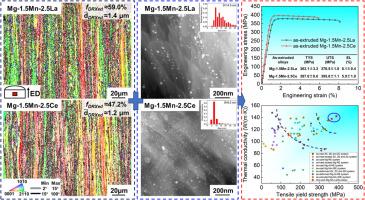
High thermal conductivity and high strength Mg-1.5Mn-2.5Ce alloy with a tensile yield strength of 387.0 MPa, ultimate tensile strength of 395.8 MPa, and thermal conductivity of 142.1 W/(m·K) was successfully fabricated via hot extrusion. The effects of La and Ce additions on the microstructure, thermal conductivity, and mechanical properties of the Mg-1.5Mn alloy were investigated. The results indicated that both the as-extruded Mg-1.5Mn-2.5La and Mg-1.5Mn-2.5Ce alloys exhibited a bimodal grain structure, with dynamically precipitated nano-scale α-Mn phases. In comparison with La, the addition of Ce enhanced the dynamic precipitation more effectively during hot extrusion, while its influence on promoting the dynamic recrystallization was relatively weaker. The high tensile strength obtained in the as-extruded Mg-1.5Mn-2.5RE alloys can be attributed to the combined influence of the bimodal grain structure (with fine dynamic recrystallized (DRXed) grain size and high proportion of un-dynamic recrystallized (unDRXed) grains), dense nano-scale precipitates, and broken Mg12RE phases, while the remarkable thermal conductivity was due to the precipitation of Mn-rich phases from the Mg matrix.
期刊介绍:
The Journal of Magnesium and Alloys serves as a global platform for both theoretical and experimental studies in magnesium science and engineering. It welcomes submissions investigating various scientific and engineering factors impacting the metallurgy, processing, microstructure, properties, and applications of magnesium and alloys. The journal covers all aspects of magnesium and alloy research, including raw materials, alloy casting, extrusion and deformation, corrosion and surface treatment, joining and machining, simulation and modeling, microstructure evolution and mechanical properties, new alloy development, magnesium-based composites, bio-materials and energy materials, applications, and recycling.




 京公网安备 11010802042870号
京ICP备2023020795号-1
京公网安备 11010802042870号
京ICP备2023020795号-1

 分享
分享
 求助内容:
求助内容: 应助结果提醒方式:
 扫码关注我们
