Yaru Geng , Ruiqing Li , Tingting Zhu , Xinling Li , Qianwen Guan , Huang Ye , Peng Wang , Junlin Li , Junhua Luo
{"title":"甲脒插层拓宽交替阳离子互层混合包晶石的光致发光范围","authors":"Yaru Geng , Ruiqing Li , Tingting Zhu , Xinling Li , Qianwen Guan , Huang Ye , Peng Wang , Junlin Li , Junhua Luo","doi":"10.1016/j.cclet.2024.110216","DOIUrl":null,"url":null,"abstract":"<div><div>Two-dimensional (2D) organic-inorganic hybrid perovskites (OIHPs) have been developed as promising candidates for photodetection, owing to their excellent semiconducting features and structural tunability. However, as an important parameter for photodetection, the photoresponsive range of 2D OIHPs is usually modulated by finite metal-halide combinations, constraining their further development. The emerging aromatic amine-based alternating-cations-interlayered (A-ACI) hybrid perovskites that exhibit excellent charge transport and additional interlayered structural designability, provide an extra solution for achieving ideal photoresponsive range. Herein, for the first time, the photoresponsive range is successfully broadened in A-ACI hybrid perovskites (NMA)<sub>4</sub>(FA)<sub>2</sub>Pb<sub>3</sub>Br<sub>12</sub> (<strong>2</strong>) remolding from (NMA)<sub>4</sub>(MA)<sub>2</sub>Pb<sub>3</sub>Br<sub>12</sub> (<strong>1</strong>) (NMA = <em>N</em>-methylbenzylaminium, FA = formamidinium and MA = methylammonium). Particularly, <strong>1</strong> and <strong>2</strong> adopt an unprecedented configuration that NMA and MA/FA are alternately arranged in the interlayer in a 4:2 manner. Importantly, <strong>2</strong> exhibits a narrower bandgap than <strong>1</strong>, which can be ascribed to the low-lying conduct band composed of intercalation FA π* orbitals. Meanwhile, <strong>2</strong> possesses a shorter interlayer distance and flatter inorganic skeleton, synergistically facilitating the wider photo-absorption range and further endowing a broadening photoresponsive range (70 nm). This research not only enriches the perovskite family but also provides insights into structure-property relationships.</div></div>","PeriodicalId":10088,"journal":{"name":"Chinese Chemical Letters","volume":"36 8","pages":"Article 110216"},"PeriodicalIF":8.9000,"publicationDate":"2025-08-01","publicationTypes":"Journal Article","fieldsOfStudy":null,"isOpenAccess":false,"openAccessPdf":"","citationCount":"0","resultStr":"{\"title\":\"Formamidine intercalation to broaden photoresponsive range in alternating-cations-interlayered hybrid perovskite\",\"authors\":\"Yaru Geng , Ruiqing Li , Tingting Zhu , Xinling Li , Qianwen Guan , Huang Ye , Peng Wang , Junlin Li , Junhua Luo\",\"doi\":\"10.1016/j.cclet.2024.110216\",\"DOIUrl\":null,\"url\":null,\"abstract\":\"<div><div>Two-dimensional (2D) organic-inorganic hybrid perovskites (OIHPs) have been developed as promising candidates for photodetection, owing to their excellent semiconducting features and structural tunability. However, as an important parameter for photodetection, the photoresponsive range of 2D OIHPs is usually modulated by finite metal-halide combinations, constraining their further development. The emerging aromatic amine-based alternating-cations-interlayered (A-ACI) hybrid perovskites that exhibit excellent charge transport and additional interlayered structural designability, provide an extra solution for achieving ideal photoresponsive range. Herein, for the first time, the photoresponsive range is successfully broadened in A-ACI hybrid perovskites (NMA)<sub>4</sub>(FA)<sub>2</sub>Pb<sub>3</sub>Br<sub>12</sub> (<strong>2</strong>) remolding from (NMA)<sub>4</sub>(MA)<sub>2</sub>Pb<sub>3</sub>Br<sub>12</sub> (<strong>1</strong>) (NMA = <em>N</em>-methylbenzylaminium, FA = formamidinium and MA = methylammonium). Particularly, <strong>1</strong> and <strong>2</strong> adopt an unprecedented configuration that NMA and MA/FA are alternately arranged in the interlayer in a 4:2 manner. Importantly, <strong>2</strong> exhibits a narrower bandgap than <strong>1</strong>, which can be ascribed to the low-lying conduct band composed of intercalation FA π* orbitals. Meanwhile, <strong>2</strong> possesses a shorter interlayer distance and flatter inorganic skeleton, synergistically facilitating the wider photo-absorption range and further endowing a broadening photoresponsive range (70 nm). This research not only enriches the perovskite family but also provides insights into structure-property relationships.</div></div>\",\"PeriodicalId\":10088,\"journal\":{\"name\":\"Chinese Chemical Letters\",\"volume\":\"36 8\",\"pages\":\"Article 110216\"},\"PeriodicalIF\":8.9000,\"publicationDate\":\"2025-08-01\",\"publicationTypes\":\"Journal Article\",\"fieldsOfStudy\":null,\"isOpenAccess\":false,\"openAccessPdf\":\"\",\"citationCount\":\"0\",\"resultStr\":null,\"platform\":\"Semanticscholar\",\"paperid\":null,\"PeriodicalName\":\"Chinese Chemical Letters\",\"FirstCategoryId\":\"92\",\"ListUrlMain\":\"https://www.sciencedirect.com/science/article/pii/S1001841724007356\",\"RegionNum\":1,\"RegionCategory\":\"化学\",\"ArticlePicture\":[],\"TitleCN\":null,\"AbstractTextCN\":null,\"PMCID\":null,\"EPubDate\":\"2024/7/5 0:00:00\",\"PubModel\":\"Epub\",\"JCR\":\"Q1\",\"JCRName\":\"CHEMISTRY, MULTIDISCIPLINARY\",\"Score\":null,\"Total\":0}","platform":"Semanticscholar","paperid":null,"PeriodicalName":"Chinese Chemical Letters","FirstCategoryId":"92","ListUrlMain":"https://www.sciencedirect.com/science/article/pii/S1001841724007356","RegionNum":1,"RegionCategory":"化学","ArticlePicture":[],"TitleCN":null,"AbstractTextCN":null,"PMCID":null,"EPubDate":"2024/7/5 0:00:00","PubModel":"Epub","JCR":"Q1","JCRName":"CHEMISTRY, MULTIDISCIPLINARY","Score":null,"Total":0}
引用次数: 0
摘要
二维(2D)有机-无机杂化钙钛矿(OIHPs)由于其优异的半导体特性和结构可调性而成为光探测的有希望的候选者。然而,作为光探测的重要参数,二维oihp的光响应范围通常由有限的金属卤化物组合调制,限制了它们的进一步发展。新兴的芳香胺基层间交换阳离子(A-ACI)杂化钙钛矿具有优异的电荷传输和层间结构可设计性,为实现理想的光响应范围提供了额外的解决方案。本文首次成功拓宽了由(NMA)4(MA)2Pb3Br12(1)重塑而成的A-ACI杂化钙钛矿(NMA)4(FA)2Pb3Br12(2)的光响应范围(NMA = n -甲基苄胺,FA = 甲脒,MA = 甲基铵)。特别是,1和2采用了前所未有的配置,NMA和MA/FA以4:2的方式交替排列在中间层中。重要的是,2表现出比1更窄的带隙,这可以归因于由插层FA π*轨道组成的低洼导电带。同时,2具有更短的层间距离和更平坦的无机骨架,协同促进了更宽的光吸收范围,进一步赋予了更宽的光响应范围(70 nm)。这项研究不仅丰富了钙钛矿家族,而且为结构-性能关系提供了见解。
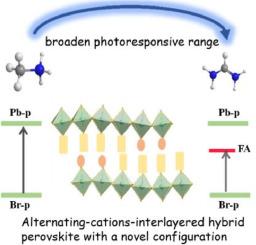
Formamidine intercalation to broaden photoresponsive range in alternating-cations-interlayered hybrid perovskite
Two-dimensional (2D) organic-inorganic hybrid perovskites (OIHPs) have been developed as promising candidates for photodetection, owing to their excellent semiconducting features and structural tunability. However, as an important parameter for photodetection, the photoresponsive range of 2D OIHPs is usually modulated by finite metal-halide combinations, constraining their further development. The emerging aromatic amine-based alternating-cations-interlayered (A-ACI) hybrid perovskites that exhibit excellent charge transport and additional interlayered structural designability, provide an extra solution for achieving ideal photoresponsive range. Herein, for the first time, the photoresponsive range is successfully broadened in A-ACI hybrid perovskites (NMA)4(FA)2Pb3Br12 (2) remolding from (NMA)4(MA)2Pb3Br12 (1) (NMA = N-methylbenzylaminium, FA = formamidinium and MA = methylammonium). Particularly, 1 and 2 adopt an unprecedented configuration that NMA and MA/FA are alternately arranged in the interlayer in a 4:2 manner. Importantly, 2 exhibits a narrower bandgap than 1, which can be ascribed to the low-lying conduct band composed of intercalation FA π* orbitals. Meanwhile, 2 possesses a shorter interlayer distance and flatter inorganic skeleton, synergistically facilitating the wider photo-absorption range and further endowing a broadening photoresponsive range (70 nm). This research not only enriches the perovskite family but also provides insights into structure-property relationships.
期刊介绍:
Chinese Chemical Letters (CCL) (ISSN 1001-8417) was founded in July 1990. The journal publishes preliminary accounts in the whole field of chemistry, including inorganic chemistry, organic chemistry, analytical chemistry, physical chemistry, polymer chemistry, applied chemistry, etc.Chinese Chemical Letters does not accept articles previously published or scheduled to be published. To verify originality, your article may be checked by the originality detection service CrossCheck.




 京公网安备 11010802042870号
京ICP备2023020795号-1
京公网安备 11010802042870号
京ICP备2023020795号-1

 分享
分享
 求助内容:
求助内容: 应助结果提醒方式:
 扫码关注我们
