Dr. Xiang Wang, Dr. Zhen-Yu Yi, Dr. Yu-Qi Wang, Prof. Dong Wang
{"title":"原子碘在氧还原反应中对 Fe-N4 位点的轴向配位效应的分子证据","authors":"Dr. Xiang Wang, Dr. Zhen-Yu Yi, Dr. Yu-Qi Wang, Prof. Dong Wang","doi":"10.1002/anie.202413673","DOIUrl":null,"url":null,"abstract":"<p>We present a molecular-scale investigation of the axial coordination effect of atomic iodine on Fe-N<sub>4</sub> sites in the oxygen reduction reaction (ORR) by electrochemical scanning tunneling microscopy (ECSTM). A well-defined model catalytic system with explicit and uniform iodine-coordinated Fe-N<sub>4</sub> sites was constructed facilely by the self-assembly of iron(II) phthalocyanine (FePc) on an I-modified Au(111) surface. The electrocatalytic activity of FePc for the ORR shows notable enhancement with axial iodine ligands. The modulation of the electronic structure of Fe sites to evoke a higher spin configuration by axial iodine was evidenced. The interaction strength between oxygen-containing species and active centers becomes weaker due to the presence of iodine ligands, and the reaction is thermodynamically preferable. Furthermore, the reaction dynamics of FePc on I/Au(111) were explicitly determined via in situ ECSTM potential pulse experiments. In contrast, axial atomic iodine was found inefficacious for improving the activity of Co-N<sub>4</sub> sites, and electron rearrangement was found to be marginal, demonstrating that adequate interactions between axial ligands and metal sites for optimizing electronic structures and catalytic behaviors are prerequisites for the impactful role of axial ligands.</p>","PeriodicalId":125,"journal":{"name":"Angewandte Chemie International Edition","volume":"64 1","pages":""},"PeriodicalIF":16.9000,"publicationDate":"2024-09-15","publicationTypes":"Journal Article","fieldsOfStudy":null,"isOpenAccess":false,"openAccessPdf":"","citationCount":"0","resultStr":"{\"title\":\"Molecular Evidence for the Axial Coordination Effect of Atomic Iodine on Fe-N4 Sites in Oxygen Reduction Reaction\",\"authors\":\"Dr. Xiang Wang, Dr. Zhen-Yu Yi, Dr. Yu-Qi Wang, Prof. Dong Wang\",\"doi\":\"10.1002/anie.202413673\",\"DOIUrl\":null,\"url\":null,\"abstract\":\"<p>We present a molecular-scale investigation of the axial coordination effect of atomic iodine on Fe-N<sub>4</sub> sites in the oxygen reduction reaction (ORR) by electrochemical scanning tunneling microscopy (ECSTM). A well-defined model catalytic system with explicit and uniform iodine-coordinated Fe-N<sub>4</sub> sites was constructed facilely by the self-assembly of iron(II) phthalocyanine (FePc) on an I-modified Au(111) surface. The electrocatalytic activity of FePc for the ORR shows notable enhancement with axial iodine ligands. The modulation of the electronic structure of Fe sites to evoke a higher spin configuration by axial iodine was evidenced. The interaction strength between oxygen-containing species and active centers becomes weaker due to the presence of iodine ligands, and the reaction is thermodynamically preferable. Furthermore, the reaction dynamics of FePc on I/Au(111) were explicitly determined via in situ ECSTM potential pulse experiments. In contrast, axial atomic iodine was found inefficacious for improving the activity of Co-N<sub>4</sub> sites, and electron rearrangement was found to be marginal, demonstrating that adequate interactions between axial ligands and metal sites for optimizing electronic structures and catalytic behaviors are prerequisites for the impactful role of axial ligands.</p>\",\"PeriodicalId\":125,\"journal\":{\"name\":\"Angewandte Chemie International Edition\",\"volume\":\"64 1\",\"pages\":\"\"},\"PeriodicalIF\":16.9000,\"publicationDate\":\"2024-09-15\",\"publicationTypes\":\"Journal Article\",\"fieldsOfStudy\":null,\"isOpenAccess\":false,\"openAccessPdf\":\"\",\"citationCount\":\"0\",\"resultStr\":null,\"platform\":\"Semanticscholar\",\"paperid\":null,\"PeriodicalName\":\"Angewandte Chemie International Edition\",\"FirstCategoryId\":\"92\",\"ListUrlMain\":\"https://onlinelibrary.wiley.com/doi/10.1002/anie.202413673\",\"RegionNum\":1,\"RegionCategory\":\"化学\",\"ArticlePicture\":[],\"TitleCN\":null,\"AbstractTextCN\":null,\"PMCID\":null,\"EPubDate\":\"\",\"PubModel\":\"\",\"JCR\":\"Q1\",\"JCRName\":\"CHEMISTRY, MULTIDISCIPLINARY\",\"Score\":null,\"Total\":0}","platform":"Semanticscholar","paperid":null,"PeriodicalName":"Angewandte Chemie International Edition","FirstCategoryId":"92","ListUrlMain":"https://onlinelibrary.wiley.com/doi/10.1002/anie.202413673","RegionNum":1,"RegionCategory":"化学","ArticlePicture":[],"TitleCN":null,"AbstractTextCN":null,"PMCID":null,"EPubDate":"","PubModel":"","JCR":"Q1","JCRName":"CHEMISTRY, MULTIDISCIPLINARY","Score":null,"Total":0}
Molecular Evidence for the Axial Coordination Effect of Atomic Iodine on Fe-N4 Sites in Oxygen Reduction Reaction
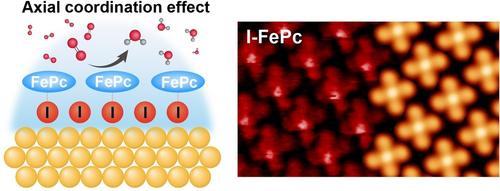
We present a molecular-scale investigation of the axial coordination effect of atomic iodine on Fe-N4 sites in the oxygen reduction reaction (ORR) by electrochemical scanning tunneling microscopy (ECSTM). A well-defined model catalytic system with explicit and uniform iodine-coordinated Fe-N4 sites was constructed facilely by the self-assembly of iron(II) phthalocyanine (FePc) on an I-modified Au(111) surface. The electrocatalytic activity of FePc for the ORR shows notable enhancement with axial iodine ligands. The modulation of the electronic structure of Fe sites to evoke a higher spin configuration by axial iodine was evidenced. The interaction strength between oxygen-containing species and active centers becomes weaker due to the presence of iodine ligands, and the reaction is thermodynamically preferable. Furthermore, the reaction dynamics of FePc on I/Au(111) were explicitly determined via in situ ECSTM potential pulse experiments. In contrast, axial atomic iodine was found inefficacious for improving the activity of Co-N4 sites, and electron rearrangement was found to be marginal, demonstrating that adequate interactions between axial ligands and metal sites for optimizing electronic structures and catalytic behaviors are prerequisites for the impactful role of axial ligands.
期刊介绍:
Angewandte Chemie, a journal of the German Chemical Society (GDCh), maintains a leading position among scholarly journals in general chemistry with an impressive Impact Factor of 16.6 (2022 Journal Citation Reports, Clarivate, 2023). Published weekly in a reader-friendly format, it features new articles almost every day. Established in 1887, Angewandte Chemie is a prominent chemistry journal, offering a dynamic blend of Review-type articles, Highlights, Communications, and Research Articles on a weekly basis, making it unique in the field.




 京公网安备 11010802042870号
京ICP备2023020795号-1
京公网安备 11010802042870号
京ICP备2023020795号-1

 分享
分享
 求助内容:
求助内容: 应助结果提醒方式:
 扫码关注我们
