{"title":"设计用于超快激光热疗的多波段蓝色发射 \"绿色 \"等离子纳米复合材料","authors":"Yury V. Ryabchikov","doi":"10.1039/D4NR03120B","DOIUrl":null,"url":null,"abstract":"<p >Although non-toxic nanoscale materials are widely employed for different healthcare applications, their performance is still considerably limited. In this paper, various approaches using the environmentally friendly ultrafast laser processing were employed to remodel IV group semiconductor nanostructures and synthesize highly-stable (<em>ξ</em>-potential is up to −47 mV) colloidal solutions of plasmonic (525 nm) nanocomposites with a strong size-dependent chemical content. All nanocomposites exhibited a remarkable lamp-excited multi-band blue emission centred at around 420 nm that is considerably (∼10-fold for Au-SiC) stronger than from nanocomposites prepared by the laser co-fragmentation technique. The latter formed a greater quantity of smaller narrowly dispersed (∼4 nm for Au–Si) plasmonic nanostructures compared to the direct laser ablation method. Moreover, it led to a greater number of semiconductor elements (∼1.7-fold for Au–Ge) in the nanocomposites, which was correlated with lower (∼30%) electrical conductivity. Aqueous colloidal solutions revealed a greater degree (∼80%) of the femtosecond laser-induced heating for all nanocomposites formed by direct laser ablation. These findings highlight the peculiarities of the applied laser processing approaches and considerably facilitate the design of specific multi-modal plasmonic-fluorescence (biosensing, bioimaging, hyperthermia) nanocomposites with a required performance that significantly expands the application area of semiconductor nanostructures.</p>","PeriodicalId":92,"journal":{"name":"Nanoscale","volume":" 41","pages":" 19453-19468"},"PeriodicalIF":5.2000,"publicationDate":"2024-09-18","publicationTypes":"Journal Article","fieldsOfStudy":null,"isOpenAccess":false,"openAccessPdf":"https://pubs.rsc.org/en/content/articlepdf/2024/nr/d4nr03120b?page=search","citationCount":"0","resultStr":"{\"title\":\"Design of “green” plasmonic nanocomposites with multi-band blue emission for ultrafast laser hyperthermia†\",\"authors\":\"Yury V. Ryabchikov\",\"doi\":\"10.1039/D4NR03120B\",\"DOIUrl\":null,\"url\":null,\"abstract\":\"<p >Although non-toxic nanoscale materials are widely employed for different healthcare applications, their performance is still considerably limited. In this paper, various approaches using the environmentally friendly ultrafast laser processing were employed to remodel IV group semiconductor nanostructures and synthesize highly-stable (<em>ξ</em>-potential is up to −47 mV) colloidal solutions of plasmonic (525 nm) nanocomposites with a strong size-dependent chemical content. All nanocomposites exhibited a remarkable lamp-excited multi-band blue emission centred at around 420 nm that is considerably (∼10-fold for Au-SiC) stronger than from nanocomposites prepared by the laser co-fragmentation technique. The latter formed a greater quantity of smaller narrowly dispersed (∼4 nm for Au–Si) plasmonic nanostructures compared to the direct laser ablation method. Moreover, it led to a greater number of semiconductor elements (∼1.7-fold for Au–Ge) in the nanocomposites, which was correlated with lower (∼30%) electrical conductivity. Aqueous colloidal solutions revealed a greater degree (∼80%) of the femtosecond laser-induced heating for all nanocomposites formed by direct laser ablation. These findings highlight the peculiarities of the applied laser processing approaches and considerably facilitate the design of specific multi-modal plasmonic-fluorescence (biosensing, bioimaging, hyperthermia) nanocomposites with a required performance that significantly expands the application area of semiconductor nanostructures.</p>\",\"PeriodicalId\":92,\"journal\":{\"name\":\"Nanoscale\",\"volume\":\" 41\",\"pages\":\" 19453-19468\"},\"PeriodicalIF\":5.2000,\"publicationDate\":\"2024-09-18\",\"publicationTypes\":\"Journal Article\",\"fieldsOfStudy\":null,\"isOpenAccess\":false,\"openAccessPdf\":\"https://pubs.rsc.org/en/content/articlepdf/2024/nr/d4nr03120b?page=search\",\"citationCount\":\"0\",\"resultStr\":null,\"platform\":\"Semanticscholar\",\"paperid\":null,\"PeriodicalName\":\"Nanoscale\",\"FirstCategoryId\":\"88\",\"ListUrlMain\":\"https://pubs.rsc.org/en/content/articlelanding/2024/nr/d4nr03120b\",\"RegionNum\":3,\"RegionCategory\":\"材料科学\",\"ArticlePicture\":[],\"TitleCN\":null,\"AbstractTextCN\":null,\"PMCID\":null,\"EPubDate\":\"\",\"PubModel\":\"\",\"JCR\":\"Q1\",\"JCRName\":\"CHEMISTRY, MULTIDISCIPLINARY\",\"Score\":null,\"Total\":0}","platform":"Semanticscholar","paperid":null,"PeriodicalName":"Nanoscale","FirstCategoryId":"88","ListUrlMain":"https://pubs.rsc.org/en/content/articlelanding/2024/nr/d4nr03120b","RegionNum":3,"RegionCategory":"材料科学","ArticlePicture":[],"TitleCN":null,"AbstractTextCN":null,"PMCID":null,"EPubDate":"","PubModel":"","JCR":"Q1","JCRName":"CHEMISTRY, MULTIDISCIPLINARY","Score":null,"Total":0}
Design of “green” plasmonic nanocomposites with multi-band blue emission for ultrafast laser hyperthermia†
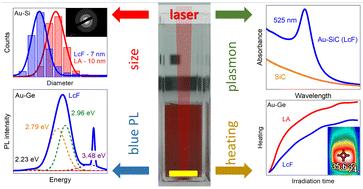
Although non-toxic nanoscale materials are widely employed for different healthcare applications, their performance is still considerably limited. In this paper, various approaches using the environmentally friendly ultrafast laser processing were employed to remodel IV group semiconductor nanostructures and synthesize highly-stable (ξ-potential is up to −47 mV) colloidal solutions of plasmonic (525 nm) nanocomposites with a strong size-dependent chemical content. All nanocomposites exhibited a remarkable lamp-excited multi-band blue emission centred at around 420 nm that is considerably (∼10-fold for Au-SiC) stronger than from nanocomposites prepared by the laser co-fragmentation technique. The latter formed a greater quantity of smaller narrowly dispersed (∼4 nm for Au–Si) plasmonic nanostructures compared to the direct laser ablation method. Moreover, it led to a greater number of semiconductor elements (∼1.7-fold for Au–Ge) in the nanocomposites, which was correlated with lower (∼30%) electrical conductivity. Aqueous colloidal solutions revealed a greater degree (∼80%) of the femtosecond laser-induced heating for all nanocomposites formed by direct laser ablation. These findings highlight the peculiarities of the applied laser processing approaches and considerably facilitate the design of specific multi-modal plasmonic-fluorescence (biosensing, bioimaging, hyperthermia) nanocomposites with a required performance that significantly expands the application area of semiconductor nanostructures.
期刊介绍:
Nanoscale is a high-impact international journal, publishing high-quality research across nanoscience and nanotechnology. Nanoscale publishes a full mix of research articles on experimental and theoretical work, including reviews, communications, and full papers.Highly interdisciplinary, this journal appeals to scientists, researchers and professionals interested in nanoscience and nanotechnology, quantum materials and quantum technology, including the areas of physics, chemistry, biology, medicine, materials, energy/environment, information technology, detection science, healthcare and drug discovery, and electronics.




 京公网安备 11010802042870号
京ICP备2023020795号-1
京公网安备 11010802042870号
京ICP备2023020795号-1

 分享
分享
 求助内容:
求助内容: 应助结果提醒方式:
 扫码关注我们
