Xiuyue Sun, Haowen Sun, Zihao Wo, Yier Su and Xiwen Zhang
{"title":"双交联大孔气凝胶具有更强的机械耐久性,可用于太阳能驱动的高效海水和废水淡化","authors":"Xiuyue Sun, Haowen Sun, Zihao Wo, Yier Su and Xiwen Zhang","doi":"10.1039/D4TA05732E","DOIUrl":null,"url":null,"abstract":"<p >Solar-driven interfacial evaporation for seawater desalination is an effective green measure to produce clean water and help alleviate freshwater scarcity. However, it is still a challenge to fabricate an interfacial solar evaporator that possesses a high evaporation rate with effective channels to resist clogging of salt accumulation during evaporation. Here, a dual-crosslinked aerogel with macropores is prepared using environmentally friendly biomass materials gelatin and cellulose nanofibril. It exhibits super salt resistance, durable mechanical strength and low thermal conductivity. In solar-driven interfacial evaporation, this aerogel achieves a peak evaporation rate of 2.14 kg m<small><sup>−2</sup></small> h<small><sup>−1</sup></small> and a solar thermal conversion efficiency of 96.3% under 1 sun illumination in 3.5 wt% brine. The macroporous structure facilitates rapid convection and reflux, originating from the ionic electrostatic effect and contributing to excellent salt resistance and long-term cycling performance of the aerogel in seawater purification. Furthermore, the aerogel exhibits durability against strong acids, alkali and dyed wastewater, suggesting its potential for sustainable applications in advanced solar-driven desalination and wastewater treatment. This study provides new insights into the utilization of biomass-based photothermal aerogels for addressing global water challenges.</p>","PeriodicalId":82,"journal":{"name":"Journal of Materials Chemistry A","volume":" 43","pages":" 29538-29549"},"PeriodicalIF":9.5000,"publicationDate":"2024-09-24","publicationTypes":"Journal Article","fieldsOfStudy":null,"isOpenAccess":false,"openAccessPdf":"","citationCount":"0","resultStr":"{\"title\":\"A dual-crosslinked macroporous aerogel with enhanced mechanical durability for efficient solar-driven desalination of seawater and wastewater†\",\"authors\":\"Xiuyue Sun, Haowen Sun, Zihao Wo, Yier Su and Xiwen Zhang\",\"doi\":\"10.1039/D4TA05732E\",\"DOIUrl\":null,\"url\":null,\"abstract\":\"<p >Solar-driven interfacial evaporation for seawater desalination is an effective green measure to produce clean water and help alleviate freshwater scarcity. However, it is still a challenge to fabricate an interfacial solar evaporator that possesses a high evaporation rate with effective channels to resist clogging of salt accumulation during evaporation. Here, a dual-crosslinked aerogel with macropores is prepared using environmentally friendly biomass materials gelatin and cellulose nanofibril. It exhibits super salt resistance, durable mechanical strength and low thermal conductivity. In solar-driven interfacial evaporation, this aerogel achieves a peak evaporation rate of 2.14 kg m<small><sup>−2</sup></small> h<small><sup>−1</sup></small> and a solar thermal conversion efficiency of 96.3% under 1 sun illumination in 3.5 wt% brine. The macroporous structure facilitates rapid convection and reflux, originating from the ionic electrostatic effect and contributing to excellent salt resistance and long-term cycling performance of the aerogel in seawater purification. Furthermore, the aerogel exhibits durability against strong acids, alkali and dyed wastewater, suggesting its potential for sustainable applications in advanced solar-driven desalination and wastewater treatment. This study provides new insights into the utilization of biomass-based photothermal aerogels for addressing global water challenges.</p>\",\"PeriodicalId\":82,\"journal\":{\"name\":\"Journal of Materials Chemistry A\",\"volume\":\" 43\",\"pages\":\" 29538-29549\"},\"PeriodicalIF\":9.5000,\"publicationDate\":\"2024-09-24\",\"publicationTypes\":\"Journal Article\",\"fieldsOfStudy\":null,\"isOpenAccess\":false,\"openAccessPdf\":\"\",\"citationCount\":\"0\",\"resultStr\":null,\"platform\":\"Semanticscholar\",\"paperid\":null,\"PeriodicalName\":\"Journal of Materials Chemistry A\",\"FirstCategoryId\":\"88\",\"ListUrlMain\":\"https://pubs.rsc.org/en/content/articlelanding/2024/ta/d4ta05732e\",\"RegionNum\":2,\"RegionCategory\":\"材料科学\",\"ArticlePicture\":[],\"TitleCN\":null,\"AbstractTextCN\":null,\"PMCID\":null,\"EPubDate\":\"\",\"PubModel\":\"\",\"JCR\":\"Q1\",\"JCRName\":\"CHEMISTRY, PHYSICAL\",\"Score\":null,\"Total\":0}","platform":"Semanticscholar","paperid":null,"PeriodicalName":"Journal of Materials Chemistry A","FirstCategoryId":"88","ListUrlMain":"https://pubs.rsc.org/en/content/articlelanding/2024/ta/d4ta05732e","RegionNum":2,"RegionCategory":"材料科学","ArticlePicture":[],"TitleCN":null,"AbstractTextCN":null,"PMCID":null,"EPubDate":"","PubModel":"","JCR":"Q1","JCRName":"CHEMISTRY, PHYSICAL","Score":null,"Total":0}
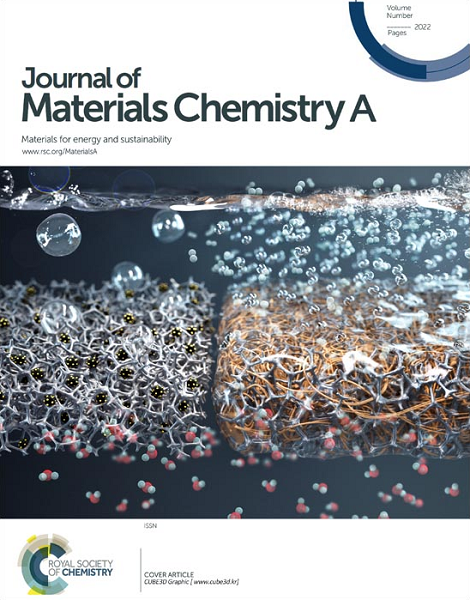
A dual-crosslinked macroporous aerogel with enhanced mechanical durability for efficient solar-driven desalination of seawater and wastewater†
Solar-driven interfacial evaporation for seawater desalination is an effective green measure to produce clean water and help alleviate freshwater scarcity. However, it is still a challenge to fabricate an interfacial solar evaporator that possesses a high evaporation rate with effective channels to resist clogging of salt accumulation during evaporation. Here, a dual-crosslinked aerogel with macropores is prepared using environmentally friendly biomass materials gelatin and cellulose nanofibril. It exhibits super salt resistance, durable mechanical strength and low thermal conductivity. In solar-driven interfacial evaporation, this aerogel achieves a peak evaporation rate of 2.14 kg m−2 h−1 and a solar thermal conversion efficiency of 96.3% under 1 sun illumination in 3.5 wt% brine. The macroporous structure facilitates rapid convection and reflux, originating from the ionic electrostatic effect and contributing to excellent salt resistance and long-term cycling performance of the aerogel in seawater purification. Furthermore, the aerogel exhibits durability against strong acids, alkali and dyed wastewater, suggesting its potential for sustainable applications in advanced solar-driven desalination and wastewater treatment. This study provides new insights into the utilization of biomass-based photothermal aerogels for addressing global water challenges.
期刊介绍:
The Journal of Materials Chemistry A, B & C covers a wide range of high-quality studies in the field of materials chemistry, with each section focusing on specific applications of the materials studied. Journal of Materials Chemistry A emphasizes applications in energy and sustainability, including topics such as artificial photosynthesis, batteries, and fuel cells. Journal of Materials Chemistry B focuses on applications in biology and medicine, while Journal of Materials Chemistry C covers applications in optical, magnetic, and electronic devices. Example topic areas within the scope of Journal of Materials Chemistry A include catalysis, green/sustainable materials, sensors, and water treatment, among others.





 京公网安备 11010802042870号
京ICP备2023020795号-1
京公网安备 11010802042870号
京ICP备2023020795号-1

 分享
分享
 求助内容:
求助内容: 应助结果提醒方式:
 扫码关注我们
