Xinyu Lei , Henghui Sun , Xinqiang Yuan , Lizhai Zhang , Yaoyao Zhang
{"title":"退火调谐高相变潜热 W-VO2 纳米棒的 B/M 相变及相变特性研究","authors":"Xinyu Lei , Henghui Sun , Xinqiang Yuan , Lizhai Zhang , Yaoyao Zhang","doi":"10.1016/j.vacuum.2024.113664","DOIUrl":null,"url":null,"abstract":"<div><div>Vanadium dioxide (VO<sub>2</sub>) can spontaneously regulate solar heat according to the ambient temperature, and has great application potential as a candidate for smart glass. However, its <em>T</em><sub><em>c</em></sub>, <em>ΔT</em><sub><em>c</em></sub> and <em>ΔH</em> cannot be coordinated at the same time, and commercial use is greatly hindered. W-doped VO<sub>2</sub> powders were prepared by the hydrothermal method under an argon atmosphere. Nanoflowers, nanorods, and other morphologies of W-doped VO<sub>2</sub> were characterized. The test results showed that W doping could reduce the <em>T</em><sub><em>c</em></sub> of VO<sub>2</sub> to 33.5 °C, <em>ΔT</em><sub><em>c</em></sub> < 10 °C, and with high <em>ΔH</em> (<em>ΔH</em> ≈ 36.98 J/g). The phase transition behavior and morphology change mechanism of W-doped VO<sub>2</sub> were investigated. The transformation of B and M phases was controlled by changing the annealing temperature, and W-VO<sub>2</sub>(M) powders with good phase transition properties were finally produced to meet the requirements of the practical application of smart glass materials.</div></div>","PeriodicalId":23559,"journal":{"name":"Vacuum","volume":"230 ","pages":"Article 113664"},"PeriodicalIF":3.9000,"publicationDate":"2024-12-01","publicationTypes":"Journal Article","fieldsOfStudy":null,"isOpenAccess":false,"openAccessPdf":"","citationCount":"0","resultStr":"{\"title\":\"Study of B/M phase transition and phase transition properties of annealing-tuned high phase transition latent heat of W-VO2 nanorods\",\"authors\":\"Xinyu Lei , Henghui Sun , Xinqiang Yuan , Lizhai Zhang , Yaoyao Zhang\",\"doi\":\"10.1016/j.vacuum.2024.113664\",\"DOIUrl\":null,\"url\":null,\"abstract\":\"<div><div>Vanadium dioxide (VO<sub>2</sub>) can spontaneously regulate solar heat according to the ambient temperature, and has great application potential as a candidate for smart glass. However, its <em>T</em><sub><em>c</em></sub>, <em>ΔT</em><sub><em>c</em></sub> and <em>ΔH</em> cannot be coordinated at the same time, and commercial use is greatly hindered. W-doped VO<sub>2</sub> powders were prepared by the hydrothermal method under an argon atmosphere. Nanoflowers, nanorods, and other morphologies of W-doped VO<sub>2</sub> were characterized. The test results showed that W doping could reduce the <em>T</em><sub><em>c</em></sub> of VO<sub>2</sub> to 33.5 °C, <em>ΔT</em><sub><em>c</em></sub> < 10 °C, and with high <em>ΔH</em> (<em>ΔH</em> ≈ 36.98 J/g). The phase transition behavior and morphology change mechanism of W-doped VO<sub>2</sub> were investigated. The transformation of B and M phases was controlled by changing the annealing temperature, and W-VO<sub>2</sub>(M) powders with good phase transition properties were finally produced to meet the requirements of the practical application of smart glass materials.</div></div>\",\"PeriodicalId\":23559,\"journal\":{\"name\":\"Vacuum\",\"volume\":\"230 \",\"pages\":\"Article 113664\"},\"PeriodicalIF\":3.9000,\"publicationDate\":\"2024-12-01\",\"publicationTypes\":\"Journal Article\",\"fieldsOfStudy\":null,\"isOpenAccess\":false,\"openAccessPdf\":\"\",\"citationCount\":\"0\",\"resultStr\":null,\"platform\":\"Semanticscholar\",\"paperid\":null,\"PeriodicalName\":\"Vacuum\",\"FirstCategoryId\":\"88\",\"ListUrlMain\":\"https://www.sciencedirect.com/science/article/pii/S0042207X24007103\",\"RegionNum\":2,\"RegionCategory\":\"材料科学\",\"ArticlePicture\":[],\"TitleCN\":null,\"AbstractTextCN\":null,\"PMCID\":null,\"EPubDate\":\"2024/9/18 0:00:00\",\"PubModel\":\"Epub\",\"JCR\":\"Q2\",\"JCRName\":\"MATERIALS SCIENCE, MULTIDISCIPLINARY\",\"Score\":null,\"Total\":0}","platform":"Semanticscholar","paperid":null,"PeriodicalName":"Vacuum","FirstCategoryId":"88","ListUrlMain":"https://www.sciencedirect.com/science/article/pii/S0042207X24007103","RegionNum":2,"RegionCategory":"材料科学","ArticlePicture":[],"TitleCN":null,"AbstractTextCN":null,"PMCID":null,"EPubDate":"2024/9/18 0:00:00","PubModel":"Epub","JCR":"Q2","JCRName":"MATERIALS SCIENCE, MULTIDISCIPLINARY","Score":null,"Total":0}
引用次数: 0
摘要
二氧化钒(VO2)可根据环境温度自发调节太阳热量,作为智能玻璃的候选材料具有巨大的应用潜力。然而,二氧化钒的Tc、ΔTc和ΔH不能同时协调,商业应用受到很大阻碍。我们在氩气环境下采用水热法制备了掺 W 的 VO2 粉末。对掺杂 W 的 VO2 的纳米花、纳米棒和其他形态进行了表征。测试结果表明,掺杂 W 能使 VO2 的 Tc 降低到 33.5 °C,ΔTc < 10 °C,并具有较高的ΔH(ΔH ≈ 36.98 J/g)。研究了掺 W VO2 的相变行为和形态变化机理。通过改变退火温度控制了B相和M相的转变,最终制备出具有良好相变特性的W-VO2(M)粉末,满足了智能玻璃材料的实际应用要求。
Study of B/M phase transition and phase transition properties of annealing-tuned high phase transition latent heat of W-VO2 nanorods
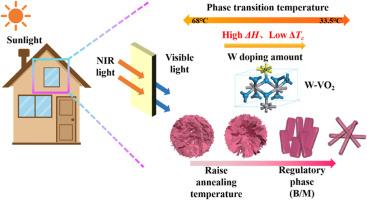
Vanadium dioxide (VO2) can spontaneously regulate solar heat according to the ambient temperature, and has great application potential as a candidate for smart glass. However, its Tc, ΔTc and ΔH cannot be coordinated at the same time, and commercial use is greatly hindered. W-doped VO2 powders were prepared by the hydrothermal method under an argon atmosphere. Nanoflowers, nanorods, and other morphologies of W-doped VO2 were characterized. The test results showed that W doping could reduce the Tc of VO2 to 33.5 °C, ΔTc < 10 °C, and with high ΔH (ΔH ≈ 36.98 J/g). The phase transition behavior and morphology change mechanism of W-doped VO2 were investigated. The transformation of B and M phases was controlled by changing the annealing temperature, and W-VO2(M) powders with good phase transition properties were finally produced to meet the requirements of the practical application of smart glass materials.
期刊介绍:
Vacuum is an international rapid publications journal with a focus on short communication. All papers are peer-reviewed, with the review process for short communication geared towards very fast turnaround times. The journal also published full research papers, thematic issues and selected papers from leading conferences.
A report in Vacuum should represent a major advance in an area that involves a controlled environment at pressures of one atmosphere or below.
The scope of the journal includes:
1. Vacuum; original developments in vacuum pumping and instrumentation, vacuum measurement, vacuum gas dynamics, gas-surface interactions, surface treatment for UHV applications and low outgassing, vacuum melting, sintering, and vacuum metrology. Technology and solutions for large-scale facilities (e.g., particle accelerators and fusion devices). New instrumentation ( e.g., detectors and electron microscopes).
2. Plasma science; advances in PVD, CVD, plasma-assisted CVD, ion sources, deposition processes and analysis.
3. Surface science; surface engineering, surface chemistry, surface analysis, crystal growth, ion-surface interactions and etching, nanometer-scale processing, surface modification.
4. Materials science; novel functional or structural materials. Metals, ceramics, and polymers. Experiments, simulations, and modelling for understanding structure-property relationships. Thin films and coatings. Nanostructures and ion implantation.




 京公网安备 11010802042870号
京ICP备2023020795号-1
京公网安备 11010802042870号
京ICP备2023020795号-1

 分享
分享
 求助内容:
求助内容: 应助结果提醒方式:
 扫码关注我们
