{"title":"SRSF1 对维持骨骼肌生长和再生过程中卫星细胞的稳态至关重要","authors":"Zhenzhen Wang, Qian Peng, Zhige Zhang, Xue You, Huimin Duan, Rula Sha, Ningyang Yuan, Zhigang Li, Zhiqin Xie, Jun Han, Ying Feng","doi":"10.1002/jcsm.13607","DOIUrl":null,"url":null,"abstract":"<div>\n \n \n <section>\n \n <h3> Background</h3>\n \n <p>The splicing factor SRSF1 emerges as a mater regulator of cell proliferation, displaying high expression in actively proliferative satellite cells (SCs). In SRSF1 knockout mice (KO) generated via <i>MyoD-Cre</i>, early mortality and muscle atrophy are observed during postnatal muscle growth. Despite these findings, the precise mechanisms through which SRSF1 loss influences SCs' functions and its role in muscle regeneration remain to be elucidated.</p>\n </section>\n \n <section>\n \n <h3> Methods</h3>\n \n <p>To unravel the exact mechanisms underlying the impact of SRSF1 deficiency SC functions, we employed single-cell RNA sequencing (scRNA-seq) on a mononuclear cell suspension isolated from the newborn diaphragm of KO and control mice. Concurrently, we subjected diaphragm muscles to RNA-seq analysis to identify dysregulated splicing events associated with SRSF1 deletion. For the analysis of the effect of SRSF1 deletion on muscle regeneration, we generated mice with inducible SC-specific <i>Srsf1</i> ablation through <i>Pax7-CreER</i>. SRSF1 ablation was induced by intraperitoneal injection of tamoxifen. Using cardiotoxin-induced muscle injury, we examined the consequences of SRSF1 depletion on SC function through HE staining, immunostaining and EdU incorporation assay. C2C12 myoblasts and isolated myoblasts were employed to assess stem cell function and senescence.</p>\n </section>\n \n <section>\n \n <h3> Results</h3>\n \n <p>Utilizing scRNA-seq analysis, we observed a noteworthy increase in activated and proliferating myoblasts when SRSF1 was absent. This increase was substantial, with the proportion rising from 28.68% in the control group to 77.06% in the knockout group. However, these myoblasts experienced mitotic abnormalities in the absence of SRSF1, resulting in cell cycle arrest and the onset of cellular senescence. In the knockout mice, the proportion of Pax7+ cells within improper niche positioning increased significantly to 25% compared to 12% in the control cells (<i>n</i> ≥ 10, <i>p</i> < 0.001). Furthermore, there was an observation of persistent cell cycle exit specifically in the Pax7+ cells deficient in SRSF1 (<i>n</i> = 6, <i>p</i> < 0.001). SRSF1 plays a pivotal role in regulating the splicing of Fgfr1op2, favouring the full-length isoform crucial for mitotic spindle organization. Disrupting SRSF1 in C2C12 and primary myoblasts results in multipolar spindle formation (<i>p</i> < 0.001) and dysregulated splicing of Fgfr1op2 and triggers cellular senescence. Consequently, adult SCs lacking SRSF1 initially activate upon injury but face substantial challenge in proliferation (<i>n</i> = 4, <i>p</i> < 0.001), leading to a failure in muscle regeneration.</p>\n </section>\n \n <section>\n \n <h3> Conclusions</h3>\n \n <p>SRSF1 plays a critical role in SCs by ensuring proper splicing, maintaining mitotic progression and preventing premature senescence. These findings underscore the significant role of SRSF1 in controlling SC proliferation during skeletal muscle growth and regeneration.</p>\n </section>\n </div>","PeriodicalId":48911,"journal":{"name":"Journal of Cachexia Sarcopenia and Muscle","volume":"15 6","pages":"2629-2641"},"PeriodicalIF":9.9000,"publicationDate":"2024-10-09","publicationTypes":"Journal Article","fieldsOfStudy":null,"isOpenAccess":false,"openAccessPdf":"https://onlinelibrary.wiley.com/doi/epdf/10.1002/jcsm.13607","citationCount":"0","resultStr":"{\"title\":\"SRSF1 Is Crucial for Maintaining Satellite Cell Homeostasis During Skeletal Muscle Growth and Regeneration\",\"authors\":\"Zhenzhen Wang, Qian Peng, Zhige Zhang, Xue You, Huimin Duan, Rula Sha, Ningyang Yuan, Zhigang Li, Zhiqin Xie, Jun Han, Ying Feng\",\"doi\":\"10.1002/jcsm.13607\",\"DOIUrl\":null,\"url\":null,\"abstract\":\"<div>\\n \\n \\n <section>\\n \\n <h3> Background</h3>\\n \\n <p>The splicing factor SRSF1 emerges as a mater regulator of cell proliferation, displaying high expression in actively proliferative satellite cells (SCs). In SRSF1 knockout mice (KO) generated via <i>MyoD-Cre</i>, early mortality and muscle atrophy are observed during postnatal muscle growth. Despite these findings, the precise mechanisms through which SRSF1 loss influences SCs' functions and its role in muscle regeneration remain to be elucidated.</p>\\n </section>\\n \\n <section>\\n \\n <h3> Methods</h3>\\n \\n <p>To unravel the exact mechanisms underlying the impact of SRSF1 deficiency SC functions, we employed single-cell RNA sequencing (scRNA-seq) on a mononuclear cell suspension isolated from the newborn diaphragm of KO and control mice. Concurrently, we subjected diaphragm muscles to RNA-seq analysis to identify dysregulated splicing events associated with SRSF1 deletion. For the analysis of the effect of SRSF1 deletion on muscle regeneration, we generated mice with inducible SC-specific <i>Srsf1</i> ablation through <i>Pax7-CreER</i>. SRSF1 ablation was induced by intraperitoneal injection of tamoxifen. Using cardiotoxin-induced muscle injury, we examined the consequences of SRSF1 depletion on SC function through HE staining, immunostaining and EdU incorporation assay. C2C12 myoblasts and isolated myoblasts were employed to assess stem cell function and senescence.</p>\\n </section>\\n \\n <section>\\n \\n <h3> Results</h3>\\n \\n <p>Utilizing scRNA-seq analysis, we observed a noteworthy increase in activated and proliferating myoblasts when SRSF1 was absent. This increase was substantial, with the proportion rising from 28.68% in the control group to 77.06% in the knockout group. However, these myoblasts experienced mitotic abnormalities in the absence of SRSF1, resulting in cell cycle arrest and the onset of cellular senescence. In the knockout mice, the proportion of Pax7+ cells within improper niche positioning increased significantly to 25% compared to 12% in the control cells (<i>n</i> ≥ 10, <i>p</i> < 0.001). Furthermore, there was an observation of persistent cell cycle exit specifically in the Pax7+ cells deficient in SRSF1 (<i>n</i> = 6, <i>p</i> < 0.001). SRSF1 plays a pivotal role in regulating the splicing of Fgfr1op2, favouring the full-length isoform crucial for mitotic spindle organization. Disrupting SRSF1 in C2C12 and primary myoblasts results in multipolar spindle formation (<i>p</i> < 0.001) and dysregulated splicing of Fgfr1op2 and triggers cellular senescence. Consequently, adult SCs lacking SRSF1 initially activate upon injury but face substantial challenge in proliferation (<i>n</i> = 4, <i>p</i> < 0.001), leading to a failure in muscle regeneration.</p>\\n </section>\\n \\n <section>\\n \\n <h3> Conclusions</h3>\\n \\n <p>SRSF1 plays a critical role in SCs by ensuring proper splicing, maintaining mitotic progression and preventing premature senescence. These findings underscore the significant role of SRSF1 in controlling SC proliferation during skeletal muscle growth and regeneration.</p>\\n </section>\\n </div>\",\"PeriodicalId\":48911,\"journal\":{\"name\":\"Journal of Cachexia Sarcopenia and Muscle\",\"volume\":\"15 6\",\"pages\":\"2629-2641\"},\"PeriodicalIF\":9.9000,\"publicationDate\":\"2024-10-09\",\"publicationTypes\":\"Journal Article\",\"fieldsOfStudy\":null,\"isOpenAccess\":false,\"openAccessPdf\":\"https://onlinelibrary.wiley.com/doi/epdf/10.1002/jcsm.13607\",\"citationCount\":\"0\",\"resultStr\":null,\"platform\":\"Semanticscholar\",\"paperid\":null,\"PeriodicalName\":\"Journal of Cachexia Sarcopenia and Muscle\",\"FirstCategoryId\":\"3\",\"ListUrlMain\":\"https://onlinelibrary.wiley.com/doi/10.1002/jcsm.13607\",\"RegionNum\":1,\"RegionCategory\":\"医学\",\"ArticlePicture\":[],\"TitleCN\":null,\"AbstractTextCN\":null,\"PMCID\":null,\"EPubDate\":\"\",\"PubModel\":\"\",\"JCR\":\"Q1\",\"JCRName\":\"GERIATRICS & GERONTOLOGY\",\"Score\":null,\"Total\":0}","platform":"Semanticscholar","paperid":null,"PeriodicalName":"Journal of Cachexia Sarcopenia and Muscle","FirstCategoryId":"3","ListUrlMain":"https://onlinelibrary.wiley.com/doi/10.1002/jcsm.13607","RegionNum":1,"RegionCategory":"医学","ArticlePicture":[],"TitleCN":null,"AbstractTextCN":null,"PMCID":null,"EPubDate":"","PubModel":"","JCR":"Q1","JCRName":"GERIATRICS & GERONTOLOGY","Score":null,"Total":0}
SRSF1 Is Crucial for Maintaining Satellite Cell Homeostasis During Skeletal Muscle Growth and Regeneration
Background
The splicing factor SRSF1 emerges as a mater regulator of cell proliferation, displaying high expression in actively proliferative satellite cells (SCs). In SRSF1 knockout mice (KO) generated via MyoD-Cre, early mortality and muscle atrophy are observed during postnatal muscle growth. Despite these findings, the precise mechanisms through which SRSF1 loss influences SCs' functions and its role in muscle regeneration remain to be elucidated.
Methods
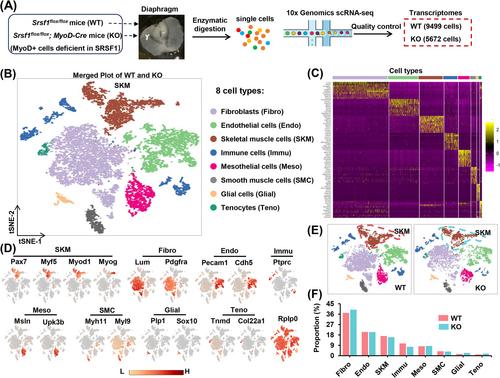
To unravel the exact mechanisms underlying the impact of SRSF1 deficiency SC functions, we employed single-cell RNA sequencing (scRNA-seq) on a mononuclear cell suspension isolated from the newborn diaphragm of KO and control mice. Concurrently, we subjected diaphragm muscles to RNA-seq analysis to identify dysregulated splicing events associated with SRSF1 deletion. For the analysis of the effect of SRSF1 deletion on muscle regeneration, we generated mice with inducible SC-specific Srsf1 ablation through Pax7-CreER. SRSF1 ablation was induced by intraperitoneal injection of tamoxifen. Using cardiotoxin-induced muscle injury, we examined the consequences of SRSF1 depletion on SC function through HE staining, immunostaining and EdU incorporation assay. C2C12 myoblasts and isolated myoblasts were employed to assess stem cell function and senescence.
Results
Utilizing scRNA-seq analysis, we observed a noteworthy increase in activated and proliferating myoblasts when SRSF1 was absent. This increase was substantial, with the proportion rising from 28.68% in the control group to 77.06% in the knockout group. However, these myoblasts experienced mitotic abnormalities in the absence of SRSF1, resulting in cell cycle arrest and the onset of cellular senescence. In the knockout mice, the proportion of Pax7+ cells within improper niche positioning increased significantly to 25% compared to 12% in the control cells (n ≥ 10, p < 0.001). Furthermore, there was an observation of persistent cell cycle exit specifically in the Pax7+ cells deficient in SRSF1 (n = 6, p < 0.001). SRSF1 plays a pivotal role in regulating the splicing of Fgfr1op2, favouring the full-length isoform crucial for mitotic spindle organization. Disrupting SRSF1 in C2C12 and primary myoblasts results in multipolar spindle formation (p < 0.001) and dysregulated splicing of Fgfr1op2 and triggers cellular senescence. Consequently, adult SCs lacking SRSF1 initially activate upon injury but face substantial challenge in proliferation (n = 4, p < 0.001), leading to a failure in muscle regeneration.
Conclusions
SRSF1 plays a critical role in SCs by ensuring proper splicing, maintaining mitotic progression and preventing premature senescence. These findings underscore the significant role of SRSF1 in controlling SC proliferation during skeletal muscle growth and regeneration.
期刊介绍:
The Journal of Cachexia, Sarcopenia and Muscle is a peer-reviewed international journal dedicated to publishing materials related to cachexia and sarcopenia, as well as body composition and its physiological and pathophysiological changes across the lifespan and in response to various illnesses from all fields of life sciences. The journal aims to provide a reliable resource for professionals interested in related research or involved in the clinical care of affected patients, such as those suffering from AIDS, cancer, chronic heart failure, chronic lung disease, liver cirrhosis, chronic kidney failure, rheumatoid arthritis, or sepsis.




 京公网安备 11010802042870号
京ICP备2023020795号-1
京公网安备 11010802042870号
京ICP备2023020795号-1

 分享
分享
 求助内容:
求助内容: 应助结果提醒方式:
 扫码关注我们
