Yue Li, Mingming Xu, Hongyan Liu, Xiaokang Wang, Yutong Wang, Meng Sun, Weidong Fan and Daofeng Sun
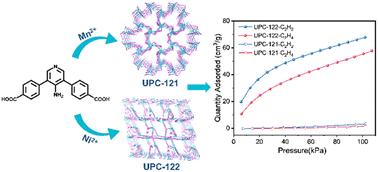
{"title":"两种拓扑结构不同的氨基功能化金属有机框架用于分离 C2H2/C2H4","authors":"Yue Li, Mingming Xu, Hongyan Liu, Xiaokang Wang, Yutong Wang, Meng Sun, Weidong Fan and Daofeng Sun","doi":"10.1039/D4DT02592J","DOIUrl":null,"url":null,"abstract":"<p >The rational design of metal–organic framework adsorbents is crucial for target gas separation. Herein, we report two three-dimensional MOFs with different topologies by regulating metal ions with amino-functionalized V-type ligands. Adsorption isotherms and Grand Canonical Monte Carlo simulation reveal that UPC-122 with channel-cavity structure has the potential to separate C<small><sub>2</sub></small>H<small><sub>2</sub></small>/C<small><sub>2</sub></small>H<small><sub>4</sub></small> at room temperature with a separation ratio of 2.35 (50/50).</p>","PeriodicalId":71,"journal":{"name":"Dalton Transactions","volume":" 45","pages":" 18094-18098"},"PeriodicalIF":3.3000,"publicationDate":"2024-11-06","publicationTypes":"Journal Article","fieldsOfStudy":null,"isOpenAccess":false,"openAccessPdf":"","citationCount":"0","resultStr":"{\"title\":\"Two amino-functionalized metal–organic frameworks with different topologies for C2H2/C2H4 separation†\",\"authors\":\"Yue Li, Mingming Xu, Hongyan Liu, Xiaokang Wang, Yutong Wang, Meng Sun, Weidong Fan and Daofeng Sun\",\"doi\":\"10.1039/D4DT02592J\",\"DOIUrl\":null,\"url\":null,\"abstract\":\"<p >The rational design of metal–organic framework adsorbents is crucial for target gas separation. Herein, we report two three-dimensional MOFs with different topologies by regulating metal ions with amino-functionalized V-type ligands. Adsorption isotherms and Grand Canonical Monte Carlo simulation reveal that UPC-122 with channel-cavity structure has the potential to separate C<small><sub>2</sub></small>H<small><sub>2</sub></small>/C<small><sub>2</sub></small>H<small><sub>4</sub></small> at room temperature with a separation ratio of 2.35 (50/50).</p>\",\"PeriodicalId\":71,\"journal\":{\"name\":\"Dalton Transactions\",\"volume\":\" 45\",\"pages\":\" 18094-18098\"},\"PeriodicalIF\":3.3000,\"publicationDate\":\"2024-11-06\",\"publicationTypes\":\"Journal Article\",\"fieldsOfStudy\":null,\"isOpenAccess\":false,\"openAccessPdf\":\"\",\"citationCount\":\"0\",\"resultStr\":null,\"platform\":\"Semanticscholar\",\"paperid\":null,\"PeriodicalName\":\"Dalton Transactions\",\"FirstCategoryId\":\"92\",\"ListUrlMain\":\"https://pubs.rsc.org/en/content/articlelanding/2024/dt/d4dt02592j\",\"RegionNum\":3,\"RegionCategory\":\"化学\",\"ArticlePicture\":[],\"TitleCN\":null,\"AbstractTextCN\":null,\"PMCID\":null,\"EPubDate\":\"\",\"PubModel\":\"\",\"JCR\":\"Q2\",\"JCRName\":\"CHEMISTRY, INORGANIC & NUCLEAR\",\"Score\":null,\"Total\":0}","platform":"Semanticscholar","paperid":null,"PeriodicalName":"Dalton Transactions","FirstCategoryId":"92","ListUrlMain":"https://pubs.rsc.org/en/content/articlelanding/2024/dt/d4dt02592j","RegionNum":3,"RegionCategory":"化学","ArticlePicture":[],"TitleCN":null,"AbstractTextCN":null,"PMCID":null,"EPubDate":"","PubModel":"","JCR":"Q2","JCRName":"CHEMISTRY, INORGANIC & NUCLEAR","Score":null,"Total":0}
引用次数: 0
摘要
合理设计金属有机框架吸附剂对于目标气体分离至关重要。在此,我们通过用氨基功能化的 V 型配体调节金属离子,报告了两种具有不同拓扑结构的三维 MOFs。吸附等温线和大卡农蒙特卡洛模拟显示,具有通道空腔结构的 UPC-122 具有在室温下分离 C2H2/C2H4 的潜力,分离比为 2.35(50/50)。
Two amino-functionalized metal–organic frameworks with different topologies for C2H2/C2H4 separation†
The rational design of metal–organic framework adsorbents is crucial for target gas separation. Herein, we report two three-dimensional MOFs with different topologies by regulating metal ions with amino-functionalized V-type ligands. Adsorption isotherms and Grand Canonical Monte Carlo simulation reveal that UPC-122 with channel-cavity structure has the potential to separate C2H2/C2H4 at room temperature with a separation ratio of 2.35 (50/50).
期刊介绍:
Dalton Transactions is a journal for all areas of inorganic chemistry, which encompasses the organometallic, bioinorganic and materials chemistry of the elements, with applications including synthesis, catalysis, energy conversion/storage, electrical devices and medicine. Dalton Transactions welcomes high-quality, original submissions in all of these areas and more, where the advancement of knowledge in inorganic chemistry is significant.




 京公网安备 11010802042870号
京ICP备2023020795号-1
京公网安备 11010802042870号
京ICP备2023020795号-1

 分享
分享
 求助内容:
求助内容: 应助结果提醒方式:
 扫码关注我们
