Shandong Huang, Dong Feng, Yuanzhi Zhu, Yihong Ding, Delong Xie, Yi Mei and Tianbiao Zeng
{"title":"锚定在钠离子电池应用石墨纳米片上的 NiSbS/NiS/NiS 纳米复合材料的增强电化学性能","authors":"Shandong Huang, Dong Feng, Yuanzhi Zhu, Yihong Ding, Delong Xie, Yi Mei and Tianbiao Zeng","doi":"10.1039/D4TA07323A","DOIUrl":null,"url":null,"abstract":"<p >In the realm of scalable fabrication of anodes through ball milling, ensuring high electrochemical performance and robust cycling stability of anodes for sodium-ion batteries is paramount, but it presents a formidable hurdle. In pursuit of these goals, a distinctive hybrid composite distinguished by its intricate multiphase composition has been devised. This entails the integration of innovative NiSbS/NiSb/NiS nanomaterials onto exfoliated graphite nanosheets (Ni–Sb–S/GN) <em>via</em> a straightforward technique. Analyses indicate that the interplay between the graphite nanosheets and the hybrid Ni–Sb–S in conjunction with the discharge byproducts of Na<small><sub>2</sub></small>S substantially augment the stability and Na-ion diffusion kinetics of Ni–Sb–S/GN anodes. The novel Ni–Sb–S/GN exhibits markedly superior electrochemical performance in comparison to its Ni–Sb–S counterpart. Specifically, Ni–Sb–S/GN retains a reversible capacity of 238.7 mA h g<small><sup>−1</sup></small> at 0.2 A g<small><sup>−1</sup></small> after 300 cycles and 200 mA h g<small><sup>−1</sup></small> at 1 A g<small><sup>−1</sup></small> after 1000 cycles, corresponding to a high capacity retention rate of 83.8% compared to the 2nd cycle. This contribution presents a novel avenue for the exploitation of advanced multiphase anodes exhibiting superior capacity, rate capability, and cycling durability.</p>","PeriodicalId":82,"journal":{"name":"Journal of Materials Chemistry A","volume":" 1","pages":" 604-616"},"PeriodicalIF":9.2000,"publicationDate":"2024-11-15","publicationTypes":"Journal Article","fieldsOfStudy":null,"isOpenAccess":false,"openAccessPdf":"","citationCount":"0","resultStr":"{\"title\":\"Enhanced electrochemical performance of NiSbS/NiSb/NiS nanocomposites anchored on graphite nanosheets for sodium-ion battery applications†\",\"authors\":\"Shandong Huang, Dong Feng, Yuanzhi Zhu, Yihong Ding, Delong Xie, Yi Mei and Tianbiao Zeng\",\"doi\":\"10.1039/D4TA07323A\",\"DOIUrl\":null,\"url\":null,\"abstract\":\"<p >In the realm of scalable fabrication of anodes through ball milling, ensuring high electrochemical performance and robust cycling stability of anodes for sodium-ion batteries is paramount, but it presents a formidable hurdle. In pursuit of these goals, a distinctive hybrid composite distinguished by its intricate multiphase composition has been devised. This entails the integration of innovative NiSbS/NiSb/NiS nanomaterials onto exfoliated graphite nanosheets (Ni–Sb–S/GN) <em>via</em> a straightforward technique. Analyses indicate that the interplay between the graphite nanosheets and the hybrid Ni–Sb–S in conjunction with the discharge byproducts of Na<small><sub>2</sub></small>S substantially augment the stability and Na-ion diffusion kinetics of Ni–Sb–S/GN anodes. The novel Ni–Sb–S/GN exhibits markedly superior electrochemical performance in comparison to its Ni–Sb–S counterpart. Specifically, Ni–Sb–S/GN retains a reversible capacity of 238.7 mA h g<small><sup>−1</sup></small> at 0.2 A g<small><sup>−1</sup></small> after 300 cycles and 200 mA h g<small><sup>−1</sup></small> at 1 A g<small><sup>−1</sup></small> after 1000 cycles, corresponding to a high capacity retention rate of 83.8% compared to the 2nd cycle. This contribution presents a novel avenue for the exploitation of advanced multiphase anodes exhibiting superior capacity, rate capability, and cycling durability.</p>\",\"PeriodicalId\":82,\"journal\":{\"name\":\"Journal of Materials Chemistry A\",\"volume\":\" 1\",\"pages\":\" 604-616\"},\"PeriodicalIF\":9.2000,\"publicationDate\":\"2024-11-15\",\"publicationTypes\":\"Journal Article\",\"fieldsOfStudy\":null,\"isOpenAccess\":false,\"openAccessPdf\":\"\",\"citationCount\":\"0\",\"resultStr\":null,\"platform\":\"Semanticscholar\",\"paperid\":null,\"PeriodicalName\":\"Journal of Materials Chemistry A\",\"FirstCategoryId\":\"88\",\"ListUrlMain\":\"https://pubs.rsc.org/en/content/articlelanding/2025/ta/d4ta07323a\",\"RegionNum\":2,\"RegionCategory\":\"材料科学\",\"ArticlePicture\":[],\"TitleCN\":null,\"AbstractTextCN\":null,\"PMCID\":null,\"EPubDate\":\"\",\"PubModel\":\"\",\"JCR\":\"Q1\",\"JCRName\":\"CHEMISTRY, PHYSICAL\",\"Score\":null,\"Total\":0}","platform":"Semanticscholar","paperid":null,"PeriodicalName":"Journal of Materials Chemistry A","FirstCategoryId":"88","ListUrlMain":"https://pubs.rsc.org/en/content/articlelanding/2025/ta/d4ta07323a","RegionNum":2,"RegionCategory":"材料科学","ArticlePicture":[],"TitleCN":null,"AbstractTextCN":null,"PMCID":null,"EPubDate":"","PubModel":"","JCR":"Q1","JCRName":"CHEMISTRY, PHYSICAL","Score":null,"Total":0}
引用次数: 0
摘要
在通过球磨可扩展制造阳极的领域,确保钠离子电池阳极具有高电化学性能和强大的循环稳定性至关重要,但这也是一个巨大的障碍。为了实现这些目标,我们设计了一种独特的混合复合材料,其复杂的多相组成使其与众不同。这需要通过一种简单的技术将创新的镍锑/镍锑/镍硒纳米材料整合到剥离石墨纳米片(镍锑/镍硒/镍硒)上。分析表明,石墨纳米片和混合 Ni-Sb-S 之间的相互作用以及 Na2S 的放电副产物大大提高了 Ni-Sb-S/GN 阳极的稳定性和 Na 离子扩散动力学。与 Ni-Sb-S 阳极相比,新型 Ni-Sb-S/GN 阳极具有明显优越的电化学性能。具体地说,Ni-Sb-S/GN 在 0.2 A g-1 条件下循环 300 次后可获得 238.7 mAh g-1 的可逆容量,在 1 A g-1 条件下循环 1000 次后仍可获得 200 mAh g-1 的显著容量,从第二个循环开始,容量保持率高达 83.8%。这一贡献为开发先进的多相阳极提供了一条新途径,使其具有更高的容量、速率能力和循环耐久性。
Enhanced electrochemical performance of NiSbS/NiSb/NiS nanocomposites anchored on graphite nanosheets for sodium-ion battery applications†
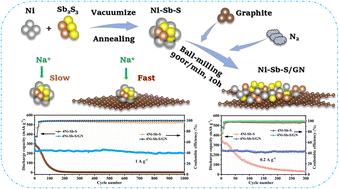
In the realm of scalable fabrication of anodes through ball milling, ensuring high electrochemical performance and robust cycling stability of anodes for sodium-ion batteries is paramount, but it presents a formidable hurdle. In pursuit of these goals, a distinctive hybrid composite distinguished by its intricate multiphase composition has been devised. This entails the integration of innovative NiSbS/NiSb/NiS nanomaterials onto exfoliated graphite nanosheets (Ni–Sb–S/GN) via a straightforward technique. Analyses indicate that the interplay between the graphite nanosheets and the hybrid Ni–Sb–S in conjunction with the discharge byproducts of Na2S substantially augment the stability and Na-ion diffusion kinetics of Ni–Sb–S/GN anodes. The novel Ni–Sb–S/GN exhibits markedly superior electrochemical performance in comparison to its Ni–Sb–S counterpart. Specifically, Ni–Sb–S/GN retains a reversible capacity of 238.7 mA h g−1 at 0.2 A g−1 after 300 cycles and 200 mA h g−1 at 1 A g−1 after 1000 cycles, corresponding to a high capacity retention rate of 83.8% compared to the 2nd cycle. This contribution presents a novel avenue for the exploitation of advanced multiphase anodes exhibiting superior capacity, rate capability, and cycling durability.
期刊介绍:
The Journal of Materials Chemistry A, B & C covers a wide range of high-quality studies in the field of materials chemistry, with each section focusing on specific applications of the materials studied. Journal of Materials Chemistry A emphasizes applications in energy and sustainability, including topics such as artificial photosynthesis, batteries, and fuel cells. Journal of Materials Chemistry B focuses on applications in biology and medicine, while Journal of Materials Chemistry C covers applications in optical, magnetic, and electronic devices. Example topic areas within the scope of Journal of Materials Chemistry A include catalysis, green/sustainable materials, sensors, and water treatment, among others.




 京公网安备 11010802042870号
京ICP备2023020795号-1
京公网安备 11010802042870号
京ICP备2023020795号-1

 分享
分享
 求助内容:
求助内容: 应助结果提醒方式:
 扫码关注我们
