Ziyi Han, Leyu Wang, Panjie Sun, Mengxin Huang, Fei Yu, Junsheng Liu, Yuanyuan Wu, Puming He, Youying Tu, Bo Li
{"title":"奎宁酸是 Caco-2 细胞中 α-葡萄糖苷酶活性、非酶糖基化和葡萄糖转运的抑制剂","authors":"Ziyi Han, Leyu Wang, Panjie Sun, Mengxin Huang, Fei Yu, Junsheng Liu, Yuanyuan Wu, Puming He, Youying Tu, Bo Li","doi":"10.1002/fft2.486","DOIUrl":null,"url":null,"abstract":"<p>Hyperglycemia and diabetes are common metabolic disorders. It is considered a safe and effective strategy to screen active ingredients from food and herbs for controlling blood sugar levels. Quinic acid (QA) is a natural polyphenolic acid with various health-promoting properties. In this study, QA was found to exhibit a potent inhibitory effect on α-glucosidase activity, with a half maximal inhibitory concentration (IC<sub>50</sub>) of 5.46 mM. This inhibitory property surpassed that of three common organic acids including gallic acid, malic acid, and citric acid. A combination of 25% acarbose (0.5 mM) and 75% QA (5 mM) (v/v) exhibited synergistic inhibition of α-glucosidase activity. Enzyme kinetics, fluorescence spectra, and molecular docking analyses indicated that QA acted as an uncompetitive inhibitor of α-glucosidase, with hydrogen bonds playing a key role in the intermolecular interactions. Moreover, QA was found to effectively inhibit three major nonenzymatic glycation products including advanced glycosylation end products (AGEs), fructosamine, and α-dicarbonyl in a dose-dependent manner, outperforming the positive control aminoguanidine (AG) within the tested concentration range. Utilizing a Caco-2 cell model, QA demonstrated the ability to inhibit the transmembrane absorption of glucose. This study highlighted QA as a promising food functional factor that had been overlooked in the past, offering potential benefits in improving hyperglycemia, diabetes, and associated complications through the inhibition of α-glucosidase, nonenzymatic glycosylation, and glucose uptake.</p>","PeriodicalId":73042,"journal":{"name":"Food frontiers","volume":"5 6","pages":"2545-2555"},"PeriodicalIF":6.9000,"publicationDate":"2024-09-10","publicationTypes":"Journal Article","fieldsOfStudy":null,"isOpenAccess":false,"openAccessPdf":"https://onlinelibrary.wiley.com/doi/epdf/10.1002/fft2.486","citationCount":"0","resultStr":"{\"title\":\"Quinic acid as an inhibitor of α-glucosidase activity, nonenzymatic glycosylation, and glucose transport in Caco-2 cells\",\"authors\":\"Ziyi Han, Leyu Wang, Panjie Sun, Mengxin Huang, Fei Yu, Junsheng Liu, Yuanyuan Wu, Puming He, Youying Tu, Bo Li\",\"doi\":\"10.1002/fft2.486\",\"DOIUrl\":null,\"url\":null,\"abstract\":\"<p>Hyperglycemia and diabetes are common metabolic disorders. It is considered a safe and effective strategy to screen active ingredients from food and herbs for controlling blood sugar levels. Quinic acid (QA) is a natural polyphenolic acid with various health-promoting properties. In this study, QA was found to exhibit a potent inhibitory effect on α-glucosidase activity, with a half maximal inhibitory concentration (IC<sub>50</sub>) of 5.46 mM. This inhibitory property surpassed that of three common organic acids including gallic acid, malic acid, and citric acid. A combination of 25% acarbose (0.5 mM) and 75% QA (5 mM) (v/v) exhibited synergistic inhibition of α-glucosidase activity. Enzyme kinetics, fluorescence spectra, and molecular docking analyses indicated that QA acted as an uncompetitive inhibitor of α-glucosidase, with hydrogen bonds playing a key role in the intermolecular interactions. Moreover, QA was found to effectively inhibit three major nonenzymatic glycation products including advanced glycosylation end products (AGEs), fructosamine, and α-dicarbonyl in a dose-dependent manner, outperforming the positive control aminoguanidine (AG) within the tested concentration range. Utilizing a Caco-2 cell model, QA demonstrated the ability to inhibit the transmembrane absorption of glucose. This study highlighted QA as a promising food functional factor that had been overlooked in the past, offering potential benefits in improving hyperglycemia, diabetes, and associated complications through the inhibition of α-glucosidase, nonenzymatic glycosylation, and glucose uptake.</p>\",\"PeriodicalId\":73042,\"journal\":{\"name\":\"Food frontiers\",\"volume\":\"5 6\",\"pages\":\"2545-2555\"},\"PeriodicalIF\":6.9000,\"publicationDate\":\"2024-09-10\",\"publicationTypes\":\"Journal Article\",\"fieldsOfStudy\":null,\"isOpenAccess\":false,\"openAccessPdf\":\"https://onlinelibrary.wiley.com/doi/epdf/10.1002/fft2.486\",\"citationCount\":\"0\",\"resultStr\":null,\"platform\":\"Semanticscholar\",\"paperid\":null,\"PeriodicalName\":\"Food frontiers\",\"FirstCategoryId\":\"1085\",\"ListUrlMain\":\"https://iadns.onlinelibrary.wiley.com/doi/10.1002/fft2.486\",\"RegionNum\":0,\"RegionCategory\":null,\"ArticlePicture\":[],\"TitleCN\":null,\"AbstractTextCN\":null,\"PMCID\":null,\"EPubDate\":\"\",\"PubModel\":\"\",\"JCR\":\"Q1\",\"JCRName\":\"FOOD SCIENCE & TECHNOLOGY\",\"Score\":null,\"Total\":0}","platform":"Semanticscholar","paperid":null,"PeriodicalName":"Food frontiers","FirstCategoryId":"1085","ListUrlMain":"https://iadns.onlinelibrary.wiley.com/doi/10.1002/fft2.486","RegionNum":0,"RegionCategory":null,"ArticlePicture":[],"TitleCN":null,"AbstractTextCN":null,"PMCID":null,"EPubDate":"","PubModel":"","JCR":"Q1","JCRName":"FOOD SCIENCE & TECHNOLOGY","Score":null,"Total":0}
Quinic acid as an inhibitor of α-glucosidase activity, nonenzymatic glycosylation, and glucose transport in Caco-2 cells
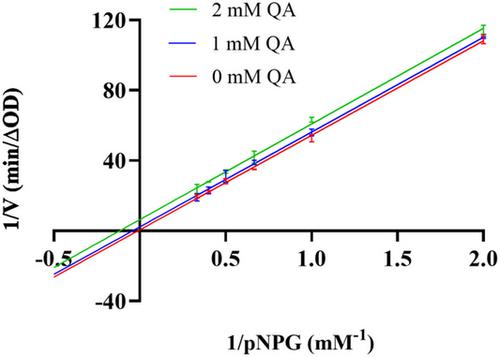
Hyperglycemia and diabetes are common metabolic disorders. It is considered a safe and effective strategy to screen active ingredients from food and herbs for controlling blood sugar levels. Quinic acid (QA) is a natural polyphenolic acid with various health-promoting properties. In this study, QA was found to exhibit a potent inhibitory effect on α-glucosidase activity, with a half maximal inhibitory concentration (IC50) of 5.46 mM. This inhibitory property surpassed that of three common organic acids including gallic acid, malic acid, and citric acid. A combination of 25% acarbose (0.5 mM) and 75% QA (5 mM) (v/v) exhibited synergistic inhibition of α-glucosidase activity. Enzyme kinetics, fluorescence spectra, and molecular docking analyses indicated that QA acted as an uncompetitive inhibitor of α-glucosidase, with hydrogen bonds playing a key role in the intermolecular interactions. Moreover, QA was found to effectively inhibit three major nonenzymatic glycation products including advanced glycosylation end products (AGEs), fructosamine, and α-dicarbonyl in a dose-dependent manner, outperforming the positive control aminoguanidine (AG) within the tested concentration range. Utilizing a Caco-2 cell model, QA demonstrated the ability to inhibit the transmembrane absorption of glucose. This study highlighted QA as a promising food functional factor that had been overlooked in the past, offering potential benefits in improving hyperglycemia, diabetes, and associated complications through the inhibition of α-glucosidase, nonenzymatic glycosylation, and glucose uptake.





 京公网安备 11010802042870号
京ICP备2023020795号-1
京公网安备 11010802042870号
京ICP备2023020795号-1

 分享
分享

 求助内容:
求助内容: 应助结果提醒方式:
 扫码关注我们
