Félix de Tombeur, Lucas Plouzeau, Jeremy Shaw, Martin J. Hodson, Kosala Ranathunge, Joanna Kotula, Patrick E. Hayes, Maëva Tremblay, Sylvain Coq, Mathias Stein, Ryosuke Nakamura, Ian J. Wright, Hans Lambers, Cyrille Violle, Peta L. Clode
{"title":"解剖和性状分析揭示了莎草表皮的硅碳权衡。","authors":"Félix de Tombeur, Lucas Plouzeau, Jeremy Shaw, Martin J. Hodson, Kosala Ranathunge, Joanna Kotula, Patrick E. Hayes, Maëva Tremblay, Sylvain Coq, Mathias Stein, Ryosuke Nakamura, Ian J. Wright, Hans Lambers, Cyrille Violle, Peta L. Clode","doi":"10.1111/pce.15307","DOIUrl":null,"url":null,"abstract":"<p>In recent years, the detection of numerous negative correlations between silicon (Si) and carbon (C)-based compounds in plants has suggested trade-offs between different stress resistance and/or mechanical support strategies. However, nearly all studies have involved whole-leaf analysis, and it is unclear how the trade-off operates mechanistically, at the cellular level. Here we combined leaf trait measurements and microscopic analyses (electron microscopy with elemental X-ray mapping and X-ray microtomography) of 17 species from a high-Si family: Cyperaceae. Accumulation of Si was strongly negatively correlated with C-based compounds, particularly tannins. Our microscopical investigations showed that the accumulation of phenolics and deposition of silica were mutually exclusive in the outer epidermal cell walls. This trade-off was independent of that between the construction of tough, sclerenchyma-rich leaves and growth potential (the <i>leaf economics spectrum</i>). We also identified a strong negative correlation between Si and accumulation of epicuticular waxes. Previous whole leaf analyses were, in effect, hiding the locations of the trade-off between Si and C-based compounds in plants. The epidermal location of this trade-off and the specific involvement of tannins and waxes suggest the existence of different strategies to resist environmental stresses. Our study provides key insights into plant Si utilization and highlights the multidimensionality of plant stress resistance strategies.</p>","PeriodicalId":222,"journal":{"name":"Plant, Cell & Environment","volume":"48 3","pages":"2396-2410"},"PeriodicalIF":6.3000,"publicationDate":"2024-11-28","publicationTypes":"Journal Article","fieldsOfStudy":null,"isOpenAccess":false,"openAccessPdf":"https://onlinelibrary.wiley.com/doi/epdf/10.1111/pce.15307","citationCount":"0","resultStr":"{\"title\":\"Anatomical and Trait Analyses Reveal a Silicon-Carbon Trade-Off in the Epidermis of Sedges\",\"authors\":\"Félix de Tombeur, Lucas Plouzeau, Jeremy Shaw, Martin J. Hodson, Kosala Ranathunge, Joanna Kotula, Patrick E. Hayes, Maëva Tremblay, Sylvain Coq, Mathias Stein, Ryosuke Nakamura, Ian J. Wright, Hans Lambers, Cyrille Violle, Peta L. Clode\",\"doi\":\"10.1111/pce.15307\",\"DOIUrl\":null,\"url\":null,\"abstract\":\"<p>In recent years, the detection of numerous negative correlations between silicon (Si) and carbon (C)-based compounds in plants has suggested trade-offs between different stress resistance and/or mechanical support strategies. However, nearly all studies have involved whole-leaf analysis, and it is unclear how the trade-off operates mechanistically, at the cellular level. Here we combined leaf trait measurements and microscopic analyses (electron microscopy with elemental X-ray mapping and X-ray microtomography) of 17 species from a high-Si family: Cyperaceae. Accumulation of Si was strongly negatively correlated with C-based compounds, particularly tannins. Our microscopical investigations showed that the accumulation of phenolics and deposition of silica were mutually exclusive in the outer epidermal cell walls. This trade-off was independent of that between the construction of tough, sclerenchyma-rich leaves and growth potential (the <i>leaf economics spectrum</i>). We also identified a strong negative correlation between Si and accumulation of epicuticular waxes. Previous whole leaf analyses were, in effect, hiding the locations of the trade-off between Si and C-based compounds in plants. The epidermal location of this trade-off and the specific involvement of tannins and waxes suggest the existence of different strategies to resist environmental stresses. Our study provides key insights into plant Si utilization and highlights the multidimensionality of plant stress resistance strategies.</p>\",\"PeriodicalId\":222,\"journal\":{\"name\":\"Plant, Cell & Environment\",\"volume\":\"48 3\",\"pages\":\"2396-2410\"},\"PeriodicalIF\":6.3000,\"publicationDate\":\"2024-11-28\",\"publicationTypes\":\"Journal Article\",\"fieldsOfStudy\":null,\"isOpenAccess\":false,\"openAccessPdf\":\"https://onlinelibrary.wiley.com/doi/epdf/10.1111/pce.15307\",\"citationCount\":\"0\",\"resultStr\":null,\"platform\":\"Semanticscholar\",\"paperid\":null,\"PeriodicalName\":\"Plant, Cell & Environment\",\"FirstCategoryId\":\"2\",\"ListUrlMain\":\"https://onlinelibrary.wiley.com/doi/10.1111/pce.15307\",\"RegionNum\":1,\"RegionCategory\":\"生物学\",\"ArticlePicture\":[],\"TitleCN\":null,\"AbstractTextCN\":null,\"PMCID\":null,\"EPubDate\":\"\",\"PubModel\":\"\",\"JCR\":\"Q1\",\"JCRName\":\"PLANT SCIENCES\",\"Score\":null,\"Total\":0}","platform":"Semanticscholar","paperid":null,"PeriodicalName":"Plant, Cell & Environment","FirstCategoryId":"2","ListUrlMain":"https://onlinelibrary.wiley.com/doi/10.1111/pce.15307","RegionNum":1,"RegionCategory":"生物学","ArticlePicture":[],"TitleCN":null,"AbstractTextCN":null,"PMCID":null,"EPubDate":"","PubModel":"","JCR":"Q1","JCRName":"PLANT SCIENCES","Score":null,"Total":0}
Anatomical and Trait Analyses Reveal a Silicon-Carbon Trade-Off in the Epidermis of Sedges
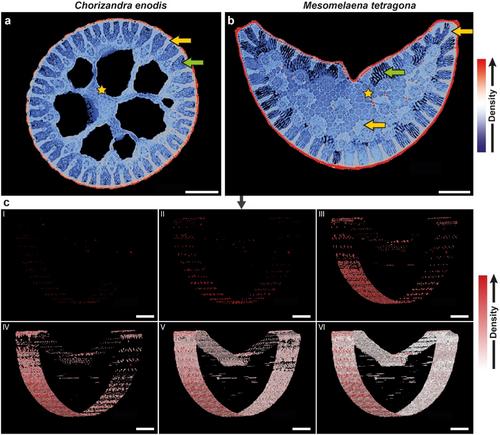
In recent years, the detection of numerous negative correlations between silicon (Si) and carbon (C)-based compounds in plants has suggested trade-offs between different stress resistance and/or mechanical support strategies. However, nearly all studies have involved whole-leaf analysis, and it is unclear how the trade-off operates mechanistically, at the cellular level. Here we combined leaf trait measurements and microscopic analyses (electron microscopy with elemental X-ray mapping and X-ray microtomography) of 17 species from a high-Si family: Cyperaceae. Accumulation of Si was strongly negatively correlated with C-based compounds, particularly tannins. Our microscopical investigations showed that the accumulation of phenolics and deposition of silica were mutually exclusive in the outer epidermal cell walls. This trade-off was independent of that between the construction of tough, sclerenchyma-rich leaves and growth potential (the leaf economics spectrum). We also identified a strong negative correlation between Si and accumulation of epicuticular waxes. Previous whole leaf analyses were, in effect, hiding the locations of the trade-off between Si and C-based compounds in plants. The epidermal location of this trade-off and the specific involvement of tannins and waxes suggest the existence of different strategies to resist environmental stresses. Our study provides key insights into plant Si utilization and highlights the multidimensionality of plant stress resistance strategies.
期刊介绍:
Plant, Cell & Environment is a premier plant science journal, offering valuable insights into plant responses to their environment. Committed to publishing high-quality theoretical and experimental research, the journal covers a broad spectrum of factors, spanning from molecular to community levels. Researchers exploring various aspects of plant biology, physiology, and ecology contribute to the journal's comprehensive understanding of plant-environment interactions.




 京公网安备 11010802042870号
京ICP备2023020795号-1
京公网安备 11010802042870号
京ICP备2023020795号-1

 分享
分享
 求助内容:
求助内容: 应助结果提醒方式:
 扫码关注我们
