Ekaterina Morgunova, Gabor Nagy, Yimeng Yin, Fangjie Zhu, Sonali Priyadarshini Nayak, Tianyi Xiao, Ilya Sokolov, Alexander Popov, Charles Laughton, Helmut Grubmuller, Jussi Taipale
{"title":"界面水赋予转录因子二核苷酸特异性","authors":"Ekaterina Morgunova, Gabor Nagy, Yimeng Yin, Fangjie Zhu, Sonali Priyadarshini Nayak, Tianyi Xiao, Ilya Sokolov, Alexander Popov, Charles Laughton, Helmut Grubmuller, Jussi Taipale","doi":"10.1038/s41594-024-01449-6","DOIUrl":null,"url":null,"abstract":"Transcription factors (TFs) recognize specific bases within their DNA-binding motifs, with each base contributing nearly independently to total binding energy. However, the energetic contributions of particular dinucleotides can deviate strongly from the additive approximation, indicating that some TFs can specifically recognize DNA dinucleotides. Here we solved high-resolution (<1 Å) structures of MYF5 and BARHL2 bound to DNAs containing sets of dinucleotides that have different affinities to the proteins. The dinucleotides were recognized either enthalpically, by an extensive water network that connects the adjacent bases to the TF, or entropically, by a hydrophobic patch that maintained interfacial water mobility. This mechanism confers differential temperature sensitivity to the optimal sites, with implications for thermal regulation of gene expression. Our results uncover the enigma of how TFs can recognize more complex local features than mononucleotides and demonstrate that water-mediated recognition is important for predicting affinities of macromolecules from their sequence. The study highlights the importance of water-mediated interactions in recognition of dinucleotides by transcription factors. Water’s influence on enthalpy and entropy modulates binding affinity and temperature sensitivity of TF binding.","PeriodicalId":49141,"journal":{"name":"Nature Structural & Molecular Biology","volume":"32 4","pages":"650-661"},"PeriodicalIF":10.1000,"publicationDate":"2025-01-03","publicationTypes":"Journal Article","fieldsOfStudy":null,"isOpenAccess":false,"openAccessPdf":"https://www.nature.comhttps://www.nature.com/articles/s41594-024-01449-6.pdf","citationCount":"0","resultStr":"{\"title\":\"Interfacial water confers transcription factors with dinucleotide specificity\",\"authors\":\"Ekaterina Morgunova, Gabor Nagy, Yimeng Yin, Fangjie Zhu, Sonali Priyadarshini Nayak, Tianyi Xiao, Ilya Sokolov, Alexander Popov, Charles Laughton, Helmut Grubmuller, Jussi Taipale\",\"doi\":\"10.1038/s41594-024-01449-6\",\"DOIUrl\":null,\"url\":null,\"abstract\":\"Transcription factors (TFs) recognize specific bases within their DNA-binding motifs, with each base contributing nearly independently to total binding energy. However, the energetic contributions of particular dinucleotides can deviate strongly from the additive approximation, indicating that some TFs can specifically recognize DNA dinucleotides. Here we solved high-resolution (<1 Å) structures of MYF5 and BARHL2 bound to DNAs containing sets of dinucleotides that have different affinities to the proteins. The dinucleotides were recognized either enthalpically, by an extensive water network that connects the adjacent bases to the TF, or entropically, by a hydrophobic patch that maintained interfacial water mobility. This mechanism confers differential temperature sensitivity to the optimal sites, with implications for thermal regulation of gene expression. Our results uncover the enigma of how TFs can recognize more complex local features than mononucleotides and demonstrate that water-mediated recognition is important for predicting affinities of macromolecules from their sequence. The study highlights the importance of water-mediated interactions in recognition of dinucleotides by transcription factors. Water’s influence on enthalpy and entropy modulates binding affinity and temperature sensitivity of TF binding.\",\"PeriodicalId\":49141,\"journal\":{\"name\":\"Nature Structural & Molecular Biology\",\"volume\":\"32 4\",\"pages\":\"650-661\"},\"PeriodicalIF\":10.1000,\"publicationDate\":\"2025-01-03\",\"publicationTypes\":\"Journal Article\",\"fieldsOfStudy\":null,\"isOpenAccess\":false,\"openAccessPdf\":\"https://www.nature.comhttps://www.nature.com/articles/s41594-024-01449-6.pdf\",\"citationCount\":\"0\",\"resultStr\":null,\"platform\":\"Semanticscholar\",\"paperid\":null,\"PeriodicalName\":\"Nature Structural & Molecular Biology\",\"FirstCategoryId\":\"99\",\"ListUrlMain\":\"https://www.nature.com/articles/s41594-024-01449-6\",\"RegionNum\":1,\"RegionCategory\":\"生物学\",\"ArticlePicture\":[],\"TitleCN\":null,\"AbstractTextCN\":null,\"PMCID\":null,\"EPubDate\":\"\",\"PubModel\":\"\",\"JCR\":\"Q1\",\"JCRName\":\"BIOCHEMISTRY & MOLECULAR BIOLOGY\",\"Score\":null,\"Total\":0}","platform":"Semanticscholar","paperid":null,"PeriodicalName":"Nature Structural & Molecular Biology","FirstCategoryId":"99","ListUrlMain":"https://www.nature.com/articles/s41594-024-01449-6","RegionNum":1,"RegionCategory":"生物学","ArticlePicture":[],"TitleCN":null,"AbstractTextCN":null,"PMCID":null,"EPubDate":"","PubModel":"","JCR":"Q1","JCRName":"BIOCHEMISTRY & MOLECULAR BIOLOGY","Score":null,"Total":0}
Interfacial water confers transcription factors with dinucleotide specificity
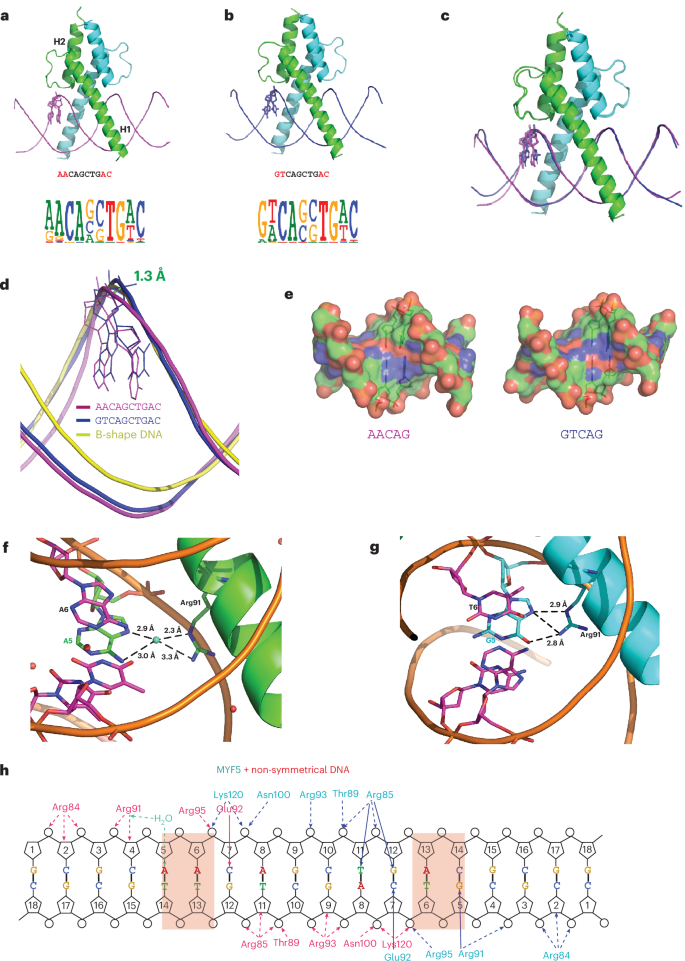
Transcription factors (TFs) recognize specific bases within their DNA-binding motifs, with each base contributing nearly independently to total binding energy. However, the energetic contributions of particular dinucleotides can deviate strongly from the additive approximation, indicating that some TFs can specifically recognize DNA dinucleotides. Here we solved high-resolution (<1 Å) structures of MYF5 and BARHL2 bound to DNAs containing sets of dinucleotides that have different affinities to the proteins. The dinucleotides were recognized either enthalpically, by an extensive water network that connects the adjacent bases to the TF, or entropically, by a hydrophobic patch that maintained interfacial water mobility. This mechanism confers differential temperature sensitivity to the optimal sites, with implications for thermal regulation of gene expression. Our results uncover the enigma of how TFs can recognize more complex local features than mononucleotides and demonstrate that water-mediated recognition is important for predicting affinities of macromolecules from their sequence. The study highlights the importance of water-mediated interactions in recognition of dinucleotides by transcription factors. Water’s influence on enthalpy and entropy modulates binding affinity and temperature sensitivity of TF binding.
期刊介绍:
Nature Structural & Molecular Biology is a comprehensive platform that combines structural and molecular research. Our journal focuses on exploring the functional and mechanistic aspects of biological processes, emphasizing how molecular components collaborate to achieve a particular function. While structural data can shed light on these insights, our publication does not require them as a prerequisite.





 京公网安备 11010802042870号
京ICP备2023020795号-1
京公网安备 11010802042870号
京ICP备2023020795号-1

 分享
分享
 求助内容:
求助内容: 应助结果提醒方式:
 扫码关注我们
