Yixuan Pan, Meiyang Liu, Chun Ruan, Mengyuan Peng, Min Hao, Qi Zhang, Jingdong Xue, Yanling Niu, Ningzhe Li, Haipeng Guan, Pei Wang, Mingqian Hu, Haitao Li, Wenjuan Wang, Juan Song, Yanhua Yao, Yimin Lao, Bing Li
{"title":"Rpd3S固有的不对称性协调了其核小体与延长RNA聚合酶II的结合","authors":"Yixuan Pan, Meiyang Liu, Chun Ruan, Mengyuan Peng, Min Hao, Qi Zhang, Jingdong Xue, Yanling Niu, Ningzhe Li, Haipeng Guan, Pei Wang, Mingqian Hu, Haitao Li, Wenjuan Wang, Juan Song, Yanhua Yao, Yimin Lao, Bing Li","doi":"10.1038/s41594-024-01453-w","DOIUrl":null,"url":null,"abstract":"The Rpd3S histone deacetylase complex has a crucial role in genomic integrity by deacetylating transcribed nucleosomes following RNA polymerase (Pol) II passage. Cryo-EM studies highlight the importance of asymmetrical Rco1–Eaf3 dimers in nucleosome binding, yet the interaction dynamics with nucleosomal substrates alongside elongating Pol II are poorly understood. Here we demonstrate the essential function of the Rco1 N-terminal intrinsically disordered region (IDR) in modulating Pol II association, in which K/R mutations within the Rco1 IDR impair interaction of Rpd3S with the C-terminal domain (CTD) of Rpb1, without affecting nucleosome recognition or complex integrity. We also identify the Rco1-PHD1 and Eaf3-CHD domains as crucial for specific binding to Ser5-phosphorylated CTD. The Rco1 IDR alleviates autoinhibition from its C terminus, facilitating PHD1-CHD engagement with phosphorylated CTD. Furthermore, we reveal a conserved mechanism by which asymmetrical Rco1–Eaf3 dimers coordinate nucleosome engagement and Pol II interaction, enhancing understanding of epigenetic complexes associated with transcriptional machinery. This study reveals the role of the Rpd3S complex in genomic integrity, highlighting how its asymmetrical structure influences interaction with transcribed nucleosomes and elongating RNA polymerase II.","PeriodicalId":49141,"journal":{"name":"Nature Structural & Molecular Biology","volume":"32 4","pages":"687-697"},"PeriodicalIF":10.1000,"publicationDate":"2025-01-08","publicationTypes":"Journal Article","fieldsOfStudy":null,"isOpenAccess":false,"openAccessPdf":"","citationCount":"0","resultStr":"{\"title\":\"Inherent asymmetry of Rpd3S coordinates its nucleosome engagement and association with elongating RNA polymerase II\",\"authors\":\"Yixuan Pan, Meiyang Liu, Chun Ruan, Mengyuan Peng, Min Hao, Qi Zhang, Jingdong Xue, Yanling Niu, Ningzhe Li, Haipeng Guan, Pei Wang, Mingqian Hu, Haitao Li, Wenjuan Wang, Juan Song, Yanhua Yao, Yimin Lao, Bing Li\",\"doi\":\"10.1038/s41594-024-01453-w\",\"DOIUrl\":null,\"url\":null,\"abstract\":\"The Rpd3S histone deacetylase complex has a crucial role in genomic integrity by deacetylating transcribed nucleosomes following RNA polymerase (Pol) II passage. Cryo-EM studies highlight the importance of asymmetrical Rco1–Eaf3 dimers in nucleosome binding, yet the interaction dynamics with nucleosomal substrates alongside elongating Pol II are poorly understood. Here we demonstrate the essential function of the Rco1 N-terminal intrinsically disordered region (IDR) in modulating Pol II association, in which K/R mutations within the Rco1 IDR impair interaction of Rpd3S with the C-terminal domain (CTD) of Rpb1, without affecting nucleosome recognition or complex integrity. We also identify the Rco1-PHD1 and Eaf3-CHD domains as crucial for specific binding to Ser5-phosphorylated CTD. The Rco1 IDR alleviates autoinhibition from its C terminus, facilitating PHD1-CHD engagement with phosphorylated CTD. Furthermore, we reveal a conserved mechanism by which asymmetrical Rco1–Eaf3 dimers coordinate nucleosome engagement and Pol II interaction, enhancing understanding of epigenetic complexes associated with transcriptional machinery. This study reveals the role of the Rpd3S complex in genomic integrity, highlighting how its asymmetrical structure influences interaction with transcribed nucleosomes and elongating RNA polymerase II.\",\"PeriodicalId\":49141,\"journal\":{\"name\":\"Nature Structural & Molecular Biology\",\"volume\":\"32 4\",\"pages\":\"687-697\"},\"PeriodicalIF\":10.1000,\"publicationDate\":\"2025-01-08\",\"publicationTypes\":\"Journal Article\",\"fieldsOfStudy\":null,\"isOpenAccess\":false,\"openAccessPdf\":\"\",\"citationCount\":\"0\",\"resultStr\":null,\"platform\":\"Semanticscholar\",\"paperid\":null,\"PeriodicalName\":\"Nature Structural & Molecular Biology\",\"FirstCategoryId\":\"99\",\"ListUrlMain\":\"https://www.nature.com/articles/s41594-024-01453-w\",\"RegionNum\":1,\"RegionCategory\":\"生物学\",\"ArticlePicture\":[],\"TitleCN\":null,\"AbstractTextCN\":null,\"PMCID\":null,\"EPubDate\":\"\",\"PubModel\":\"\",\"JCR\":\"Q1\",\"JCRName\":\"BIOCHEMISTRY & MOLECULAR BIOLOGY\",\"Score\":null,\"Total\":0}","platform":"Semanticscholar","paperid":null,"PeriodicalName":"Nature Structural & Molecular Biology","FirstCategoryId":"99","ListUrlMain":"https://www.nature.com/articles/s41594-024-01453-w","RegionNum":1,"RegionCategory":"生物学","ArticlePicture":[],"TitleCN":null,"AbstractTextCN":null,"PMCID":null,"EPubDate":"","PubModel":"","JCR":"Q1","JCRName":"BIOCHEMISTRY & MOLECULAR BIOLOGY","Score":null,"Total":0}
Inherent asymmetry of Rpd3S coordinates its nucleosome engagement and association with elongating RNA polymerase II
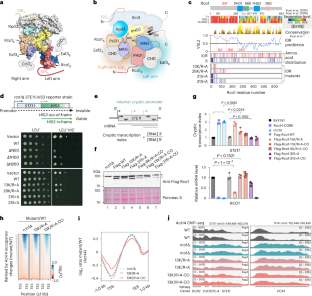
The Rpd3S histone deacetylase complex has a crucial role in genomic integrity by deacetylating transcribed nucleosomes following RNA polymerase (Pol) II passage. Cryo-EM studies highlight the importance of asymmetrical Rco1–Eaf3 dimers in nucleosome binding, yet the interaction dynamics with nucleosomal substrates alongside elongating Pol II are poorly understood. Here we demonstrate the essential function of the Rco1 N-terminal intrinsically disordered region (IDR) in modulating Pol II association, in which K/R mutations within the Rco1 IDR impair interaction of Rpd3S with the C-terminal domain (CTD) of Rpb1, without affecting nucleosome recognition or complex integrity. We also identify the Rco1-PHD1 and Eaf3-CHD domains as crucial for specific binding to Ser5-phosphorylated CTD. The Rco1 IDR alleviates autoinhibition from its C terminus, facilitating PHD1-CHD engagement with phosphorylated CTD. Furthermore, we reveal a conserved mechanism by which asymmetrical Rco1–Eaf3 dimers coordinate nucleosome engagement and Pol II interaction, enhancing understanding of epigenetic complexes associated with transcriptional machinery. This study reveals the role of the Rpd3S complex in genomic integrity, highlighting how its asymmetrical structure influences interaction with transcribed nucleosomes and elongating RNA polymerase II.
期刊介绍:
Nature Structural & Molecular Biology is a comprehensive platform that combines structural and molecular research. Our journal focuses on exploring the functional and mechanistic aspects of biological processes, emphasizing how molecular components collaborate to achieve a particular function. While structural data can shed light on these insights, our publication does not require them as a prerequisite.





 京公网安备 11010802042870号
京ICP备2023020795号-1
京公网安备 11010802042870号
京ICP备2023020795号-1

 分享
分享
 求助内容:
求助内容: 应助结果提醒方式:
 扫码关注我们
