{"title":"基于多库哈希选择的稀疏卷积 FPGA 加速器","authors":"Jia Xu, Han Pu, Dong Wang","doi":"10.3390/mi16010022","DOIUrl":null,"url":null,"abstract":"<p><p>Reconfigurable processor-based acceleration of deep convolutional neural network (DCNN) algorithms has emerged as a widely adopted technique, with particular attention on sparse neural network acceleration as an active research area. However, many computing devices that claim high computational power still struggle to execute neural network algorithms with optimal efficiency, low latency, and minimal power consumption. Consequently, there remains significant potential for further exploration into improving the efficiency, latency, and power consumption of neural network accelerators across diverse computational scenarios. This paper investigates three key techniques for hardware acceleration of sparse neural networks. The main contributions are as follows: (1) Most neural network inference tasks are typically executed on general-purpose computing devices, which often fail to deliver high energy efficiency and are not well-suited for accelerating sparse convolutional models. In this work, we propose a specialized computational circuit for the convolutional operations of sparse neural networks. This circuit is designed to detect and eliminate the computational effort associated with zero values in the sparse convolutional kernels, thereby enhancing energy efficiency. (2) The data access patterns in convolutional neural networks introduce significant pressure on the high-latency off-chip memory access process. Due to issues such as data discontinuity, the data reading unit often fails to fully exploit the available bandwidth during off-chip read and write operations. In this paper, we analyze bandwidth utilization in the context of convolutional accelerator data handling and propose a strategy to improve off-chip access efficiency. Specifically, we leverage a compiler optimization plugin developed for Vitis HLS, which automatically identifies and optimizes on-chip bandwidth utilization. (3) In coefficient-based accelerators, the synchronous operation of individual computational units can significantly hinder efficiency. Previous approaches have achieved asynchronous convolution by designing separate memory units for each computational unit; however, this method consumes a substantial amount of on-chip memory resources. To address this issue, we propose a shared feature map cache design for asynchronous convolution in the accelerators presented in this paper. This design resolves address access conflicts when multiple computational units concurrently access a set of caches by utilizing a hash-based address indexing algorithm. Moreover, the shared cache architecture reduces data redundancy and conserves on-chip resources. Using the optimized accelerator, we successfully executed ResNet50 inference on an Intel Arria 10 1150GX FPGA, achieving a throughput of 497 GOPS, or an equivalent computational power of 1579 GOPS, with a power consumption of only 22 watts.</p>","PeriodicalId":18508,"journal":{"name":"Micromachines","volume":"16 1","pages":""},"PeriodicalIF":3.5000,"publicationDate":"2024-12-27","publicationTypes":"Journal Article","fieldsOfStudy":null,"isOpenAccess":false,"openAccessPdf":"https://www.ncbi.nlm.nih.gov/pmc/articles/PMC11767370/pdf/","citationCount":"0","resultStr":"{\"title\":\"Sparse Convolution FPGA Accelerator Based on Multi-Bank Hash Selection.\",\"authors\":\"Jia Xu, Han Pu, Dong Wang\",\"doi\":\"10.3390/mi16010022\",\"DOIUrl\":null,\"url\":null,\"abstract\":\"<p><p>Reconfigurable processor-based acceleration of deep convolutional neural network (DCNN) algorithms has emerged as a widely adopted technique, with particular attention on sparse neural network acceleration as an active research area. However, many computing devices that claim high computational power still struggle to execute neural network algorithms with optimal efficiency, low latency, and minimal power consumption. Consequently, there remains significant potential for further exploration into improving the efficiency, latency, and power consumption of neural network accelerators across diverse computational scenarios. This paper investigates three key techniques for hardware acceleration of sparse neural networks. The main contributions are as follows: (1) Most neural network inference tasks are typically executed on general-purpose computing devices, which often fail to deliver high energy efficiency and are not well-suited for accelerating sparse convolutional models. In this work, we propose a specialized computational circuit for the convolutional operations of sparse neural networks. This circuit is designed to detect and eliminate the computational effort associated with zero values in the sparse convolutional kernels, thereby enhancing energy efficiency. (2) The data access patterns in convolutional neural networks introduce significant pressure on the high-latency off-chip memory access process. Due to issues such as data discontinuity, the data reading unit often fails to fully exploit the available bandwidth during off-chip read and write operations. In this paper, we analyze bandwidth utilization in the context of convolutional accelerator data handling and propose a strategy to improve off-chip access efficiency. Specifically, we leverage a compiler optimization plugin developed for Vitis HLS, which automatically identifies and optimizes on-chip bandwidth utilization. (3) In coefficient-based accelerators, the synchronous operation of individual computational units can significantly hinder efficiency. Previous approaches have achieved asynchronous convolution by designing separate memory units for each computational unit; however, this method consumes a substantial amount of on-chip memory resources. To address this issue, we propose a shared feature map cache design for asynchronous convolution in the accelerators presented in this paper. This design resolves address access conflicts when multiple computational units concurrently access a set of caches by utilizing a hash-based address indexing algorithm. Moreover, the shared cache architecture reduces data redundancy and conserves on-chip resources. Using the optimized accelerator, we successfully executed ResNet50 inference on an Intel Arria 10 1150GX FPGA, achieving a throughput of 497 GOPS, or an equivalent computational power of 1579 GOPS, with a power consumption of only 22 watts.</p>\",\"PeriodicalId\":18508,\"journal\":{\"name\":\"Micromachines\",\"volume\":\"16 1\",\"pages\":\"\"},\"PeriodicalIF\":3.5000,\"publicationDate\":\"2024-12-27\",\"publicationTypes\":\"Journal Article\",\"fieldsOfStudy\":null,\"isOpenAccess\":false,\"openAccessPdf\":\"https://www.ncbi.nlm.nih.gov/pmc/articles/PMC11767370/pdf/\",\"citationCount\":\"0\",\"resultStr\":null,\"platform\":\"Semanticscholar\",\"paperid\":null,\"PeriodicalName\":\"Micromachines\",\"FirstCategoryId\":\"5\",\"ListUrlMain\":\"https://doi.org/10.3390/mi16010022\",\"RegionNum\":3,\"RegionCategory\":\"工程技术\",\"ArticlePicture\":[],\"TitleCN\":null,\"AbstractTextCN\":null,\"PMCID\":null,\"EPubDate\":\"\",\"PubModel\":\"\",\"JCR\":\"Q2\",\"JCRName\":\"CHEMISTRY, ANALYTICAL\",\"Score\":null,\"Total\":0}","platform":"Semanticscholar","paperid":null,"PeriodicalName":"Micromachines","FirstCategoryId":"5","ListUrlMain":"https://doi.org/10.3390/mi16010022","RegionNum":3,"RegionCategory":"工程技术","ArticlePicture":[],"TitleCN":null,"AbstractTextCN":null,"PMCID":null,"EPubDate":"","PubModel":"","JCR":"Q2","JCRName":"CHEMISTRY, ANALYTICAL","Score":null,"Total":0}
Sparse Convolution FPGA Accelerator Based on Multi-Bank Hash Selection.
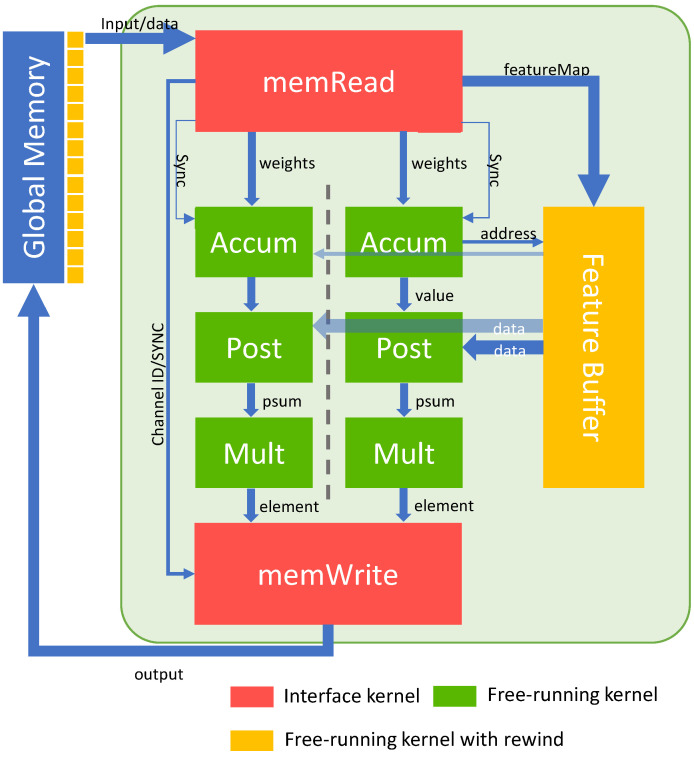
Reconfigurable processor-based acceleration of deep convolutional neural network (DCNN) algorithms has emerged as a widely adopted technique, with particular attention on sparse neural network acceleration as an active research area. However, many computing devices that claim high computational power still struggle to execute neural network algorithms with optimal efficiency, low latency, and minimal power consumption. Consequently, there remains significant potential for further exploration into improving the efficiency, latency, and power consumption of neural network accelerators across diverse computational scenarios. This paper investigates three key techniques for hardware acceleration of sparse neural networks. The main contributions are as follows: (1) Most neural network inference tasks are typically executed on general-purpose computing devices, which often fail to deliver high energy efficiency and are not well-suited for accelerating sparse convolutional models. In this work, we propose a specialized computational circuit for the convolutional operations of sparse neural networks. This circuit is designed to detect and eliminate the computational effort associated with zero values in the sparse convolutional kernels, thereby enhancing energy efficiency. (2) The data access patterns in convolutional neural networks introduce significant pressure on the high-latency off-chip memory access process. Due to issues such as data discontinuity, the data reading unit often fails to fully exploit the available bandwidth during off-chip read and write operations. In this paper, we analyze bandwidth utilization in the context of convolutional accelerator data handling and propose a strategy to improve off-chip access efficiency. Specifically, we leverage a compiler optimization plugin developed for Vitis HLS, which automatically identifies and optimizes on-chip bandwidth utilization. (3) In coefficient-based accelerators, the synchronous operation of individual computational units can significantly hinder efficiency. Previous approaches have achieved asynchronous convolution by designing separate memory units for each computational unit; however, this method consumes a substantial amount of on-chip memory resources. To address this issue, we propose a shared feature map cache design for asynchronous convolution in the accelerators presented in this paper. This design resolves address access conflicts when multiple computational units concurrently access a set of caches by utilizing a hash-based address indexing algorithm. Moreover, the shared cache architecture reduces data redundancy and conserves on-chip resources. Using the optimized accelerator, we successfully executed ResNet50 inference on an Intel Arria 10 1150GX FPGA, achieving a throughput of 497 GOPS, or an equivalent computational power of 1579 GOPS, with a power consumption of only 22 watts.
期刊介绍:
Micromachines (ISSN 2072-666X) is an international, peer-reviewed open access journal which provides an advanced forum for studies related to micro-scaled machines and micromachinery. It publishes reviews, regular research papers and short communications. Our aim is to encourage scientists to publish their experimental and theoretical results in as much detail as possible. There is no restriction on the length of the papers. The full experimental details must be provided so that the results can be reproduced.







 京公网安备 11010802042870号
京ICP备2023020795号-1
京公网安备 11010802042870号
京ICP备2023020795号-1

 分享
分享
 求助内容:
求助内容: 应助结果提醒方式:
 扫码关注我们
