Kristine A. Karvonen MD, MS, David R. Doody MS, Dwight Barry PhD, Kira Bona MD, MPH, Lena E. Winestone MD, MSHP, Abby R. Rosenberg MD, MS, MA, Jason A. Mendoza MD, MPH, Stephen M. Schwartz PhD, MPH, Eric J. Chow MD, MPH
{"title":"西雅图和华盛顿州塔科马2000-2019年间诊断出癌症的儿童、青少年和年轻人的历史红线和生存率。","authors":"Kristine A. Karvonen MD, MS, David R. Doody MS, Dwight Barry PhD, Kira Bona MD, MPH, Lena E. Winestone MD, MSHP, Abby R. Rosenberg MD, MS, MA, Jason A. Mendoza MD, MPH, Stephen M. Schwartz PhD, MPH, Eric J. Chow MD, MPH","doi":"10.1002/cncr.35677","DOIUrl":null,"url":null,"abstract":"<div>\n \n \n <section>\n \n <h3> Background</h3>\n \n <p>Historical redlining has been associated with inferior survival in adult-onset cancers. However, its relationship with pediatric, adolescent, and young–adult-onset cancer outcomes is unknown.</p>\n </section>\n \n <section>\n \n <h3> Methods</h3>\n \n <p>This study identified incident cancer among individuals <40 years of age living in Seattle and Tacoma between 2000–2019 via the population-based Cancer Surveillance System. The authors determined case redlining status using Home Owners’ Loans Corporation data overlaid with 2000 and 2010 census tracts. Kaplan–Meier methods and multivariable Cox proportional hazards models were used to determine 5- and 10-year overall survival and hazard ratio (HR) of death according to redlined status. Cox models adjusted for patient and tumor characteristics and area-level poverty; interaction between redlining and area-level poverty was also assessed.</p>\n </section>\n \n <section>\n \n <h3> Results</h3>\n \n <p>Among 4355 cases (median age at diagnosis 32 years), overall survival at 5 years was lower (85.1%; 95% confidence interval [CI], 83.5%–86.5%) among individuals residing in redlined neighborhoods compared with those in unexposed neighborhoods (90.3%; 95% CI, 89.0%–91.5%). Survival differences persisted at 10 years. The unadjusted hazard of death for redlined exposed individuals with cancer was higher than redlined unexposed (hazard ratio [HR], 1.62; 95% CI, 1.39–1.89). In the fully adjusted model, mortality remained higher for redlined cases (HR, 1.32; 95% CI, 1.12–1.56). There did not appear to be effect modification from area-level poverty in the relationship between redlining and death (<i>p</i> = .49).</p>\n </section>\n \n <section>\n \n <h3> Conclusions</h3>\n \n <p>Among young individuals with cancer, residence at diagnosis in previously redlined neighborhoods was associated with lower survival compared with those residing in nonredlined neighborhoods, supporting the hypothesis that structural racism exerts persistent effects on contemporary health outcomes.</p>\n </section>\n </div>","PeriodicalId":138,"journal":{"name":"Cancer","volume":"131 3","pages":""},"PeriodicalIF":5.1000,"publicationDate":"2025-01-27","publicationTypes":"Journal Article","fieldsOfStudy":null,"isOpenAccess":false,"openAccessPdf":"","citationCount":"0","resultStr":"{\"title\":\"Historical redlining and survival among children, adolescents, and young adults with cancer diagnosed between 2000–2019 in Seattle and Tacoma, Washington\",\"authors\":\"Kristine A. Karvonen MD, MS, David R. Doody MS, Dwight Barry PhD, Kira Bona MD, MPH, Lena E. Winestone MD, MSHP, Abby R. Rosenberg MD, MS, MA, Jason A. Mendoza MD, MPH, Stephen M. Schwartz PhD, MPH, Eric J. Chow MD, MPH\",\"doi\":\"10.1002/cncr.35677\",\"DOIUrl\":null,\"url\":null,\"abstract\":\"<div>\\n \\n \\n <section>\\n \\n <h3> Background</h3>\\n \\n <p>Historical redlining has been associated with inferior survival in adult-onset cancers. However, its relationship with pediatric, adolescent, and young–adult-onset cancer outcomes is unknown.</p>\\n </section>\\n \\n <section>\\n \\n <h3> Methods</h3>\\n \\n <p>This study identified incident cancer among individuals <40 years of age living in Seattle and Tacoma between 2000–2019 via the population-based Cancer Surveillance System. The authors determined case redlining status using Home Owners’ Loans Corporation data overlaid with 2000 and 2010 census tracts. Kaplan–Meier methods and multivariable Cox proportional hazards models were used to determine 5- and 10-year overall survival and hazard ratio (HR) of death according to redlined status. Cox models adjusted for patient and tumor characteristics and area-level poverty; interaction between redlining and area-level poverty was also assessed.</p>\\n </section>\\n \\n <section>\\n \\n <h3> Results</h3>\\n \\n <p>Among 4355 cases (median age at diagnosis 32 years), overall survival at 5 years was lower (85.1%; 95% confidence interval [CI], 83.5%–86.5%) among individuals residing in redlined neighborhoods compared with those in unexposed neighborhoods (90.3%; 95% CI, 89.0%–91.5%). Survival differences persisted at 10 years. The unadjusted hazard of death for redlined exposed individuals with cancer was higher than redlined unexposed (hazard ratio [HR], 1.62; 95% CI, 1.39–1.89). In the fully adjusted model, mortality remained higher for redlined cases (HR, 1.32; 95% CI, 1.12–1.56). There did not appear to be effect modification from area-level poverty in the relationship between redlining and death (<i>p</i> = .49).</p>\\n </section>\\n \\n <section>\\n \\n <h3> Conclusions</h3>\\n \\n <p>Among young individuals with cancer, residence at diagnosis in previously redlined neighborhoods was associated with lower survival compared with those residing in nonredlined neighborhoods, supporting the hypothesis that structural racism exerts persistent effects on contemporary health outcomes.</p>\\n </section>\\n </div>\",\"PeriodicalId\":138,\"journal\":{\"name\":\"Cancer\",\"volume\":\"131 3\",\"pages\":\"\"},\"PeriodicalIF\":5.1000,\"publicationDate\":\"2025-01-27\",\"publicationTypes\":\"Journal Article\",\"fieldsOfStudy\":null,\"isOpenAccess\":false,\"openAccessPdf\":\"\",\"citationCount\":\"0\",\"resultStr\":null,\"platform\":\"Semanticscholar\",\"paperid\":null,\"PeriodicalName\":\"Cancer\",\"FirstCategoryId\":\"3\",\"ListUrlMain\":\"https://acsjournals.onlinelibrary.wiley.com/doi/10.1002/cncr.35677\",\"RegionNum\":2,\"RegionCategory\":\"医学\",\"ArticlePicture\":[],\"TitleCN\":null,\"AbstractTextCN\":null,\"PMCID\":null,\"EPubDate\":\"\",\"PubModel\":\"\",\"JCR\":\"Q1\",\"JCRName\":\"ONCOLOGY\",\"Score\":null,\"Total\":0}","platform":"Semanticscholar","paperid":null,"PeriodicalName":"Cancer","FirstCategoryId":"3","ListUrlMain":"https://acsjournals.onlinelibrary.wiley.com/doi/10.1002/cncr.35677","RegionNum":2,"RegionCategory":"医学","ArticlePicture":[],"TitleCN":null,"AbstractTextCN":null,"PMCID":null,"EPubDate":"","PubModel":"","JCR":"Q1","JCRName":"ONCOLOGY","Score":null,"Total":0}
Historical redlining and survival among children, adolescents, and young adults with cancer diagnosed between 2000–2019 in Seattle and Tacoma, Washington
Background
Historical redlining has been associated with inferior survival in adult-onset cancers. However, its relationship with pediatric, adolescent, and young–adult-onset cancer outcomes is unknown.
Methods
This study identified incident cancer among individuals <40 years of age living in Seattle and Tacoma between 2000–2019 via the population-based Cancer Surveillance System. The authors determined case redlining status using Home Owners’ Loans Corporation data overlaid with 2000 and 2010 census tracts. Kaplan–Meier methods and multivariable Cox proportional hazards models were used to determine 5- and 10-year overall survival and hazard ratio (HR) of death according to redlined status. Cox models adjusted for patient and tumor characteristics and area-level poverty; interaction between redlining and area-level poverty was also assessed.
Results
Among 4355 cases (median age at diagnosis 32 years), overall survival at 5 years was lower (85.1%; 95% confidence interval [CI], 83.5%–86.5%) among individuals residing in redlined neighborhoods compared with those in unexposed neighborhoods (90.3%; 95% CI, 89.0%–91.5%). Survival differences persisted at 10 years. The unadjusted hazard of death for redlined exposed individuals with cancer was higher than redlined unexposed (hazard ratio [HR], 1.62; 95% CI, 1.39–1.89). In the fully adjusted model, mortality remained higher for redlined cases (HR, 1.32; 95% CI, 1.12–1.56). There did not appear to be effect modification from area-level poverty in the relationship between redlining and death (p = .49).
Conclusions
Among young individuals with cancer, residence at diagnosis in previously redlined neighborhoods was associated with lower survival compared with those residing in nonredlined neighborhoods, supporting the hypothesis that structural racism exerts persistent effects on contemporary health outcomes.
期刊介绍:
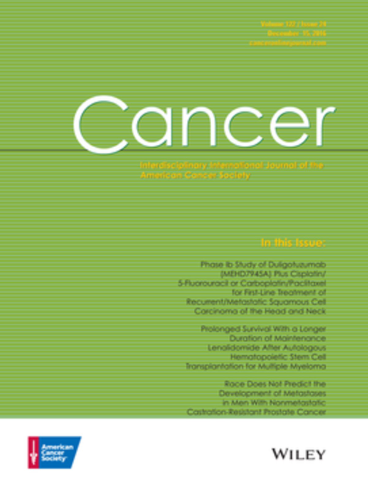
The CANCER site is a full-text, electronic implementation of CANCER, an Interdisciplinary International Journal of the American Cancer Society, and CANCER CYTOPATHOLOGY, a Journal of the American Cancer Society.
CANCER publishes interdisciplinary oncologic information according to, but not limited to, the following disease sites and disciplines: blood/bone marrow; breast disease; endocrine disorders; epidemiology; gastrointestinal tract; genitourinary disease; gynecologic oncology; head and neck disease; hepatobiliary tract; integrated medicine; lung disease; medical oncology; neuro-oncology; pathology radiation oncology; translational research



 京公网安备 11010802042870号
京ICP备2023020795号-1
京公网安备 11010802042870号
京ICP备2023020795号-1

 分享
分享
 求助内容:
求助内容: 应助结果提醒方式:
 扫码关注我们
