Sunita Birara, Moumita Majumder and Ramesh K. Metre
{"title":"作为单室 H2O2 燃料电池阴极材料的双(甲臢酸)铁(II)配合物","authors":"Sunita Birara, Moumita Majumder and Ramesh K. Metre","doi":"10.1039/D4DT03253E","DOIUrl":null,"url":null,"abstract":"<p >In this paper, we describe the synthesis of two six-coordinate, pseudo(octahedral) bis(formazanate) Fe(<small>II</small>) complexes based on newly developed redox-active benzothiazole-substituted formazanate ligands. Complexes [Fe<small><sup>II</sup></small>(L1)<small><sub>2</sub></small>], <strong>1</strong>, and [Fe<small><sup>II</sup></small>(L2)<small><sub>2</sub></small>], <strong>2</strong>, were synthesized by reacting 1-(benzothiazol-2-yl)-5-phenyl-3-(pyren-1-yl)formazan (<strong>L1H</strong>) and 1-(benzothiazol-2-yl)-5-(2-benzoyl-4-chlorophenyl)-3-phenylformazan (<strong>L2H</strong>), respectively, with appropriate Fe(<small>II</small>) precursors at room temperature. The molecular structures of both bis(formazanate) iron complexes were established using single-crystal XRD, and other characterization methods were utilized to further characterize these complexes, as well as the newly synthesized ligands. Furthermore, the cyclic voltammetry studies of these compounds are documented, revealing that both complexes can undergo electrochemical reductions to create anionic and dianionic species. These complexes were further employed as cathodes in one-compartment membrane-less H<small><sub>2</sub></small>O<small><sub>2</sub></small> fuel cells, operating in 0.5 M H<small><sub>2</sub></small>O<small><sub>2</sub></small>, with nickel foam serving as the anode. The maximum power densities achieved by the designed H<small><sub>2</sub></small>O<small><sub>2</sub></small> fuel cells for complexes <strong>1</strong> and <strong>2</strong> were 1.88 mW cm<small><sup>−2</sup></small> and 3.08 mW cm<small><sup>−2</sup></small>, respectively. This study demonstrates the significant potential of formazanate-based compounds in the development of cathode materials for H<small><sub>2</sub></small>O<small><sub>2</sub></small> fuel cells.</p>","PeriodicalId":71,"journal":{"name":"Dalton Transactions","volume":" 10","pages":" 4120-4134"},"PeriodicalIF":3.3000,"publicationDate":"2025-01-28","publicationTypes":"Journal Article","fieldsOfStudy":null,"isOpenAccess":false,"openAccessPdf":"","citationCount":"0","resultStr":"{\"title\":\"Bis(formazanate) iron(ii) complexes as cathode materials for one-compartment H2O2 fuel cells†\",\"authors\":\"Sunita Birara, Moumita Majumder and Ramesh K. Metre\",\"doi\":\"10.1039/D4DT03253E\",\"DOIUrl\":null,\"url\":null,\"abstract\":\"<p >In this paper, we describe the synthesis of two six-coordinate, pseudo(octahedral) bis(formazanate) Fe(<small>II</small>) complexes based on newly developed redox-active benzothiazole-substituted formazanate ligands. Complexes [Fe<small><sup>II</sup></small>(L1)<small><sub>2</sub></small>], <strong>1</strong>, and [Fe<small><sup>II</sup></small>(L2)<small><sub>2</sub></small>], <strong>2</strong>, were synthesized by reacting 1-(benzothiazol-2-yl)-5-phenyl-3-(pyren-1-yl)formazan (<strong>L1H</strong>) and 1-(benzothiazol-2-yl)-5-(2-benzoyl-4-chlorophenyl)-3-phenylformazan (<strong>L2H</strong>), respectively, with appropriate Fe(<small>II</small>) precursors at room temperature. The molecular structures of both bis(formazanate) iron complexes were established using single-crystal XRD, and other characterization methods were utilized to further characterize these complexes, as well as the newly synthesized ligands. Furthermore, the cyclic voltammetry studies of these compounds are documented, revealing that both complexes can undergo electrochemical reductions to create anionic and dianionic species. These complexes were further employed as cathodes in one-compartment membrane-less H<small><sub>2</sub></small>O<small><sub>2</sub></small> fuel cells, operating in 0.5 M H<small><sub>2</sub></small>O<small><sub>2</sub></small>, with nickel foam serving as the anode. The maximum power densities achieved by the designed H<small><sub>2</sub></small>O<small><sub>2</sub></small> fuel cells for complexes <strong>1</strong> and <strong>2</strong> were 1.88 mW cm<small><sup>−2</sup></small> and 3.08 mW cm<small><sup>−2</sup></small>, respectively. This study demonstrates the significant potential of formazanate-based compounds in the development of cathode materials for H<small><sub>2</sub></small>O<small><sub>2</sub></small> fuel cells.</p>\",\"PeriodicalId\":71,\"journal\":{\"name\":\"Dalton Transactions\",\"volume\":\" 10\",\"pages\":\" 4120-4134\"},\"PeriodicalIF\":3.3000,\"publicationDate\":\"2025-01-28\",\"publicationTypes\":\"Journal Article\",\"fieldsOfStudy\":null,\"isOpenAccess\":false,\"openAccessPdf\":\"\",\"citationCount\":\"0\",\"resultStr\":null,\"platform\":\"Semanticscholar\",\"paperid\":null,\"PeriodicalName\":\"Dalton Transactions\",\"FirstCategoryId\":\"92\",\"ListUrlMain\":\"https://pubs.rsc.org/en/content/articlelanding/2025/dt/d4dt03253e\",\"RegionNum\":3,\"RegionCategory\":\"化学\",\"ArticlePicture\":[],\"TitleCN\":null,\"AbstractTextCN\":null,\"PMCID\":null,\"EPubDate\":\"\",\"PubModel\":\"\",\"JCR\":\"Q2\",\"JCRName\":\"CHEMISTRY, INORGANIC & NUCLEAR\",\"Score\":null,\"Total\":0}","platform":"Semanticscholar","paperid":null,"PeriodicalName":"Dalton Transactions","FirstCategoryId":"92","ListUrlMain":"https://pubs.rsc.org/en/content/articlelanding/2025/dt/d4dt03253e","RegionNum":3,"RegionCategory":"化学","ArticlePicture":[],"TitleCN":null,"AbstractTextCN":null,"PMCID":null,"EPubDate":"","PubModel":"","JCR":"Q2","JCRName":"CHEMISTRY, INORGANIC & NUCLEAR","Score":null,"Total":0}
引用次数: 0
摘要
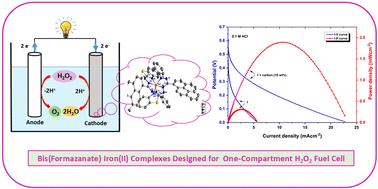
本文报道了两种基于新型氧化还原活性苯并噻唑取代的双(甲酸乙酯)配体的六坐标伪(八面体)双(甲酸乙酯)Fe(II)配合物。用合适的Fe(II)前驱体在室温下分别与1-(苯并噻唑-2-基)-5-苯基-3-(芘-1-基)甲酸(L1H)和1-(苯并噻唑-2-基)-5-(2-苯并甲酰-4-氯苯基)-3-苯基甲酸(L2H)反应合成配合物[FeII(L1)2], 1和[FeII(L2)2], 2。利用单晶XRD建立了这两种双(甲酸)铁配合物的分子结构,并利用其他表征方法进一步表征了这两种配合物以及新合成的配体。此外,这些化合物的循环伏安法被记录,揭示了这两个配合物可能经历电化学还原产生阴离子和重阴离子的物种。这些配合物进一步用作一室无膜H2O2燃料电池的阴极,在0.5 M H2O2中工作,泡沫镍作为阳极。所设计的H2O2燃料电池对配合物1和2的最大功率密度分别为1.88 mW cm-2和3.08 mW cm-2。这项研究表明,在开发H2O2燃料电池正极材料中,研究基于甲酸盐的化合物具有重要的潜力。
Bis(formazanate) iron(ii) complexes as cathode materials for one-compartment H2O2 fuel cells†
In this paper, we describe the synthesis of two six-coordinate, pseudo(octahedral) bis(formazanate) Fe(II) complexes based on newly developed redox-active benzothiazole-substituted formazanate ligands. Complexes [FeII(L1)2], 1, and [FeII(L2)2], 2, were synthesized by reacting 1-(benzothiazol-2-yl)-5-phenyl-3-(pyren-1-yl)formazan (L1H) and 1-(benzothiazol-2-yl)-5-(2-benzoyl-4-chlorophenyl)-3-phenylformazan (L2H), respectively, with appropriate Fe(II) precursors at room temperature. The molecular structures of both bis(formazanate) iron complexes were established using single-crystal XRD, and other characterization methods were utilized to further characterize these complexes, as well as the newly synthesized ligands. Furthermore, the cyclic voltammetry studies of these compounds are documented, revealing that both complexes can undergo electrochemical reductions to create anionic and dianionic species. These complexes were further employed as cathodes in one-compartment membrane-less H2O2 fuel cells, operating in 0.5 M H2O2, with nickel foam serving as the anode. The maximum power densities achieved by the designed H2O2 fuel cells for complexes 1 and 2 were 1.88 mW cm−2 and 3.08 mW cm−2, respectively. This study demonstrates the significant potential of formazanate-based compounds in the development of cathode materials for H2O2 fuel cells.
期刊介绍:
Dalton Transactions is a journal for all areas of inorganic chemistry, which encompasses the organometallic, bioinorganic and materials chemistry of the elements, with applications including synthesis, catalysis, energy conversion/storage, electrical devices and medicine. Dalton Transactions welcomes high-quality, original submissions in all of these areas and more, where the advancement of knowledge in inorganic chemistry is significant.




 京公网安备 11010802042870号
京ICP备2023020795号-1
京公网安备 11010802042870号
京ICP备2023020795号-1

 分享
分享
 求助内容:
求助内容: 应助结果提醒方式:
 扫码关注我们
