Kategowdru Vijayakumar Soujanya, Suresh Kumar Gurusiddaiah and Appukuttan Padmanabhan Jayadeep*,
{"title":"UPLC-ESI-HRMS/MS /MS表征、抗氧化活性和富含胚乳的五指粟(Eleusine coracana)种皮和胚乳组分","authors":"Kategowdru Vijayakumar Soujanya, Suresh Kumar Gurusiddaiah and Appukuttan Padmanabhan Jayadeep*, ","doi":"10.1021/acsfoodscitech.4c00581","DOIUrl":null,"url":null,"abstract":"<p >The finger millet seed coat and endosperm are rich in phytonutrients, and processing these components through thermal methods can influence their metabolite composition. This study evaluated their phenolic profiles using ultraperformance liquid chromatography-electrospray ionization-high-resolution mass spectrometry (UPLC-ESI-HRMS/MS), identifying 30 phytochemical compounds, including 17 phenolic acids and 13 flavonoids. Novel compounds such as ellagic acid glucoside and 3-hydroxycoumarin were found in the seed coat, while the endosperm contained 3-hydroxycoumarin, ellagic acid glucoside, and genistin. Drum drying resulted in the appearance of ferulic acid-4-glucoside quercetin-3-(6′-malonylglucoside) and gallocatechin, but there was a disappearance of caffeoyl aspartic acid and apigenin-7-glucoside from both seed coat and endosperm extracts. Despite processing, the catechin content decreased by only 13%. Drum drying decreased the total dietary fiber (TDF) in the seed coat (25%) but increased it in the endosperm (14%). 2,2′-Diphenyl-1-picrylhydrazyl (DPPH) scavenging activity decreased in the seed coat (30%) but increased in the endosperm (18%). Total antioxidant activity was unaffected. These results suggest that drum-dried finger millet fractions offer potential as functional foods with enhanced nutritional and antioxidant properties.</p>","PeriodicalId":72048,"journal":{"name":"ACS food science & technology","volume":"5 1","pages":"85–94 85–94"},"PeriodicalIF":3.0000,"publicationDate":"2024-12-22","publicationTypes":"Journal Article","fieldsOfStudy":null,"isOpenAccess":false,"openAccessPdf":"","citationCount":"0","resultStr":"{\"title\":\"UPLC-ESI-HRMS/MS Phenolic Characterization, Antioxidant Activity, and Proximate Composition of Drum-Dried Finger Millet (Eleusine coracana) Seed Coat- and Endosperm-Rich Fractions\",\"authors\":\"Kategowdru Vijayakumar Soujanya, Suresh Kumar Gurusiddaiah and Appukuttan Padmanabhan Jayadeep*, \",\"doi\":\"10.1021/acsfoodscitech.4c00581\",\"DOIUrl\":null,\"url\":null,\"abstract\":\"<p >The finger millet seed coat and endosperm are rich in phytonutrients, and processing these components through thermal methods can influence their metabolite composition. This study evaluated their phenolic profiles using ultraperformance liquid chromatography-electrospray ionization-high-resolution mass spectrometry (UPLC-ESI-HRMS/MS), identifying 30 phytochemical compounds, including 17 phenolic acids and 13 flavonoids. Novel compounds such as ellagic acid glucoside and 3-hydroxycoumarin were found in the seed coat, while the endosperm contained 3-hydroxycoumarin, ellagic acid glucoside, and genistin. Drum drying resulted in the appearance of ferulic acid-4-glucoside quercetin-3-(6′-malonylglucoside) and gallocatechin, but there was a disappearance of caffeoyl aspartic acid and apigenin-7-glucoside from both seed coat and endosperm extracts. Despite processing, the catechin content decreased by only 13%. Drum drying decreased the total dietary fiber (TDF) in the seed coat (25%) but increased it in the endosperm (14%). 2,2′-Diphenyl-1-picrylhydrazyl (DPPH) scavenging activity decreased in the seed coat (30%) but increased in the endosperm (18%). Total antioxidant activity was unaffected. These results suggest that drum-dried finger millet fractions offer potential as functional foods with enhanced nutritional and antioxidant properties.</p>\",\"PeriodicalId\":72048,\"journal\":{\"name\":\"ACS food science & technology\",\"volume\":\"5 1\",\"pages\":\"85–94 85–94\"},\"PeriodicalIF\":3.0000,\"publicationDate\":\"2024-12-22\",\"publicationTypes\":\"Journal Article\",\"fieldsOfStudy\":null,\"isOpenAccess\":false,\"openAccessPdf\":\"\",\"citationCount\":\"0\",\"resultStr\":null,\"platform\":\"Semanticscholar\",\"paperid\":null,\"PeriodicalName\":\"ACS food science & technology\",\"FirstCategoryId\":\"1085\",\"ListUrlMain\":\"https://pubs.acs.org/doi/10.1021/acsfoodscitech.4c00581\",\"RegionNum\":0,\"RegionCategory\":null,\"ArticlePicture\":[],\"TitleCN\":null,\"AbstractTextCN\":null,\"PMCID\":null,\"EPubDate\":\"\",\"PubModel\":\"\",\"JCR\":\"Q2\",\"JCRName\":\"FOOD SCIENCE & TECHNOLOGY\",\"Score\":null,\"Total\":0}","platform":"Semanticscholar","paperid":null,"PeriodicalName":"ACS food science & technology","FirstCategoryId":"1085","ListUrlMain":"https://pubs.acs.org/doi/10.1021/acsfoodscitech.4c00581","RegionNum":0,"RegionCategory":null,"ArticlePicture":[],"TitleCN":null,"AbstractTextCN":null,"PMCID":null,"EPubDate":"","PubModel":"","JCR":"Q2","JCRName":"FOOD SCIENCE & TECHNOLOGY","Score":null,"Total":0}
UPLC-ESI-HRMS/MS Phenolic Characterization, Antioxidant Activity, and Proximate Composition of Drum-Dried Finger Millet (Eleusine coracana) Seed Coat- and Endosperm-Rich Fractions
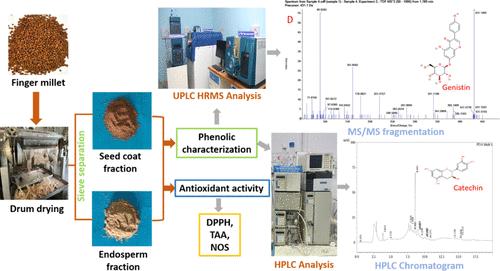
The finger millet seed coat and endosperm are rich in phytonutrients, and processing these components through thermal methods can influence their metabolite composition. This study evaluated their phenolic profiles using ultraperformance liquid chromatography-electrospray ionization-high-resolution mass spectrometry (UPLC-ESI-HRMS/MS), identifying 30 phytochemical compounds, including 17 phenolic acids and 13 flavonoids. Novel compounds such as ellagic acid glucoside and 3-hydroxycoumarin were found in the seed coat, while the endosperm contained 3-hydroxycoumarin, ellagic acid glucoside, and genistin. Drum drying resulted in the appearance of ferulic acid-4-glucoside quercetin-3-(6′-malonylglucoside) and gallocatechin, but there was a disappearance of caffeoyl aspartic acid and apigenin-7-glucoside from both seed coat and endosperm extracts. Despite processing, the catechin content decreased by only 13%. Drum drying decreased the total dietary fiber (TDF) in the seed coat (25%) but increased it in the endosperm (14%). 2,2′-Diphenyl-1-picrylhydrazyl (DPPH) scavenging activity decreased in the seed coat (30%) but increased in the endosperm (18%). Total antioxidant activity was unaffected. These results suggest that drum-dried finger millet fractions offer potential as functional foods with enhanced nutritional and antioxidant properties.




 京公网安备 11010802042870号
京ICP备2023020795号-1
京公网安备 11010802042870号
京ICP备2023020795号-1

 分享
分享

 求助内容:
求助内容: 应助结果提醒方式:
 扫码关注我们
