Dan Li , Danni Dai , Jianrong Wang, Zhen Ai, Chao Zhang
{"title":"受鱼鳞启发的仿生纳米涂层镁植入物用于感染性骨缺损血管化骨再生","authors":"Dan Li , Danni Dai , Jianrong Wang, Zhen Ai, Chao Zhang","doi":"10.1016/j.jma.2024.07.012","DOIUrl":null,"url":null,"abstract":"<div><div>The regeneration of infected bone defects is still challenging and time-consuming, due to the adverse osteogenic microenvironment caused by bacterial contamination and pronounced ischemia. Biodegradable magnesium (Mg)-based alloys are desirable for orthopedic implants due to the mechanical properties approximating those of human bone and the released Mg<sup>2+</sup> ions essential to osteogenic activity. However, the fast and uncontrolled self-degradation of Mg alloy, along with the inadequate antimicrobial activity, limit their strength in the osteogenic microenvironment. Inspired by the structural and physiological characteristics of “fish scales,” two-dimensional (2D) nanomaterials, black phosphorus (BP) and graphene oxide (GO), were assembled together under the action of pulsed electric field. The bionic 2D layered BP/GO nano-coating was constructed for infection resistance, osteogenic microenvironment optimization, and biodegradation control. In the early stage of implantation, it exerted a photothermal effect to ablate bacterial biofilms and avoid contaminating the microenvironment. The blocking effect of the “nano fish scales” - 2D material superposition regulated the degradation of implants. In the later stage, it attracted the migration of vascular endothelial cells (VECs) and released phosphate slowly for <em>in situ</em> mineralization to create the microenvironment favoring vascularized bone formation. It is indicated that the enhancement of microtubule deacetylation and cytoskeletal reorganization played a key role in the effect of VEC migration and angiogenesis. This study provided a promising bionic strategy for creating osteogenic microenvironments that match the sequential healing process of infected bone defects.</div></div>","PeriodicalId":16214,"journal":{"name":"Journal of Magnesium and Alloys","volume":"13 1","pages":"Pages 311-329"},"PeriodicalIF":13.8000,"publicationDate":"2025-01-01","publicationTypes":"Journal Article","fieldsOfStudy":null,"isOpenAccess":false,"openAccessPdf":"","citationCount":"0","resultStr":"{\"title\":\"Fish scale-inspired biomimetic nanocoatings on magnesium implants for vascularized bone regeneration in infected bone defects\",\"authors\":\"Dan Li , Danni Dai , Jianrong Wang, Zhen Ai, Chao Zhang\",\"doi\":\"10.1016/j.jma.2024.07.012\",\"DOIUrl\":null,\"url\":null,\"abstract\":\"<div><div>The regeneration of infected bone defects is still challenging and time-consuming, due to the adverse osteogenic microenvironment caused by bacterial contamination and pronounced ischemia. Biodegradable magnesium (Mg)-based alloys are desirable for orthopedic implants due to the mechanical properties approximating those of human bone and the released Mg<sup>2+</sup> ions essential to osteogenic activity. However, the fast and uncontrolled self-degradation of Mg alloy, along with the inadequate antimicrobial activity, limit their strength in the osteogenic microenvironment. Inspired by the structural and physiological characteristics of “fish scales,” two-dimensional (2D) nanomaterials, black phosphorus (BP) and graphene oxide (GO), were assembled together under the action of pulsed electric field. The bionic 2D layered BP/GO nano-coating was constructed for infection resistance, osteogenic microenvironment optimization, and biodegradation control. In the early stage of implantation, it exerted a photothermal effect to ablate bacterial biofilms and avoid contaminating the microenvironment. The blocking effect of the “nano fish scales” - 2D material superposition regulated the degradation of implants. In the later stage, it attracted the migration of vascular endothelial cells (VECs) and released phosphate slowly for <em>in situ</em> mineralization to create the microenvironment favoring vascularized bone formation. It is indicated that the enhancement of microtubule deacetylation and cytoskeletal reorganization played a key role in the effect of VEC migration and angiogenesis. This study provided a promising bionic strategy for creating osteogenic microenvironments that match the sequential healing process of infected bone defects.</div></div>\",\"PeriodicalId\":16214,\"journal\":{\"name\":\"Journal of Magnesium and Alloys\",\"volume\":\"13 1\",\"pages\":\"Pages 311-329\"},\"PeriodicalIF\":13.8000,\"publicationDate\":\"2025-01-01\",\"publicationTypes\":\"Journal Article\",\"fieldsOfStudy\":null,\"isOpenAccess\":false,\"openAccessPdf\":\"\",\"citationCount\":\"0\",\"resultStr\":null,\"platform\":\"Semanticscholar\",\"paperid\":null,\"PeriodicalName\":\"Journal of Magnesium and Alloys\",\"FirstCategoryId\":\"88\",\"ListUrlMain\":\"https://www.sciencedirect.com/science/article/pii/S2213956724002512\",\"RegionNum\":1,\"RegionCategory\":\"材料科学\",\"ArticlePicture\":[],\"TitleCN\":null,\"AbstractTextCN\":null,\"PMCID\":null,\"EPubDate\":\"2024/7/31 0:00:00\",\"PubModel\":\"Epub\",\"JCR\":\"Q1\",\"JCRName\":\"METALLURGY & METALLURGICAL ENGINEERING\",\"Score\":null,\"Total\":0}","platform":"Semanticscholar","paperid":null,"PeriodicalName":"Journal of Magnesium and Alloys","FirstCategoryId":"88","ListUrlMain":"https://www.sciencedirect.com/science/article/pii/S2213956724002512","RegionNum":1,"RegionCategory":"材料科学","ArticlePicture":[],"TitleCN":null,"AbstractTextCN":null,"PMCID":null,"EPubDate":"2024/7/31 0:00:00","PubModel":"Epub","JCR":"Q1","JCRName":"METALLURGY & METALLURGICAL ENGINEERING","Score":null,"Total":0}
Fish scale-inspired biomimetic nanocoatings on magnesium implants for vascularized bone regeneration in infected bone defects
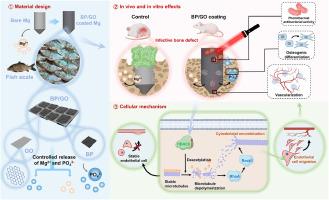
The regeneration of infected bone defects is still challenging and time-consuming, due to the adverse osteogenic microenvironment caused by bacterial contamination and pronounced ischemia. Biodegradable magnesium (Mg)-based alloys are desirable for orthopedic implants due to the mechanical properties approximating those of human bone and the released Mg2+ ions essential to osteogenic activity. However, the fast and uncontrolled self-degradation of Mg alloy, along with the inadequate antimicrobial activity, limit their strength in the osteogenic microenvironment. Inspired by the structural and physiological characteristics of “fish scales,” two-dimensional (2D) nanomaterials, black phosphorus (BP) and graphene oxide (GO), were assembled together under the action of pulsed electric field. The bionic 2D layered BP/GO nano-coating was constructed for infection resistance, osteogenic microenvironment optimization, and biodegradation control. In the early stage of implantation, it exerted a photothermal effect to ablate bacterial biofilms and avoid contaminating the microenvironment. The blocking effect of the “nano fish scales” - 2D material superposition regulated the degradation of implants. In the later stage, it attracted the migration of vascular endothelial cells (VECs) and released phosphate slowly for in situ mineralization to create the microenvironment favoring vascularized bone formation. It is indicated that the enhancement of microtubule deacetylation and cytoskeletal reorganization played a key role in the effect of VEC migration and angiogenesis. This study provided a promising bionic strategy for creating osteogenic microenvironments that match the sequential healing process of infected bone defects.
期刊介绍:
The Journal of Magnesium and Alloys serves as a global platform for both theoretical and experimental studies in magnesium science and engineering. It welcomes submissions investigating various scientific and engineering factors impacting the metallurgy, processing, microstructure, properties, and applications of magnesium and alloys. The journal covers all aspects of magnesium and alloy research, including raw materials, alloy casting, extrusion and deformation, corrosion and surface treatment, joining and machining, simulation and modeling, microstructure evolution and mechanical properties, new alloy development, magnesium-based composites, bio-materials and energy materials, applications, and recycling.




 京公网安备 11010802042870号
京ICP备2023020795号-1
京公网安备 11010802042870号
京ICP备2023020795号-1

 分享
分享
 求助内容:
求助内容: 应助结果提醒方式:
 扫码关注我们
