Dr. Maya Guillaumont, Dr. Stéphanie Halbert, Dr. Alexy P. Freitas, Dr. Valérie Briois, Dr. Sophie Carenco, Prof. Hélène Gérard
{"title":"油胺还原铜(II)成核的两步还原途径:模拟与实验联合研究。","authors":"Dr. Maya Guillaumont, Dr. Stéphanie Halbert, Dr. Alexy P. Freitas, Dr. Valérie Briois, Dr. Sophie Carenco, Prof. Hélène Gérard","doi":"10.1002/cphc.202401027","DOIUrl":null,"url":null,"abstract":"<p>Oleylamine is widely used in the synthesis of colloidal nanoparticles, as a solvent, as a stabilizing agent, and sometimes as a reducing agent. For example, metallic nanoparticles are obtained through reduction when Ni(II) and Pd(II) precursors are used or through disproportionation in the case of Ni(I) or Co(I). A similar dichotomy is observed for Cu precursors, with an additional complexity due to the nature of the precursor salt. In the present article, we report a combined DFT evaluation of possible reduction paths for Cu(II) and Cu(I) reduction by oleylamine, including the competition with Cu(I) disproportionation, and X-ray Absorption Spectroscopy monitoring of the oxidation state of copper(II) acetylacetonate in oleylamine. We show that the reduction of copper(II) acetylacetonate goes through a two-steps process, with the intermediate formation of Cu(I) complexes. The role of phosphine ligands is demonstrated as well as the relevance of these findings in case alternative copper sources such as copper halogen salts.</p>","PeriodicalId":9819,"journal":{"name":"Chemphyschem","volume":"26 8","pages":""},"PeriodicalIF":2.4000,"publicationDate":"2025-02-10","publicationTypes":"Journal Article","fieldsOfStudy":null,"isOpenAccess":false,"openAccessPdf":"https://onlinelibrary.wiley.com/doi/epdf/10.1002/cphc.202401027","citationCount":"0","resultStr":"{\"title\":\"Two-Step Reduction Pathway of Copper(II) by Oleylamine for the Nucleation of Cu(0) Nanoparticles: A Joint Modelling and Experimental Study\",\"authors\":\"Dr. Maya Guillaumont, Dr. Stéphanie Halbert, Dr. Alexy P. Freitas, Dr. Valérie Briois, Dr. Sophie Carenco, Prof. Hélène Gérard\",\"doi\":\"10.1002/cphc.202401027\",\"DOIUrl\":null,\"url\":null,\"abstract\":\"<p>Oleylamine is widely used in the synthesis of colloidal nanoparticles, as a solvent, as a stabilizing agent, and sometimes as a reducing agent. For example, metallic nanoparticles are obtained through reduction when Ni(II) and Pd(II) precursors are used or through disproportionation in the case of Ni(I) or Co(I). A similar dichotomy is observed for Cu precursors, with an additional complexity due to the nature of the precursor salt. In the present article, we report a combined DFT evaluation of possible reduction paths for Cu(II) and Cu(I) reduction by oleylamine, including the competition with Cu(I) disproportionation, and X-ray Absorption Spectroscopy monitoring of the oxidation state of copper(II) acetylacetonate in oleylamine. We show that the reduction of copper(II) acetylacetonate goes through a two-steps process, with the intermediate formation of Cu(I) complexes. The role of phosphine ligands is demonstrated as well as the relevance of these findings in case alternative copper sources such as copper halogen salts.</p>\",\"PeriodicalId\":9819,\"journal\":{\"name\":\"Chemphyschem\",\"volume\":\"26 8\",\"pages\":\"\"},\"PeriodicalIF\":2.4000,\"publicationDate\":\"2025-02-10\",\"publicationTypes\":\"Journal Article\",\"fieldsOfStudy\":null,\"isOpenAccess\":false,\"openAccessPdf\":\"https://onlinelibrary.wiley.com/doi/epdf/10.1002/cphc.202401027\",\"citationCount\":\"0\",\"resultStr\":null,\"platform\":\"Semanticscholar\",\"paperid\":null,\"PeriodicalName\":\"Chemphyschem\",\"FirstCategoryId\":\"92\",\"ListUrlMain\":\"https://chemistry-europe.onlinelibrary.wiley.com/doi/10.1002/cphc.202401027\",\"RegionNum\":3,\"RegionCategory\":\"化学\",\"ArticlePicture\":[],\"TitleCN\":null,\"AbstractTextCN\":null,\"PMCID\":null,\"EPubDate\":\"\",\"PubModel\":\"\",\"JCR\":\"Q3\",\"JCRName\":\"CHEMISTRY, PHYSICAL\",\"Score\":null,\"Total\":0}","platform":"Semanticscholar","paperid":null,"PeriodicalName":"Chemphyschem","FirstCategoryId":"92","ListUrlMain":"https://chemistry-europe.onlinelibrary.wiley.com/doi/10.1002/cphc.202401027","RegionNum":3,"RegionCategory":"化学","ArticlePicture":[],"TitleCN":null,"AbstractTextCN":null,"PMCID":null,"EPubDate":"","PubModel":"","JCR":"Q3","JCRName":"CHEMISTRY, PHYSICAL","Score":null,"Total":0}
Two-Step Reduction Pathway of Copper(II) by Oleylamine for the Nucleation of Cu(0) Nanoparticles: A Joint Modelling and Experimental Study
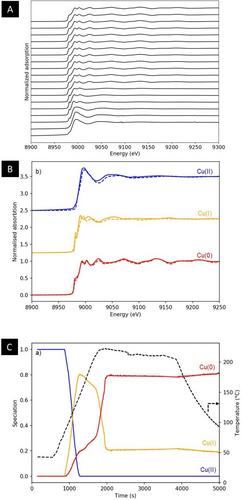
Oleylamine is widely used in the synthesis of colloidal nanoparticles, as a solvent, as a stabilizing agent, and sometimes as a reducing agent. For example, metallic nanoparticles are obtained through reduction when Ni(II) and Pd(II) precursors are used or through disproportionation in the case of Ni(I) or Co(I). A similar dichotomy is observed for Cu precursors, with an additional complexity due to the nature of the precursor salt. In the present article, we report a combined DFT evaluation of possible reduction paths for Cu(II) and Cu(I) reduction by oleylamine, including the competition with Cu(I) disproportionation, and X-ray Absorption Spectroscopy monitoring of the oxidation state of copper(II) acetylacetonate in oleylamine. We show that the reduction of copper(II) acetylacetonate goes through a two-steps process, with the intermediate formation of Cu(I) complexes. The role of phosphine ligands is demonstrated as well as the relevance of these findings in case alternative copper sources such as copper halogen salts.
期刊介绍:
ChemPhysChem is one of the leading chemistry/physics interdisciplinary journals (ISI Impact Factor 2018: 3.077) for physical chemistry and chemical physics. It is published on behalf of Chemistry Europe, an association of 16 European chemical societies.
ChemPhysChem is an international source for important primary and critical secondary information across the whole field of physical chemistry and chemical physics. It integrates this wide and flourishing field ranging from Solid State and Soft-Matter Research, Electro- and Photochemistry, Femtochemistry and Nanotechnology, Complex Systems, Single-Molecule Research, Clusters and Colloids, Catalysis and Surface Science, Biophysics and Physical Biochemistry, Atmospheric and Environmental Chemistry, and many more topics. ChemPhysChem is peer-reviewed.







 京公网安备 11010802042870号
京ICP备2023020795号-1
京公网安备 11010802042870号
京ICP备2023020795号-1

 分享
分享
 求助内容:
求助内容: 应助结果提醒方式:
 扫码关注我们
