Yueling Yu , Yanming Liu , Xingzhu Zhang , Bowen lv , Yuanlu Xu , Xinfei Fan
{"title":"通过与电-芬顿相结合,在太阳能界面蒸发中共同促进挥发性有机化合物降解和蒸汽生成","authors":"Yueling Yu , Yanming Liu , Xingzhu Zhang , Bowen lv , Yuanlu Xu , Xinfei Fan","doi":"10.1016/j.watres.2025.123348","DOIUrl":null,"url":null,"abstract":"<div><div>Solar interfacial evaporation (SIE) process offers an effective and sustainable approach for alleviating freshwater shortage, but the simultaneous evaporation of volatile organic compound (VOC) limits the application of this technique. Herein, a novel electro-Fenton assisted SIE (EF/SIE) was proposed for the first time to co-enhance steam generation and VOC removal based on an evaporator composed of graphite felt decorated with Fe/N-doped porous carbon (FeNCx/GF). This dual functional evaporator integrating photothermal and electrocatalytic technology achieved a “self-sufficient” degradation process, in which FeNCx acted as the heterogeneous electrocatalyst to in-situ produce H<sub>2</sub>O<sub>2</sub> and reactive oxidizing species (ROS) for VOC degradation at evaporator interface. As a result, the VOC removal efficiency of EF/SIE system achieved 97.8 ± 1.7 % in the condensate, which was 4.8 times that of the sole SIE system. Meanwhile, due to the Joule heating during electro-Fenton process, the conversion rate from water to vapor was accelerated, reaching an evaporation rate to 1.65 kg m<sup>-2</sup> h<sup>-1</sup> at the cathodic interface, while that of the sole SIE system was only 1.43 kg m<sup>-2</sup> h<sup>-1</sup>. Additionally, an external solar cell enabled complete photo-electro-thermal conversion that ensured an excellent VOC removal efficiency (99 %) of the EF/SIE system in the outdoor experiment. The innovatively designed system also showed versatility in different water substrates. Thus, the dual functional evaporators successfully integrated SIE with EF, providing a sustainable and synergetic strategy for efficient treatment of wastewater containing VOC.</div></div>","PeriodicalId":443,"journal":{"name":"Water Research","volume":"277 ","pages":"Article 123348"},"PeriodicalIF":12.4000,"publicationDate":"2025-06-01","publicationTypes":"Journal Article","fieldsOfStudy":null,"isOpenAccess":false,"openAccessPdf":"","citationCount":"0","resultStr":"{\"title\":\"Co-enhancing volatile organic compound degradation and steam generation in solar interfacial evaporation by integrating with electro-Fenton\",\"authors\":\"Yueling Yu , Yanming Liu , Xingzhu Zhang , Bowen lv , Yuanlu Xu , Xinfei Fan\",\"doi\":\"10.1016/j.watres.2025.123348\",\"DOIUrl\":null,\"url\":null,\"abstract\":\"<div><div>Solar interfacial evaporation (SIE) process offers an effective and sustainable approach for alleviating freshwater shortage, but the simultaneous evaporation of volatile organic compound (VOC) limits the application of this technique. Herein, a novel electro-Fenton assisted SIE (EF/SIE) was proposed for the first time to co-enhance steam generation and VOC removal based on an evaporator composed of graphite felt decorated with Fe/N-doped porous carbon (FeNCx/GF). This dual functional evaporator integrating photothermal and electrocatalytic technology achieved a “self-sufficient” degradation process, in which FeNCx acted as the heterogeneous electrocatalyst to in-situ produce H<sub>2</sub>O<sub>2</sub> and reactive oxidizing species (ROS) for VOC degradation at evaporator interface. As a result, the VOC removal efficiency of EF/SIE system achieved 97.8 ± 1.7 % in the condensate, which was 4.8 times that of the sole SIE system. Meanwhile, due to the Joule heating during electro-Fenton process, the conversion rate from water to vapor was accelerated, reaching an evaporation rate to 1.65 kg m<sup>-2</sup> h<sup>-1</sup> at the cathodic interface, while that of the sole SIE system was only 1.43 kg m<sup>-2</sup> h<sup>-1</sup>. Additionally, an external solar cell enabled complete photo-electro-thermal conversion that ensured an excellent VOC removal efficiency (99 %) of the EF/SIE system in the outdoor experiment. The innovatively designed system also showed versatility in different water substrates. Thus, the dual functional evaporators successfully integrated SIE with EF, providing a sustainable and synergetic strategy for efficient treatment of wastewater containing VOC.</div></div>\",\"PeriodicalId\":443,\"journal\":{\"name\":\"Water Research\",\"volume\":\"277 \",\"pages\":\"Article 123348\"},\"PeriodicalIF\":12.4000,\"publicationDate\":\"2025-06-01\",\"publicationTypes\":\"Journal Article\",\"fieldsOfStudy\":null,\"isOpenAccess\":false,\"openAccessPdf\":\"\",\"citationCount\":\"0\",\"resultStr\":null,\"platform\":\"Semanticscholar\",\"paperid\":null,\"PeriodicalName\":\"Water Research\",\"FirstCategoryId\":\"93\",\"ListUrlMain\":\"https://www.sciencedirect.com/science/article/pii/S0043135425002611\",\"RegionNum\":1,\"RegionCategory\":\"环境科学与生态学\",\"ArticlePicture\":[],\"TitleCN\":null,\"AbstractTextCN\":null,\"PMCID\":null,\"EPubDate\":\"2025/2/21 0:00:00\",\"PubModel\":\"Epub\",\"JCR\":\"Q1\",\"JCRName\":\"ENGINEERING, ENVIRONMENTAL\",\"Score\":null,\"Total\":0}","platform":"Semanticscholar","paperid":null,"PeriodicalName":"Water Research","FirstCategoryId":"93","ListUrlMain":"https://www.sciencedirect.com/science/article/pii/S0043135425002611","RegionNum":1,"RegionCategory":"环境科学与生态学","ArticlePicture":[],"TitleCN":null,"AbstractTextCN":null,"PMCID":null,"EPubDate":"2025/2/21 0:00:00","PubModel":"Epub","JCR":"Q1","JCRName":"ENGINEERING, ENVIRONMENTAL","Score":null,"Total":0}
引用次数: 0
摘要
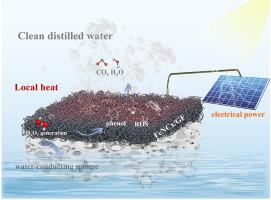
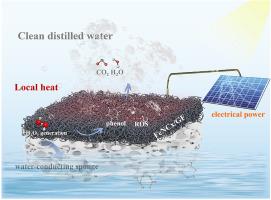
太阳能界面蒸发(SIE)技术为缓解淡水短缺提供了一种有效且可持续的方法,但挥发性有机化合物(VOC)的同步蒸发限制了该技术的应用。本文首次提出了一种新型的电fenton辅助蒸发器(EF/SIE),该蒸发器基于Fe/ n掺杂多孔碳(FeNCx/GF)修饰的石墨毡组成的蒸发器,以共同增强蒸汽产生和VOC去除。这种集光热和电催化技术于一体的双功能蒸发器实现了“自给自足”的降解过程,其中FeNCx作为非均相电催化剂,在蒸发器界面处原位产生H2O2和活性氧(reactive oxidation species, ROS)降解VOC。结果表明,EF/SIE体系对凝结水VOC的去除效率为97.8±1.7%,是单一SIE体系的4.8倍。同时,由于电- fenton过程中的焦耳加热,加速了水到蒸汽的转化速率,在阴极界面处蒸发速率达到1.65 kg m-2 h-1,而单一SIE体系的蒸发速率仅为1.43 kg m-2 h-1。此外,外部太阳能电池实现了完全的光电-热转换,确保了EF/SIE系统在室外实验中具有优异的VOC去除效率(99%)。创新设计的系统在不同的水基质中也显示出多功能性。因此,双功能蒸发器成功地将SIE与EF集成在一起,为有效处理含VOC的废水提供了可持续和协同的策略。
Co-enhancing volatile organic compound degradation and steam generation in solar interfacial evaporation by integrating with electro-Fenton
Solar interfacial evaporation (SIE) process offers an effective and sustainable approach for alleviating freshwater shortage, but the simultaneous evaporation of volatile organic compound (VOC) limits the application of this technique. Herein, a novel electro-Fenton assisted SIE (EF/SIE) was proposed for the first time to co-enhance steam generation and VOC removal based on an evaporator composed of graphite felt decorated with Fe/N-doped porous carbon (FeNCx/GF). This dual functional evaporator integrating photothermal and electrocatalytic technology achieved a “self-sufficient” degradation process, in which FeNCx acted as the heterogeneous electrocatalyst to in-situ produce H2O2 and reactive oxidizing species (ROS) for VOC degradation at evaporator interface. As a result, the VOC removal efficiency of EF/SIE system achieved 97.8 ± 1.7 % in the condensate, which was 4.8 times that of the sole SIE system. Meanwhile, due to the Joule heating during electro-Fenton process, the conversion rate from water to vapor was accelerated, reaching an evaporation rate to 1.65 kg m-2 h-1 at the cathodic interface, while that of the sole SIE system was only 1.43 kg m-2 h-1. Additionally, an external solar cell enabled complete photo-electro-thermal conversion that ensured an excellent VOC removal efficiency (99 %) of the EF/SIE system in the outdoor experiment. The innovatively designed system also showed versatility in different water substrates. Thus, the dual functional evaporators successfully integrated SIE with EF, providing a sustainable and synergetic strategy for efficient treatment of wastewater containing VOC.
期刊介绍:
Water Research, along with its open access companion journal Water Research X, serves as a platform for publishing original research papers covering various aspects of the science and technology related to the anthropogenic water cycle, water quality, and its management worldwide. The audience targeted by the journal comprises biologists, chemical engineers, chemists, civil engineers, environmental engineers, limnologists, and microbiologists. The scope of the journal include:
•Treatment processes for water and wastewaters (municipal, agricultural, industrial, and on-site treatment), including resource recovery and residuals management;
•Urban hydrology including sewer systems, stormwater management, and green infrastructure;
•Drinking water treatment and distribution;
•Potable and non-potable water reuse;
•Sanitation, public health, and risk assessment;
•Anaerobic digestion, solid and hazardous waste management, including source characterization and the effects and control of leachates and gaseous emissions;
•Contaminants (chemical, microbial, anthropogenic particles such as nanoparticles or microplastics) and related water quality sensing, monitoring, fate, and assessment;
•Anthropogenic impacts on inland, tidal, coastal and urban waters, focusing on surface and ground waters, and point and non-point sources of pollution;
•Environmental restoration, linked to surface water, groundwater and groundwater remediation;
•Analysis of the interfaces between sediments and water, and between water and atmosphere, focusing specifically on anthropogenic impacts;
•Mathematical modelling, systems analysis, machine learning, and beneficial use of big data related to the anthropogenic water cycle;
•Socio-economic, policy, and regulations studies.




 京公网安备 11010802042870号
京ICP备2023020795号-1
京公网安备 11010802042870号
京ICP备2023020795号-1

 分享
分享
 求助内容:
求助内容: 应助结果提醒方式:
 扫码关注我们
