Karin E. J. Rödström, Bisher Eymsh, Peter Proks, Mehtab S. Hayre, Sönke Cordeiro, Edward Mendez-Otalvaro, Christian Madry, Anna Rowland, Wojciech Kopec, Simon Newstead, Thomas Baukrowitz, Marcus Schewe, Stephen J. Tucker
{"title":"人类 THIK-1 K2P K+ 通道的低温电子显微镜结构揭示了受脂质和麻醉剂调控的下 Y 门","authors":"Karin E. J. Rödström, Bisher Eymsh, Peter Proks, Mehtab S. Hayre, Sönke Cordeiro, Edward Mendez-Otalvaro, Christian Madry, Anna Rowland, Wojciech Kopec, Simon Newstead, Thomas Baukrowitz, Marcus Schewe, Stephen J. Tucker","doi":"10.1038/s41594-025-01497-6","DOIUrl":null,"url":null,"abstract":"THIK-1 (KCNK13) is a halothane-inhibited and anionic-lipid-activated two-pore domain (K2P) K+ channel implicated in microglial activation and neuroinflammation, and a current target for the treatment of neurodegenerative disorders, for example Alzheimer’s disease and amyothropic lateral sclerosis (ALS). However, compared to other K2P channels, little is known about the structural and functional properties of THIK-1. Here we present a 3.16-Å-resolution cryo-EM structure of human THIK-1 that reveals several distinct features, in particular, a tyrosine in M4 that contributes to a lower ‘Y gate’ that opens upon activation by physiologically relevant G-protein-coupled receptor and lipid signaling pathways. We demonstrate that linoleic acid bound within a modulatory pocket adjacent to the filter influences channel activity, and that halothane inhibition involves a binding site within the inner cavity, both resulting in conformational changes to the Y gate. Finally, the extracellular cap domain contains positively charged residues that line the ion exit pathway and contribute to the distinct biophysical properties of this channel. Overall, our results provide structural insights into THIK-1 function and identify distinct regulatory sites that expand its potential as a drug target for the modulation of microglial function. In this study, Rödström et al. use cryo-EM to reveal a range of structural features in THIK-1 K+ channel and demonstrate how these features define many functional properties of the channel, thus expanding its potential as a drug target.","PeriodicalId":49141,"journal":{"name":"Nature Structural & Molecular Biology","volume":"32 7","pages":"1167-1174"},"PeriodicalIF":10.1000,"publicationDate":"2025-02-26","publicationTypes":"Journal Article","fieldsOfStudy":null,"isOpenAccess":false,"openAccessPdf":"https://www.nature.comhttps://www.nature.com/articles/s41594-025-01497-6.pdf","citationCount":"0","resultStr":"{\"title\":\"Cryo-EM structure of the human THIK-1 K2P K+ channel reveals a lower Y gate regulated by lipids and anesthetics\",\"authors\":\"Karin E. J. Rödström, Bisher Eymsh, Peter Proks, Mehtab S. Hayre, Sönke Cordeiro, Edward Mendez-Otalvaro, Christian Madry, Anna Rowland, Wojciech Kopec, Simon Newstead, Thomas Baukrowitz, Marcus Schewe, Stephen J. Tucker\",\"doi\":\"10.1038/s41594-025-01497-6\",\"DOIUrl\":null,\"url\":null,\"abstract\":\"THIK-1 (KCNK13) is a halothane-inhibited and anionic-lipid-activated two-pore domain (K2P) K+ channel implicated in microglial activation and neuroinflammation, and a current target for the treatment of neurodegenerative disorders, for example Alzheimer’s disease and amyothropic lateral sclerosis (ALS). However, compared to other K2P channels, little is known about the structural and functional properties of THIK-1. Here we present a 3.16-Å-resolution cryo-EM structure of human THIK-1 that reveals several distinct features, in particular, a tyrosine in M4 that contributes to a lower ‘Y gate’ that opens upon activation by physiologically relevant G-protein-coupled receptor and lipid signaling pathways. We demonstrate that linoleic acid bound within a modulatory pocket adjacent to the filter influences channel activity, and that halothane inhibition involves a binding site within the inner cavity, both resulting in conformational changes to the Y gate. Finally, the extracellular cap domain contains positively charged residues that line the ion exit pathway and contribute to the distinct biophysical properties of this channel. Overall, our results provide structural insights into THIK-1 function and identify distinct regulatory sites that expand its potential as a drug target for the modulation of microglial function. In this study, Rödström et al. use cryo-EM to reveal a range of structural features in THIK-1 K+ channel and demonstrate how these features define many functional properties of the channel, thus expanding its potential as a drug target.\",\"PeriodicalId\":49141,\"journal\":{\"name\":\"Nature Structural & Molecular Biology\",\"volume\":\"32 7\",\"pages\":\"1167-1174\"},\"PeriodicalIF\":10.1000,\"publicationDate\":\"2025-02-26\",\"publicationTypes\":\"Journal Article\",\"fieldsOfStudy\":null,\"isOpenAccess\":false,\"openAccessPdf\":\"https://www.nature.comhttps://www.nature.com/articles/s41594-025-01497-6.pdf\",\"citationCount\":\"0\",\"resultStr\":null,\"platform\":\"Semanticscholar\",\"paperid\":null,\"PeriodicalName\":\"Nature Structural & Molecular Biology\",\"FirstCategoryId\":\"99\",\"ListUrlMain\":\"https://www.nature.com/articles/s41594-025-01497-6\",\"RegionNum\":1,\"RegionCategory\":\"生物学\",\"ArticlePicture\":[],\"TitleCN\":null,\"AbstractTextCN\":null,\"PMCID\":null,\"EPubDate\":\"\",\"PubModel\":\"\",\"JCR\":\"Q1\",\"JCRName\":\"BIOCHEMISTRY & MOLECULAR BIOLOGY\",\"Score\":null,\"Total\":0}","platform":"Semanticscholar","paperid":null,"PeriodicalName":"Nature Structural & Molecular Biology","FirstCategoryId":"99","ListUrlMain":"https://www.nature.com/articles/s41594-025-01497-6","RegionNum":1,"RegionCategory":"生物学","ArticlePicture":[],"TitleCN":null,"AbstractTextCN":null,"PMCID":null,"EPubDate":"","PubModel":"","JCR":"Q1","JCRName":"BIOCHEMISTRY & MOLECULAR BIOLOGY","Score":null,"Total":0}
Cryo-EM structure of the human THIK-1 K2P K+ channel reveals a lower Y gate regulated by lipids and anesthetics
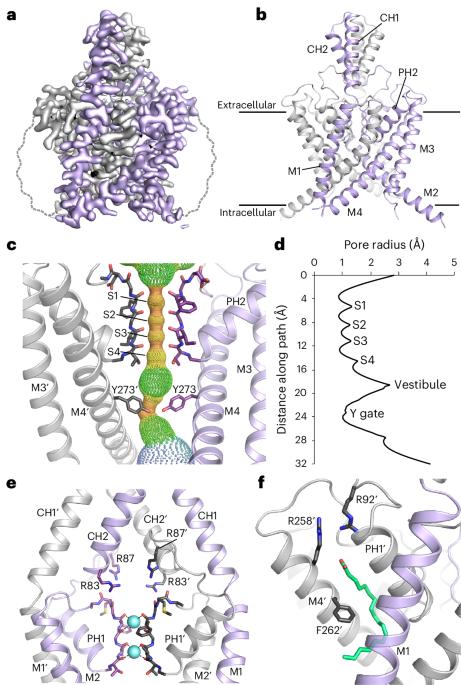
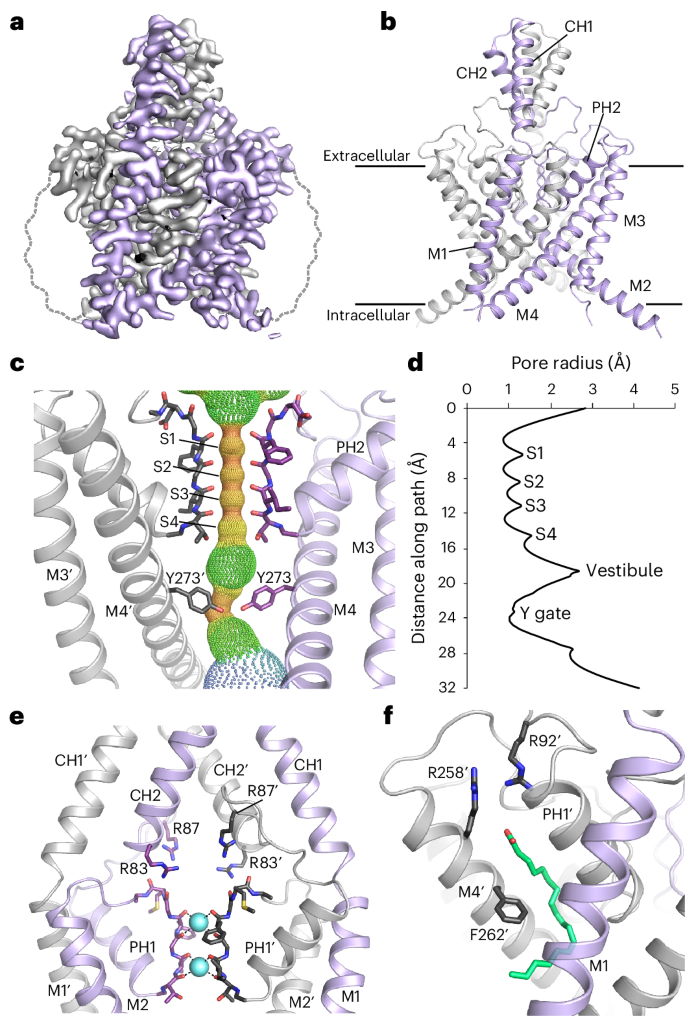
THIK-1 (KCNK13) is a halothane-inhibited and anionic-lipid-activated two-pore domain (K2P) K+ channel implicated in microglial activation and neuroinflammation, and a current target for the treatment of neurodegenerative disorders, for example Alzheimer’s disease and amyothropic lateral sclerosis (ALS). However, compared to other K2P channels, little is known about the structural and functional properties of THIK-1. Here we present a 3.16-Å-resolution cryo-EM structure of human THIK-1 that reveals several distinct features, in particular, a tyrosine in M4 that contributes to a lower ‘Y gate’ that opens upon activation by physiologically relevant G-protein-coupled receptor and lipid signaling pathways. We demonstrate that linoleic acid bound within a modulatory pocket adjacent to the filter influences channel activity, and that halothane inhibition involves a binding site within the inner cavity, both resulting in conformational changes to the Y gate. Finally, the extracellular cap domain contains positively charged residues that line the ion exit pathway and contribute to the distinct biophysical properties of this channel. Overall, our results provide structural insights into THIK-1 function and identify distinct regulatory sites that expand its potential as a drug target for the modulation of microglial function. In this study, Rödström et al. use cryo-EM to reveal a range of structural features in THIK-1 K+ channel and demonstrate how these features define many functional properties of the channel, thus expanding its potential as a drug target.
期刊介绍:
Nature Structural & Molecular Biology is a comprehensive platform that combines structural and molecular research. Our journal focuses on exploring the functional and mechanistic aspects of biological processes, emphasizing how molecular components collaborate to achieve a particular function. While structural data can shed light on these insights, our publication does not require them as a prerequisite.




 京公网安备 11010802042870号
京ICP备2023020795号-1
京公网安备 11010802042870号
京ICP备2023020795号-1

 分享
分享
 求助内容:
求助内容: 应助结果提醒方式:
 扫码关注我们
