Xinyi Chang, Xiaota Cheng, Xia Yin, Renchao Che, Jianyong Yu, Yi-Tao Liu, Bin Ding
{"title":"通过应变工程策略实现基于弹性陶瓷-碳纳米晶须/纳米纤维气凝胶的多模热门控","authors":"Xinyi Chang, Xiaota Cheng, Xia Yin, Renchao Che, Jianyong Yu, Yi-Tao Liu, Bin Ding","doi":"10.1021/acsnano.5c00125","DOIUrl":null,"url":null,"abstract":"The capability to regulate heat transport dynamically and reversibly within solid materials propels advancement in aerospace conditioning, battery thermal control, and energy harvesting/conversion industries. Although aerogels are known for thermal insulation properties, their constant thermal resistance induced by immutable pore structure makes them struggle to reverse-release the accumulated thermal energy. Here, we develop a nanocrystalline whisker/nanofiber aerogel (WFA) thermal gating induced by the self-catalyzed growth strategy, whose elasticity offers possibilities for dynamic thermal management. Thermal conductivities can be continuously regulated by external compressive strain-trigged heat conduction pathway and interfacial resistance variations, switching seamlessly between 0.020 W m<sup>–1</sup> K<sup>–1</sup> in an uncompressed state and 0.071 W m<sup>–1</sup> K<sup>–1</sup> at 80% compressive strain, with a modulation ratio of ∼3.55. The integral inorganic nature ensures the thermal stability of WFAs over a large thermal gradient, from −196 °C deep cryogenic to 1500 °C ultrahigh temperature. The resulting multimode WFAs provide a feasible solution for thermal management in extreme environments.","PeriodicalId":21,"journal":{"name":"ACS Nano","volume":"28 1","pages":""},"PeriodicalIF":16.0000,"publicationDate":"2025-03-03","publicationTypes":"Journal Article","fieldsOfStudy":null,"isOpenAccess":false,"openAccessPdf":"","citationCount":"0","resultStr":"{\"title\":\"Multimode Thermal Gating Based on Elastic Ceramic-Carbon Nanowhisker/Nanofiber Aerogels by Strain Engineering Strategy\",\"authors\":\"Xinyi Chang, Xiaota Cheng, Xia Yin, Renchao Che, Jianyong Yu, Yi-Tao Liu, Bin Ding\",\"doi\":\"10.1021/acsnano.5c00125\",\"DOIUrl\":null,\"url\":null,\"abstract\":\"The capability to regulate heat transport dynamically and reversibly within solid materials propels advancement in aerospace conditioning, battery thermal control, and energy harvesting/conversion industries. Although aerogels are known for thermal insulation properties, their constant thermal resistance induced by immutable pore structure makes them struggle to reverse-release the accumulated thermal energy. Here, we develop a nanocrystalline whisker/nanofiber aerogel (WFA) thermal gating induced by the self-catalyzed growth strategy, whose elasticity offers possibilities for dynamic thermal management. Thermal conductivities can be continuously regulated by external compressive strain-trigged heat conduction pathway and interfacial resistance variations, switching seamlessly between 0.020 W m<sup>–1</sup> K<sup>–1</sup> in an uncompressed state and 0.071 W m<sup>–1</sup> K<sup>–1</sup> at 80% compressive strain, with a modulation ratio of ∼3.55. The integral inorganic nature ensures the thermal stability of WFAs over a large thermal gradient, from −196 °C deep cryogenic to 1500 °C ultrahigh temperature. The resulting multimode WFAs provide a feasible solution for thermal management in extreme environments.\",\"PeriodicalId\":21,\"journal\":{\"name\":\"ACS Nano\",\"volume\":\"28 1\",\"pages\":\"\"},\"PeriodicalIF\":16.0000,\"publicationDate\":\"2025-03-03\",\"publicationTypes\":\"Journal Article\",\"fieldsOfStudy\":null,\"isOpenAccess\":false,\"openAccessPdf\":\"\",\"citationCount\":\"0\",\"resultStr\":null,\"platform\":\"Semanticscholar\",\"paperid\":null,\"PeriodicalName\":\"ACS Nano\",\"FirstCategoryId\":\"88\",\"ListUrlMain\":\"https://doi.org/10.1021/acsnano.5c00125\",\"RegionNum\":1,\"RegionCategory\":\"材料科学\",\"ArticlePicture\":[],\"TitleCN\":null,\"AbstractTextCN\":null,\"PMCID\":null,\"EPubDate\":\"\",\"PubModel\":\"\",\"JCR\":\"Q1\",\"JCRName\":\"CHEMISTRY, MULTIDISCIPLINARY\",\"Score\":null,\"Total\":0}","platform":"Semanticscholar","paperid":null,"PeriodicalName":"ACS Nano","FirstCategoryId":"88","ListUrlMain":"https://doi.org/10.1021/acsnano.5c00125","RegionNum":1,"RegionCategory":"材料科学","ArticlePicture":[],"TitleCN":null,"AbstractTextCN":null,"PMCID":null,"EPubDate":"","PubModel":"","JCR":"Q1","JCRName":"CHEMISTRY, MULTIDISCIPLINARY","Score":null,"Total":0}
引用次数: 0
摘要
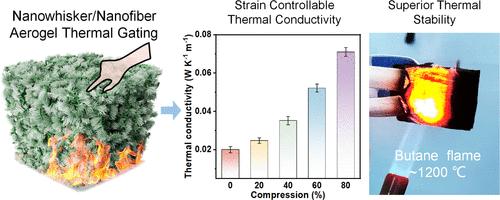
在固体材料中动态可逆地调节热传输的能力推动了航空航天空调、电池热控制和能量收集/转换行业的进步。虽然气凝胶以其隔热性能而闻名,但由于其不变的孔隙结构引起的恒定热阻使其难以反向释放积累的热能。在这里,我们开发了一种由自催化生长策略诱导的纳米晶须/纳米纤维气凝胶(WFA)热门,其弹性为动态热管理提供了可能性。热导率可以通过外部压缩应变触发的热传导途径和界面电阻变化连续调节,在未压缩状态下的0.020 W m-1 K-1和80%压缩应变下的0.071 W m-1 K-1之间无缝切换,调制比为~ 3.55。整体无机性质确保了wfa在从- 196°C深低温到1500°C超高温的大热梯度下的热稳定性。由此产生的多模wfa为极端环境下的热管理提供了可行的解决方案。
Multimode Thermal Gating Based on Elastic Ceramic-Carbon Nanowhisker/Nanofiber Aerogels by Strain Engineering Strategy
The capability to regulate heat transport dynamically and reversibly within solid materials propels advancement in aerospace conditioning, battery thermal control, and energy harvesting/conversion industries. Although aerogels are known for thermal insulation properties, their constant thermal resistance induced by immutable pore structure makes them struggle to reverse-release the accumulated thermal energy. Here, we develop a nanocrystalline whisker/nanofiber aerogel (WFA) thermal gating induced by the self-catalyzed growth strategy, whose elasticity offers possibilities for dynamic thermal management. Thermal conductivities can be continuously regulated by external compressive strain-trigged heat conduction pathway and interfacial resistance variations, switching seamlessly between 0.020 W m–1 K–1 in an uncompressed state and 0.071 W m–1 K–1 at 80% compressive strain, with a modulation ratio of ∼3.55. The integral inorganic nature ensures the thermal stability of WFAs over a large thermal gradient, from −196 °C deep cryogenic to 1500 °C ultrahigh temperature. The resulting multimode WFAs provide a feasible solution for thermal management in extreme environments.
期刊介绍:
ACS Nano, published monthly, serves as an international forum for comprehensive articles on nanoscience and nanotechnology research at the intersections of chemistry, biology, materials science, physics, and engineering. The journal fosters communication among scientists in these communities, facilitating collaboration, new research opportunities, and advancements through discoveries. ACS Nano covers synthesis, assembly, characterization, theory, and simulation of nanostructures, nanobiotechnology, nanofabrication, methods and tools for nanoscience and nanotechnology, and self- and directed-assembly. Alongside original research articles, it offers thorough reviews, perspectives on cutting-edge research, and discussions envisioning the future of nanoscience and nanotechnology.




 京公网安备 11010802042870号
京ICP备2023020795号-1
京公网安备 11010802042870号
京ICP备2023020795号-1

 分享
分享
 求助内容:
求助内容: 应助结果提醒方式:
 扫码关注我们
