Dongdong Xu, Lug Trémulot, Zheng Yang, Amna Mhamdi, Gilles Châtel-Innocenti, Laura Mathieu, Christophe Espinasse, Frank Van Breusegem, Hélène Vanacker, Emmanuelle Issakidis-Bourguet, Graham Noctor
{"title":"细胞内单脱氢抗坏血酸还原酶2促进拟南芥氧化应激信号传导。","authors":"Dongdong Xu, Lug Trémulot, Zheng Yang, Amna Mhamdi, Gilles Châtel-Innocenti, Laura Mathieu, Christophe Espinasse, Frank Van Breusegem, Hélène Vanacker, Emmanuelle Issakidis-Bourguet, Graham Noctor","doi":"10.1111/pce.15488","DOIUrl":null,"url":null,"abstract":"<div>\n \n <p>The antioxidative enzyme monodehydroascorbate reductase (MDHAR) is represented by five genes in Arabidopsis, including four that encode cytosolic and peroxisomal proteins. The <i>in planta</i> importance of these specific isoforms during oxidative stress remain to be characterised. T-DNA mutants for <i>MDAR</i> genes encoding cytosolic and peroxisomal isoforms were studied. To examine their roles in conditions of intracellular oxidative stress, mutants were crossed with a <i>cat2</i> line lacking the major leaf catalase. Enzyme assays in <i>mdar</i> mutants and of recombinant MDHARs suggest that peroxisomal MDHAR1 and cytosolic MDHAR2 are major players in leaf NADH- and NADPH-dependent activities, respectively. All mutants showed a wild-type phenotype when grown in standard conditions. In the <i>cat2</i> background, loss of peroxisomal MDHAR functions decreased growth whereas loss of the cytosolic MDHAR2 function had no effect on growth but annulled a large part of transcriptomic and phenotypic responses to oxidative stress. The effects of the <i>mdar2</i> mutation included decreased salicylic acid accumulation and enhanced glutathione oxidation, and were reverted by complementation with the <i>MDAR2</i> sequence. Together, the data show that the cytosolic MDHAR2 is dispensable in optimal conditions but essential to promote biotic defence responses triggered by oxidative stress.</p></div>","PeriodicalId":222,"journal":{"name":"Plant, Cell & Environment","volume":"48 7","pages":"4966-4982"},"PeriodicalIF":6.9000,"publicationDate":"2025-03-26","publicationTypes":"Journal Article","fieldsOfStudy":null,"isOpenAccess":false,"openAccessPdf":"","citationCount":"0","resultStr":"{\"title\":\"Cytosolic Monodehydroascorbate Reductase 2 Promotes Oxidative Stress Signaling in Arabidopsis\",\"authors\":\"Dongdong Xu, Lug Trémulot, Zheng Yang, Amna Mhamdi, Gilles Châtel-Innocenti, Laura Mathieu, Christophe Espinasse, Frank Van Breusegem, Hélène Vanacker, Emmanuelle Issakidis-Bourguet, Graham Noctor\",\"doi\":\"10.1111/pce.15488\",\"DOIUrl\":null,\"url\":null,\"abstract\":\"<div>\\n \\n <p>The antioxidative enzyme monodehydroascorbate reductase (MDHAR) is represented by five genes in Arabidopsis, including four that encode cytosolic and peroxisomal proteins. The <i>in planta</i> importance of these specific isoforms during oxidative stress remain to be characterised. T-DNA mutants for <i>MDAR</i> genes encoding cytosolic and peroxisomal isoforms were studied. To examine their roles in conditions of intracellular oxidative stress, mutants were crossed with a <i>cat2</i> line lacking the major leaf catalase. Enzyme assays in <i>mdar</i> mutants and of recombinant MDHARs suggest that peroxisomal MDHAR1 and cytosolic MDHAR2 are major players in leaf NADH- and NADPH-dependent activities, respectively. All mutants showed a wild-type phenotype when grown in standard conditions. In the <i>cat2</i> background, loss of peroxisomal MDHAR functions decreased growth whereas loss of the cytosolic MDHAR2 function had no effect on growth but annulled a large part of transcriptomic and phenotypic responses to oxidative stress. The effects of the <i>mdar2</i> mutation included decreased salicylic acid accumulation and enhanced glutathione oxidation, and were reverted by complementation with the <i>MDAR2</i> sequence. Together, the data show that the cytosolic MDHAR2 is dispensable in optimal conditions but essential to promote biotic defence responses triggered by oxidative stress.</p></div>\",\"PeriodicalId\":222,\"journal\":{\"name\":\"Plant, Cell & Environment\",\"volume\":\"48 7\",\"pages\":\"4966-4982\"},\"PeriodicalIF\":6.9000,\"publicationDate\":\"2025-03-26\",\"publicationTypes\":\"Journal Article\",\"fieldsOfStudy\":null,\"isOpenAccess\":false,\"openAccessPdf\":\"\",\"citationCount\":\"0\",\"resultStr\":null,\"platform\":\"Semanticscholar\",\"paperid\":null,\"PeriodicalName\":\"Plant, Cell & Environment\",\"FirstCategoryId\":\"2\",\"ListUrlMain\":\"https://onlinelibrary.wiley.com/doi/10.1111/pce.15488\",\"RegionNum\":1,\"RegionCategory\":\"生物学\",\"ArticlePicture\":[],\"TitleCN\":null,\"AbstractTextCN\":null,\"PMCID\":null,\"EPubDate\":\"\",\"PubModel\":\"\",\"JCR\":\"Q1\",\"JCRName\":\"PLANT SCIENCES\",\"Score\":null,\"Total\":0}","platform":"Semanticscholar","paperid":null,"PeriodicalName":"Plant, Cell & Environment","FirstCategoryId":"2","ListUrlMain":"https://onlinelibrary.wiley.com/doi/10.1111/pce.15488","RegionNum":1,"RegionCategory":"生物学","ArticlePicture":[],"TitleCN":null,"AbstractTextCN":null,"PMCID":null,"EPubDate":"","PubModel":"","JCR":"Q1","JCRName":"PLANT SCIENCES","Score":null,"Total":0}
Cytosolic Monodehydroascorbate Reductase 2 Promotes Oxidative Stress Signaling in Arabidopsis
The antioxidative enzyme monodehydroascorbate reductase (MDHAR) is represented by five genes in Arabidopsis, including four that encode cytosolic and peroxisomal proteins. The in planta importance of these specific isoforms during oxidative stress remain to be characterised. T-DNA mutants for MDAR genes encoding cytosolic and peroxisomal isoforms were studied. To examine their roles in conditions of intracellular oxidative stress, mutants were crossed with a cat2 line lacking the major leaf catalase. Enzyme assays in mdar mutants and of recombinant MDHARs suggest that peroxisomal MDHAR1 and cytosolic MDHAR2 are major players in leaf NADH- and NADPH-dependent activities, respectively. All mutants showed a wild-type phenotype when grown in standard conditions. In the cat2 background, loss of peroxisomal MDHAR functions decreased growth whereas loss of the cytosolic MDHAR2 function had no effect on growth but annulled a large part of transcriptomic and phenotypic responses to oxidative stress. The effects of the mdar2 mutation included decreased salicylic acid accumulation and enhanced glutathione oxidation, and were reverted by complementation with the MDAR2 sequence. Together, the data show that the cytosolic MDHAR2 is dispensable in optimal conditions but essential to promote biotic defence responses triggered by oxidative stress.
期刊介绍:
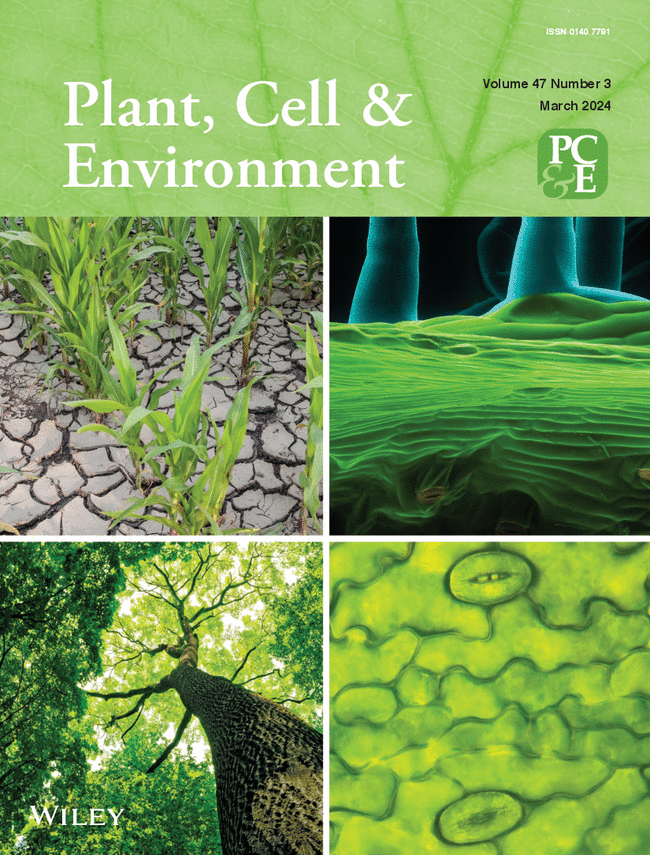
Plant, Cell & Environment is a premier plant science journal, offering valuable insights into plant responses to their environment. Committed to publishing high-quality theoretical and experimental research, the journal covers a broad spectrum of factors, spanning from molecular to community levels. Researchers exploring various aspects of plant biology, physiology, and ecology contribute to the journal's comprehensive understanding of plant-environment interactions.




 京公网安备 11010802042870号
京ICP备2023020795号-1
京公网安备 11010802042870号
京ICP备2023020795号-1

 分享
分享
 求助内容:
求助内容: 应助结果提醒方式:
 扫码关注我们
