{"title":"Abstract B004: An isogenic CRISPR screen identifies novel MYC-driven vulnerabilities","authors":"Peter Lin, Linda Penn","doi":"10.1158/1538-8514.synthleth24-b004","DOIUrl":null,"url":null,"abstract":"\n c-MYC (MYC) is a central regulatory protein that is dysregulated in >50% of all human cancers and is linked to aggressive disease. Developing MYC inhibitors would revolutionize cancer treatment; however, developing small molecules that directly target MYC is challenging. An alternative approach is to identify and inhibit critical MYC partner proteins to inactivate MYC and trigger cancer cell death. Inhibiting these targets therapeutically can result in synthetic lethality (MYC-SL), which can be exploited in MYC-dysregulated cancers. To identify MYC-SL targets, we performed a genome-wide CRISPR knock-out screen using an isogenic pair of normal and MYC-driven breast cancer cells. In contrast to other screens, this model is dependent on MYC and recapitulates human disease at both pathological and molecular levels in vivo. We identified high-priority hits to validate from the screen using two independent approaches: 1) a traditional gene-set enrichment analysis to identify highly represented biological pathways; and 2) analyzing the Cancer Dependency Map (DEPMAP) to select hits that are likely to be robust beyond the context of our screening conditions. Using a traditional gene-set enrichment analysis approach, we identified topoisomerase 1 (TOP1) as an actionable vulnerability that can be targeted with clinically approved inhibitors. Genetic and pharmacological inhibition of TOP1 resulted in MYC-driven cell death compared to that in control cells. Finally, drug response to TOP1 inhibitors significantly correlated with MYC levels and activity across panels of breast cancer cell lines and patient-derived organoids, highlighting TOP1 as a promising target for MYC-driven cancers. As a secondary approach to interpreting our CRISPR screen hits, we analyzed DEPMAP to identify MYC-SLs that are differentially essential in MYC-dependent cancer cells. Specifically, data from RNA interference screens in hundreds of cancer cell lines were used to describe the response of these cells to MYC knockdown. These data were used to define MYC-dependent and MYC-independent cell lines within the context of this analysis. These two groups were then investigated for their in silico response to the knockdown of each of our MYC-SL hits. MYC-SLs, which were also differentially essential in MYC-dependent cancer cells from DEPMAP, were prioritized for further investigation. Critical MYC cofactors that have been validated by us and others (e.g., CDK9) were identified, providing confidence in this approach, and rationalizing ongoing investigations. Together, this work features two successful strategies to prioritize hits from hundreds of synthetic-lethal genome-wide CRISPR screens to identify novel MYC-driven vulnerabilities in cancer.\n Citation Format: Peter Lin, Linda Penn. An isogenic CRISPR screen identifies novel MYC-driven vulnerabilities [abstract]. In: Proceedings of the AACR Special Conference in Cancer Research: Expanding and Translating Cancer Synthetic Vulnerabilities; 2024 Jun 10-13; Montreal, Quebec, Canada. Philadelphia (PA): AACR; Mol Cancer Ther 2024;23(6 Suppl):Abstract nr B004.","PeriodicalId":5,"journal":{"name":"ACS Applied Materials & Interfaces","volume":" 10","pages":""},"PeriodicalIF":8.2000,"publicationDate":"2024-06-10","publicationTypes":"Journal Article","fieldsOfStudy":null,"isOpenAccess":false,"openAccessPdf":"","citationCount":"0","resultStr":null,"platform":"Semanticscholar","paperid":null,"PeriodicalName":"ACS Applied Materials & Interfaces","FirstCategoryId":"3","ListUrlMain":"https://doi.org/10.1158/1538-8514.synthleth24-b004","RegionNum":2,"RegionCategory":"材料科学","ArticlePicture":[],"TitleCN":null,"AbstractTextCN":null,"PMCID":null,"EPubDate":"","PubModel":"","JCR":"Q1","JCRName":"MATERIALS SCIENCE, MULTIDISCIPLINARY","Score":null,"Total":0}
引用次数: 0
Abstract
c-MYC (MYC) is a central regulatory protein that is dysregulated in >50% of all human cancers and is linked to aggressive disease. Developing MYC inhibitors would revolutionize cancer treatment; however, developing small molecules that directly target MYC is challenging. An alternative approach is to identify and inhibit critical MYC partner proteins to inactivate MYC and trigger cancer cell death. Inhibiting these targets therapeutically can result in synthetic lethality (MYC-SL), which can be exploited in MYC-dysregulated cancers. To identify MYC-SL targets, we performed a genome-wide CRISPR knock-out screen using an isogenic pair of normal and MYC-driven breast cancer cells. In contrast to other screens, this model is dependent on MYC and recapitulates human disease at both pathological and molecular levels in vivo. We identified high-priority hits to validate from the screen using two independent approaches: 1) a traditional gene-set enrichment analysis to identify highly represented biological pathways; and 2) analyzing the Cancer Dependency Map (DEPMAP) to select hits that are likely to be robust beyond the context of our screening conditions. Using a traditional gene-set enrichment analysis approach, we identified topoisomerase 1 (TOP1) as an actionable vulnerability that can be targeted with clinically approved inhibitors. Genetic and pharmacological inhibition of TOP1 resulted in MYC-driven cell death compared to that in control cells. Finally, drug response to TOP1 inhibitors significantly correlated with MYC levels and activity across panels of breast cancer cell lines and patient-derived organoids, highlighting TOP1 as a promising target for MYC-driven cancers. As a secondary approach to interpreting our CRISPR screen hits, we analyzed DEPMAP to identify MYC-SLs that are differentially essential in MYC-dependent cancer cells. Specifically, data from RNA interference screens in hundreds of cancer cell lines were used to describe the response of these cells to MYC knockdown. These data were used to define MYC-dependent and MYC-independent cell lines within the context of this analysis. These two groups were then investigated for their in silico response to the knockdown of each of our MYC-SL hits. MYC-SLs, which were also differentially essential in MYC-dependent cancer cells from DEPMAP, were prioritized for further investigation. Critical MYC cofactors that have been validated by us and others (e.g., CDK9) were identified, providing confidence in this approach, and rationalizing ongoing investigations. Together, this work features two successful strategies to prioritize hits from hundreds of synthetic-lethal genome-wide CRISPR screens to identify novel MYC-driven vulnerabilities in cancer.
Citation Format: Peter Lin, Linda Penn. An isogenic CRISPR screen identifies novel MYC-driven vulnerabilities [abstract]. In: Proceedings of the AACR Special Conference in Cancer Research: Expanding and Translating Cancer Synthetic Vulnerabilities; 2024 Jun 10-13; Montreal, Quebec, Canada. Philadelphia (PA): AACR; Mol Cancer Ther 2024;23(6 Suppl):Abstract nr B004.
期刊介绍:
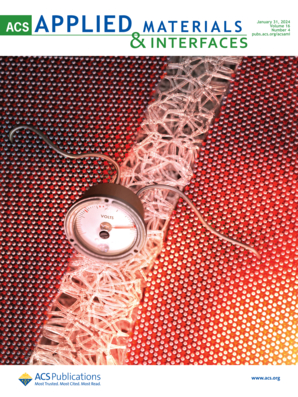
ACS Applied Materials & Interfaces is a leading interdisciplinary journal that brings together chemists, engineers, physicists, and biologists to explore the development and utilization of newly-discovered materials and interfacial processes for specific applications. Our journal has experienced remarkable growth since its establishment in 2009, both in terms of the number of articles published and the impact of the research showcased. We are proud to foster a truly global community, with the majority of published articles originating from outside the United States, reflecting the rapid growth of applied research worldwide.



 京公网安备 11010802042870号
京ICP备2023020795号-1
京公网安备 11010802042870号
京ICP备2023020795号-1

 分享
分享
 求助内容:
求助内容: 应助结果提醒方式:
 扫码关注我们
