Xi Zhang, Shazed Aziz, Bidita Salahuddin, Zhonghua Zhu
{"title":"Bioinspired Hydro- and Hydrothermally Responsive Tubular Soft Actuators.","authors":"Xi Zhang, Shazed Aziz, Bidita Salahuddin, Zhonghua Zhu","doi":"10.1021/acsami.4c11779","DOIUrl":null,"url":null,"abstract":"<p><p>Soft actuators made of thermoresponsive polymers have great potential for intelligent robotics and biomedical devices due to their reversible deformation capability in response to temperature fluctuations. However, they are constrained by a predefined phase transition temperature, limited directional deformation, and nonbiocompatible formulations, thereby restricting their practical utility. Herein a new biomimicry approach is presented to overcome these limitations by developing hydro- and hydrothermally responsive soft actuators made of biocompatible and pliable materials i.e. cotton yarn and polyurethane. We mimic the tubular shape of elephant trunks with their unique muscle orientation by embedding a helical cotton yarn within a hydrophilic polyurethane tube, followed by targeted surface patterning. Unlike the narrow-range shape morphing across the phase transition temperature boundary of typical thermoresponsive hydrogel actuators, we harness hydrothermal stiffness variations in polyurethane to obtain consistent morphing capabilities over a much wider temperature range. The developed actuators can perform versatile activities such as linear, bending, curvilinear, and rotating movements, overcoming the unidirectional motion limitations of conventional soft actuators. The cell viability assay on the building block materials also confirms the high biocompatibility of the actuators. The reported facile fabrication strategy provides new insights for designing complex yet free-standing soft actuators from readily available supple materials.</p>","PeriodicalId":5,"journal":{"name":"ACS Applied Materials & Interfaces","volume":" ","pages":"59202-59215"},"PeriodicalIF":8.2000,"publicationDate":"2024-10-30","publicationTypes":"Journal Article","fieldsOfStudy":null,"isOpenAccess":false,"openAccessPdf":"","citationCount":"0","resultStr":null,"platform":"Semanticscholar","paperid":null,"PeriodicalName":"ACS Applied Materials & Interfaces","FirstCategoryId":"88","ListUrlMain":"https://doi.org/10.1021/acsami.4c11779","RegionNum":2,"RegionCategory":"材料科学","ArticlePicture":[],"TitleCN":null,"AbstractTextCN":null,"PMCID":null,"EPubDate":"2024/10/22 0:00:00","PubModel":"Epub","JCR":"Q1","JCRName":"MATERIALS SCIENCE, MULTIDISCIPLINARY","Score":null,"Total":0}
引用次数: 0
Abstract
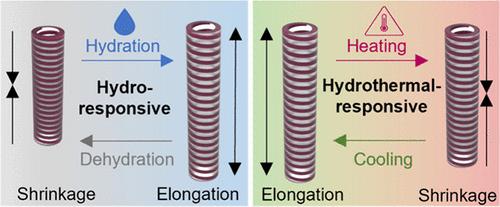
Soft actuators made of thermoresponsive polymers have great potential for intelligent robotics and biomedical devices due to their reversible deformation capability in response to temperature fluctuations. However, they are constrained by a predefined phase transition temperature, limited directional deformation, and nonbiocompatible formulations, thereby restricting their practical utility. Herein a new biomimicry approach is presented to overcome these limitations by developing hydro- and hydrothermally responsive soft actuators made of biocompatible and pliable materials i.e. cotton yarn and polyurethane. We mimic the tubular shape of elephant trunks with their unique muscle orientation by embedding a helical cotton yarn within a hydrophilic polyurethane tube, followed by targeted surface patterning. Unlike the narrow-range shape morphing across the phase transition temperature boundary of typical thermoresponsive hydrogel actuators, we harness hydrothermal stiffness variations in polyurethane to obtain consistent morphing capabilities over a much wider temperature range. The developed actuators can perform versatile activities such as linear, bending, curvilinear, and rotating movements, overcoming the unidirectional motion limitations of conventional soft actuators. The cell viability assay on the building block materials also confirms the high biocompatibility of the actuators. The reported facile fabrication strategy provides new insights for designing complex yet free-standing soft actuators from readily available supple materials.
期刊介绍:
ACS Applied Materials & Interfaces is a leading interdisciplinary journal that brings together chemists, engineers, physicists, and biologists to explore the development and utilization of newly-discovered materials and interfacial processes for specific applications. Our journal has experienced remarkable growth since its establishment in 2009, both in terms of the number of articles published and the impact of the research showcased. We are proud to foster a truly global community, with the majority of published articles originating from outside the United States, reflecting the rapid growth of applied research worldwide.




 京公网安备 11010802042870号
京ICP备2023020795号-1
京公网安备 11010802042870号
京ICP备2023020795号-1

 分享
分享
 求助内容:
求助内容: 应助结果提醒方式:
 扫码关注我们
